
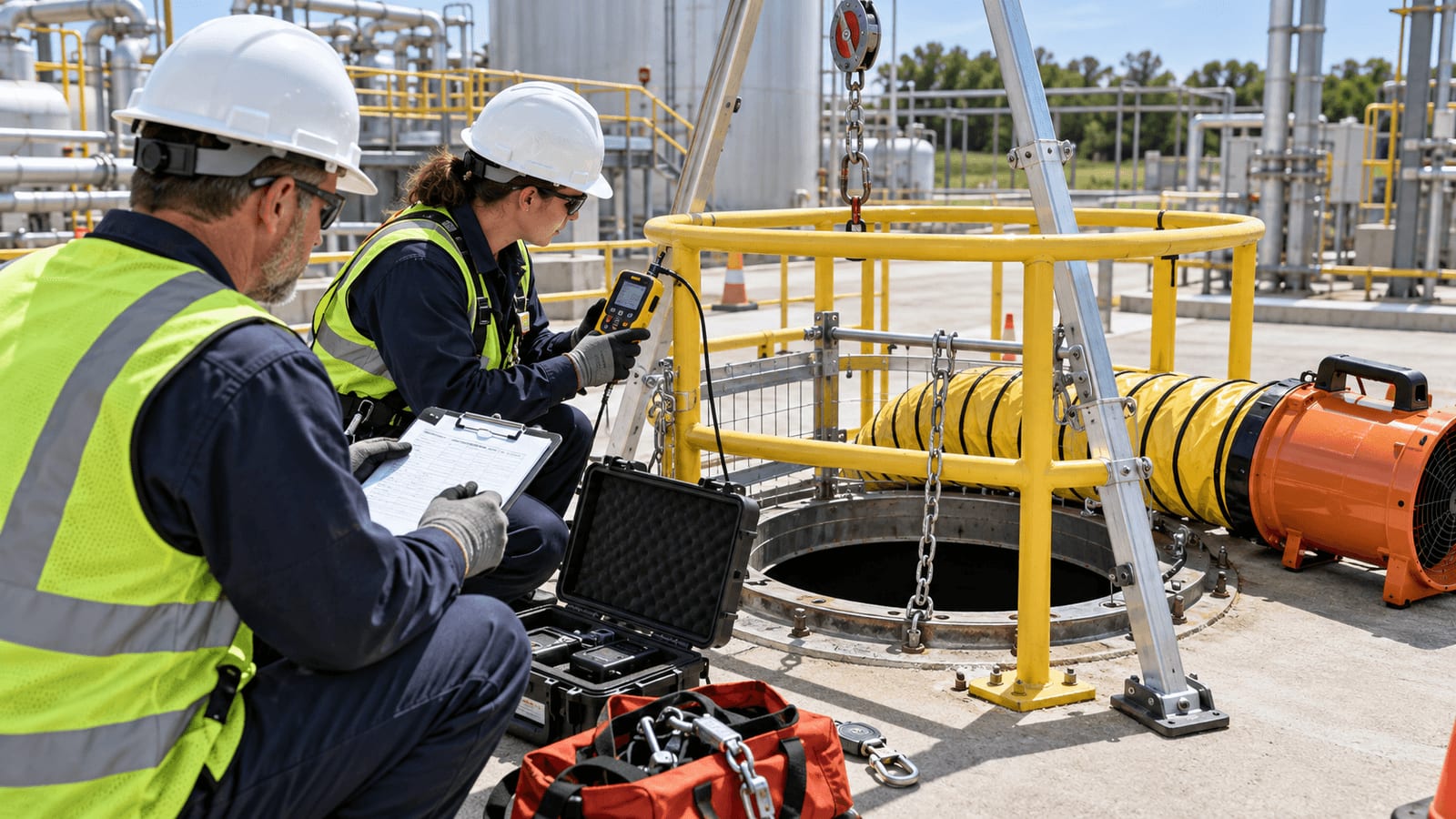
Alternate confined space entry is a narrow compliance option that depends on documented hazards, effective ventilation, testing, and disciplined execution.
Employers sometimes hear that a permit space can be entered without a full permit process if a blower is running. That shorthand is incomplete and can be dangerous. Under OSHA's general industry standard, the alternate procedures in 29 CFR 1910.146(c)(5) apply only when the employer can demonstrate that the space meets specific conditions and then follows the required entry steps.
The central question is not whether ventilation equipment is available. The employer must be able to show that the only hazard posed by the permit space is an actual or potential hazardous atmosphere, that continuous forced-air ventilation alone is sufficient to keep the space safe for entry, and that monitoring and inspection data support those conclusions. If another hazard remains, the alternate route may not fit.
Who This Affects
This issue affects facility owners, maintenance managers, safety professionals, supervisors, contractors, and workers who enter tanks, pits, vaults, process spaces, or similar areas in general industry. It is especially relevant when a team repeats an entry and begins to treat the blower, monitor, and written certification as a routine package rather than as controls tied to a specific space and task.
The employer that directs its own employees to enter must evaluate the space and choose the appropriate entry method. A host employer and contractor also need to exchange hazard and precaution information and coordinate operations when their work overlaps. A contractor's standard form does not replace the host's knowledge of the facility, and a host's old space file does not replace the contractor's task-specific evaluation.
Authorized entrants need enough information to understand the entry conditions, observe testing when applicable, recognize warning signs, and exit if a hazardous atmosphere is detected. Employees or their authorized representatives must have access to the supporting determinations and data required by the alternate procedure. Supervisors need to know when the procedure cannot be used or must be stopped.
Instrument users and ventilation-equipment operators play important roles even when they are not assigned traditional permit roles. They need to understand calibration status, sampling order, sampling locations, duct placement, clean-air sources, alarm response, and the limits of the equipment. A technically correct written decision can fail if these field details are handled casually.
The Confined Space Compliance Issue
Alternate entry under 1910.146(c)(5) is not the same as reclassifying a permit space as non-permit. Reclassification under paragraph (c)(7) depends on eliminating the hazards. OSHA specifically notes that controlling an atmospheric hazard with forced-air ventilation is not elimination. When ventilation is the control, paragraph (c)(5) is the relevant path if all of its conditions are satisfied.
For the alternate procedure, the employer must demonstrate that the only hazard is an actual or potential hazardous atmosphere. Physical hazards such as engulfment, moving parts, falls, electrical energy, heat, or material that could trap an entrant require evaluation. If they remain as hazards, simply adding ventilation does not convert the entry to the alternate route.
The employer must also demonstrate that continuous forced-air ventilation alone can maintain the space safe for entry. Monitoring and inspection data must support the demonstration. Data should represent the space, expected atmospheric contaminants, ventilation configuration, environmental conditions, and work. If an initial entry is needed to collect supporting data, that entry must use the full applicable permit-space requirements.
Once the conditions are established, the field steps still matter. Unsafe conditions related to removing an entrance cover must be eliminated before removal. The opening must be promptly guarded to prevent accidental falls and protect workers from objects entering the space. Before entry, the atmosphere must be tested with a calibrated direct-reading instrument for oxygen, flammable gases and vapors, and potential toxic contaminants, in that order.
No hazardous atmosphere may be present while an employee is inside. Forced air must eliminate the hazardous atmosphere before entry, reach the immediate areas where the employee is or will be, continue until everyone exits, and come from a clean source that does not increase hazards. Periodic testing is required as necessary to verify that ventilation is preventing hazardous-atmosphere accumulation.
If a hazardous atmosphere is detected, every employee must leave immediately. The employer must determine how the condition developed and implement protective measures before a later entry. The employer must also prepare a written certification before entry that identifies the date, location, and signature of the person verifying that the space is safe and required pre-entry measures were taken.
What Employers Should Check
Start with a written hazard inventory for the exact space and task. Identify normal contents, residues, connected systems, adjacent processes, cleaning agents, coatings, work-generated contaminants, oxygen displacement, and environmental effects. A task that introduces welding fumes, solvents, combustion exhaust, or other hazards may invalidate older data that supported a different activity.
Confirm that no physical hazard remains unaddressed. Review mechanical, electrical, hydraulic, pneumatic, gravity, engulfment, fall, temperature, and configuration hazards. Document how each potential physical hazard is absent or has been eliminated as required for the chosen procedure. Do not treat a warning label or employee caution as hazard elimination.
Review the quality of the supporting monitoring and inspection data. It should identify the space, instrument, sampling method, locations, duration, ventilation equipment, duct arrangement, airflow assumptions, atmospheric results, and relevant operating conditions. A single reading at the opening is unlikely to describe a tall, deep, partitioned, or irregular space. Sampling should account for potential stratification and remote areas.
Verify the ventilation setup in the field. The blower intake should draw from a clean source, away from vehicle exhaust, process vents, generators, or contaminated areas. Ducts should reach the work zone without creating trip hazards or blocking egress. Airflow should not short-circuit from the supply directly back out of the opening while leaving the entrant's area poorly ventilated.
Check instrument readiness. Follow the manufacturer's requirements for calibration, bump testing, sensor limitations, warmup, and environmental conditions. Make sure the instrument can detect the contaminants that the evaluation identified. Record or retain results as the employer's program requires, and provide entrants or their authorized representatives the opportunity to observe testing required by the standard.
Define testing frequency based on the hazards and conditions. The standard requires periodic testing as necessary, but a fixed generic interval may not fit every space. Consider the time required for a condition to develop, process changes, work activities, ventilation reliability, and the entrant's location. Continuous personal or area monitoring may be a prudent program choice even when the regulation uses the word periodic.
Confirm that the written certification is specific and complete before entry. The date, location, and verifying person's signature are required. A reusable blank template can support consistency, but copying yesterday's information without rechecking today's space defeats the purpose.
Which Training Fits This Situation
Employees who may encounter confined spaces need awareness training that helps them recognize the spaces, signs, access controls, and prohibition on unauthorized entry. Authorized entrants need role-specific training on hazards, equipment, communication, symptoms, alarm response, and exit requirements. Even when alternate procedures are used, entrants must understand why the method was selected and what conditions support it.
People who evaluate spaces and choose the entry method need program-level knowledge. They should be able to distinguish non-permit spaces, reclassified spaces, alternate-procedure entries, and full permit entries. Training should cover how work can introduce a new hazard, why ventilation is control rather than elimination, and when supporting data no longer matches the planned entry.
Employees who test atmospheres need practical instruction with the exact instruments they use. Classroom discussion should be paired with sampling exercises, alarm interpretation, response to sensor faults, documentation, and recognition of instrument limitations. Ventilation training should include duct placement, airflow confirmation, clean-air intake, power loss, and the need to keep ventilation operating until all employees exit.
Supervisors should practice decisions, not just form completion. Useful scenarios include a blower stopping, an alarm during entry, a contractor changing the task, an unexpected odor, a disconnected duct, or a physical hazard found after the opening is removed. The expected response should include immediate exit when a hazardous atmosphere is detected, evaluation of the cause, correction, and reassessment of the entry method.
Refresher training is appropriate when duties change, when there is reason to believe employees have deviated from procedures, or when knowledge or use of the procedures is inadequate. Employers should also update site-specific briefings when the space, task, equipment, or supporting data change.
Common Mistakes to Avoid
Do not assume that a blower automatically authorizes alternate entry. Ventilation is only one element, and the eligibility demonstration comes first. Do not confuse control of an atmospheric hazard with elimination. That distinction determines whether paragraph (c)(5) or reclassification under paragraph (c)(7) may apply.
Do not ignore physical hazards because they seem routine. An unguarded opening, moving equipment, a fall exposure, or an engulfment condition can change the entry method. Do not rely on a reading taken only at the opening when the entrant will work deeper or behind internal structures.
Do not place the blower intake next to exhaust or another contaminant source. Do not stop ventilation while the entrant remains inside. Do not let a duct move away from the work zone without recognizing that the supporting assumption has changed.
Do not reuse supporting data after the process, space configuration, season, contents, or task has materially changed. Do not treat the pre-entry written certification as a substitute for the underlying evaluation. The form records verification; it does not create safe conditions.
Do not delay evacuation after a hazardous atmosphere is detected. The required sequence is for employees to leave immediately, for the space to be evaluated, and for protective measures to be implemented before later entry. Resetting an alarm and continuing is not an acceptable response.
Next Step
Select one space currently entered under alternate procedures and audit the complete decision chain. Review the original hazard evaluation, supporting data, task description, ventilation configuration, test method, field certification, employee training, and alarm response. Then observe an actual setup before anyone enters.
If any part of the demonstration is weak, pause use of the alternate procedure until a qualified review establishes the appropriate method. The safest outcome may be revised data and controls, a full permit entry, hazard elimination followed by valid reclassification, or no entry at all. The employer's written program should make that decision path clear to the people who use it.
Sources
Occupational Safety and Health Administration, 29 CFR 1910.146 Permit-Required Confined Spaces | https://www.osha.gov/laws-regs/regulations/standardnumber/1910/1910.146
Occupational Safety and Health Administration, Permit-Required Confined Spaces Advisor | https://www.osha.gov/etools/confined-spaces
Occupational Safety and Health Administration, Confined Spaces | https://www.osha.gov/confined-spaces