Engulfment can overtake a confined space entrant in seconds, so employers must control material movement before anyone crosses that opening.
Liquids and flowable solids create a confined space hazard that cannot be managed by gas testing alone. Water, wastewater, grain, sand, plastic resin, coal, powders, and process materials may enter through lines, gates, chutes, conveyors, or connected vessels. Once movement begins, an entrant can be surrounded, buried, pinned, or forced into a narrowing section before an attendant can react.
An effective entry plan starts by identifying every credible path that material could take into or through the space. The employer then chooses isolation and control methods that match the system, verifies those methods before entry, and maintains them for the full job. A permit signature should document that work, not replace it.
Who This Affects
This issue affects employers whose workers enter tanks, bins, hoppers, silos, pits, vaults, sewers, wet wells, digesters, mixers, and process vessels. It also affects contractors performing cleaning, inspection, coating, repair, or maintenance in facilities they do not operate. The entry employer may depend on the host for system knowledge, but it still needs enough information to protect its employees.
Operations, maintenance, safety, and production teams all have a role. Operators may control valves or gates. Maintenance personnel may install blinds, disconnect lines, block equipment, or apply lockout procedures. Entry supervisors verify conditions and authorize the permit. Attendants and entrants must understand the warning signs and evacuation triggers associated with the specific material.
Engulfment planning also affects rescue services. A person trapped by flowing material may be difficult to reach, and the material can endanger rescuers. Rescue capability must be evaluated against the actual space, access route, material, isolation method, and likely emergency rather than assumed from a general response arrangement.
The Confined Space Compliance Issue
OSHA defines engulfment as the surrounding and effective capture of a person by a liquid or finely divided flowable solid that can be aspirated, plug the respiratory system, or exert enough force to cause death by strangulation, constriction, or crushing. A space with engulfment potential may be a permit-required confined space even when its atmosphere initially tests within acceptable limits.
For general industry permit spaces, the written program must include measures necessary to prevent unauthorized entry and identify and evaluate hazards before employees enter. The employer must develop procedures for safe permit entry, including specifying acceptable conditions, isolating the space, purging or ventilating as needed, verifying conditions, and providing equipment for safe work and rescue.
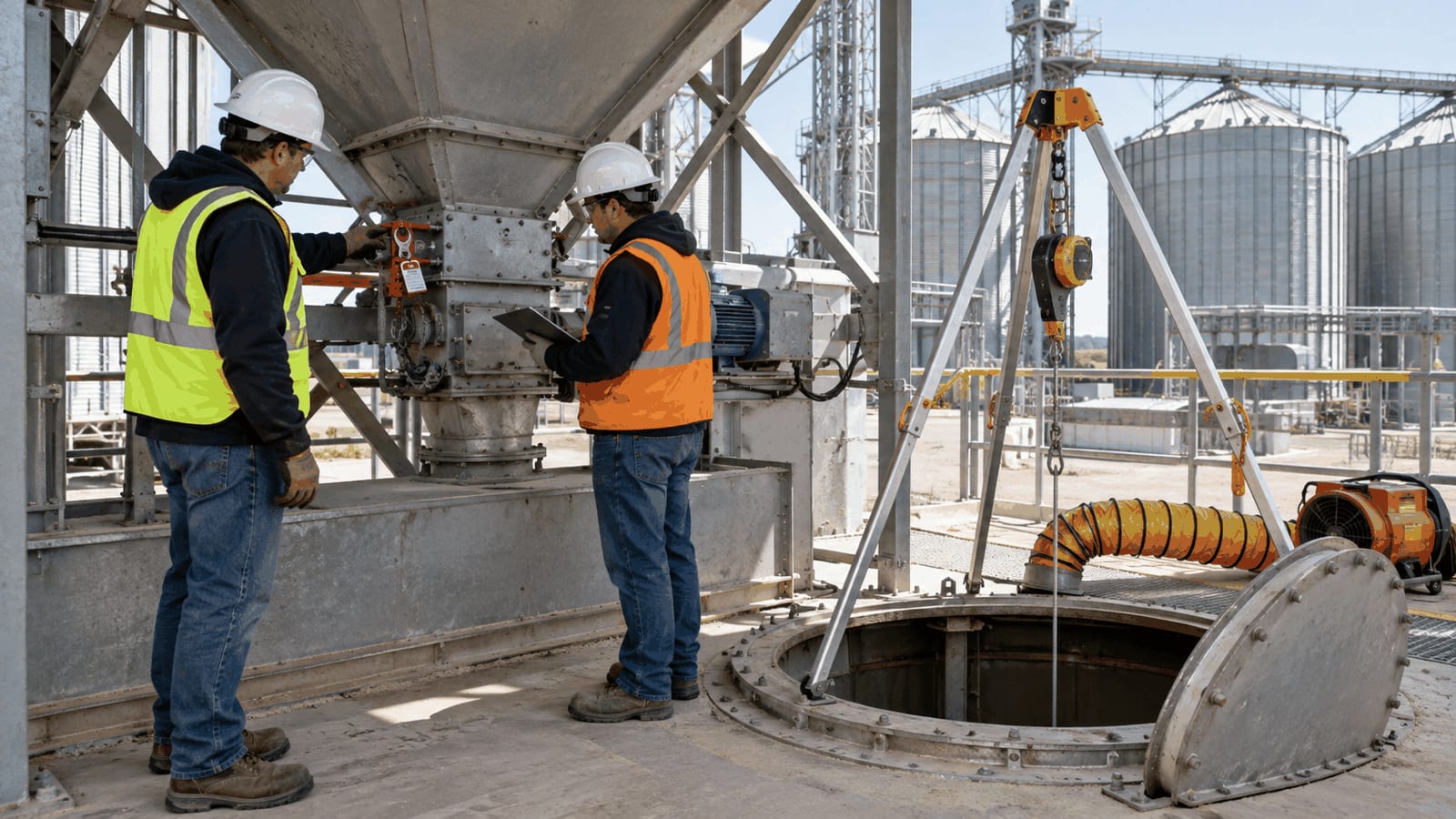
Isolation is more than turning a control switch to off. OSHA's confined space definition describes methods such as blanking or blinding, removing or misaligning pipe sections, using a double block and bleed arrangement, locking or tagging energy sources, and blocking or disconnecting mechanical linkages. The proper method depends on the equipment and the applicable energy-control requirements.
The permit must identify the space hazards and the measures used to isolate the space or eliminate and control hazards before entry. If feed systems, inflow, discharge, agitators, conveyors, or connected processes can move material, the permit and supporting isolation record should show how each path was addressed.
Construction work has a separate confined spaces standard in 29 CFR 1926 Subpart AA. Employers must determine which standard applies to the work and facility. A label such as maintenance or construction should not be chosen casually, especially during modifications, installation, demolition, or major repair.
What Employers Should Check
Begin with a material-flow map. Trace every inlet, outlet, overflow, bypass, drain, transfer line, chute, screw, conveyor, pump, gate, and connection to another vessel. Include automatic valves, remote controls, gravity flow, siphoning, backflow, and processes that can start because of level, pressure, time, or a signal from elsewhere in the plant.
Identify stored and residual energy. A closed valve can leak, a line can remain pressurized, a hopper can bridge and release unexpectedly, and material stuck to a wall can slide when disturbed. Product remaining above an entrant may move during cleaning or vibration. The assessment should consider what happens when workers wash, scrape, drill, heat, or remove a blockage.
Select a documented isolation method for each path. Confirm whether the method provides complete protection against material release and whether additional blocking, disconnection, blanking, or line opening is necessary. A valve position indicator or control-room screen should not be the only proof when the system can be physically verified by an authorized procedure.
Coordinate with operations. Establish who shuts down the process, who applies locks or tags, who verifies a zero-energy or isolated condition, who controls keys, and who may authorize restoration. Shift changes and contractor handoffs need explicit transfer steps so that a later operator does not reopen a path while entry continues.
Inspect the space before entry. Look for accumulated material, sloped piles, crusted surfaces, bridging, blocked outlets, stains showing prior inflow, and signs that a valve or gate leaks. Evaluate whether the entrant's task could destabilize the material. Atmospheric monitoring remains important, but a normal reading does not prove that engulfment has been controlled.
Define acceptable entry conditions and prohibited conditions. Examples may include verified blinds in place, a disconnected transfer line, locked feed equipment, no material above the work zone, stable residual material, controlled upstream flow, and no change in level. The exact conditions should be based on the specific system and qualified assessment.
Verify controls immediately before authorization. The entry supervisor should review isolation points, signatures, locks, tags, line status, material level, communications, rescue arrangements, and any changes since preparation began. If verification requires entering the space, that work must be addressed as permit entry rather than treated as a preliminary exception.
Maintain controls throughout entry. Someone outside the space should monitor activities that could affect inflow, weather, upstream operations, and connected systems. In sewers and storm systems, changing flow may occur beyond the immediate entry location. Employers should set conservative triggers for evacuation when isolation cannot fully remove a hazard and entry is otherwise allowed by the applicable standard and program.
Which Training Fits This Situation
Authorized entrants need training on the specific engulfment material, entry route, signs of movement, prohibited conditions, communication method, and immediate exit expectations. They should understand that self-rescue may become impossible quickly and that waiting to confirm a suspected flow can remove the chance to escape.
Attendant training should cover upstream and downstream activity, alarms, level changes, weather or process triggers, and the limits of the attendant's role. The attendant must not enter impulsively. The response should follow the planned rescue method and summon the identified service without creating additional victims.
Entry supervisors need training that connects the hazard assessment, isolation plan, permit, and field verification. They should be able to challenge a vague entry such as valves closed and ask which valves, how they were secured, whether leakage is possible, what stored material remains, and what condition would cancel the permit.
Employees who operate the process need confined space awareness even if they never enter. They must understand locks, tags, blinds, barricades, permit boundaries, and communication rules. A remote operator who does not recognize an entry control can defeat protections without seeing the space.
Role-based permit-required confined space training is appropriate for entrants, attendants, entry supervisors, and employees who support the program. Training should be paired with site procedures, hands-on isolation practice, equipment instruction, and rescue coordination. A course can support knowledge, but the employer remains responsible for evaluating hazards and implementing a workplace-specific program.
Common Mistakes to Avoid
Do not rely on atmospheric monitoring as the primary control for engulfment. A monitor may warn about oxygen, combustible gas, or selected toxic contaminants, but it will not stop grain, water, sludge, or powder from entering the space.
Do not assume a closed valve is isolation. The valve may leak, be remotely operated, share a common control circuit, or be reopened by someone who does not know entry is underway. Use the isolation method required by the system, procedure, and applicable standards, and verify it.
Do not overlook gravity. Material can move without a powered machine. A blocked chute can clear, a crust can collapse, liquid can siphon, and an upstream release can travel into a low point. The assessment must include credible nonpowered movement.
Do not place an entrant below bridged or hung-up material. Breaking a bridge from underneath can release the entire mass. Use methods designed to prevent employee exposure and involve qualified technical support when the condition is unstable or unfamiliar.
Do not let production restart through an informal handoff. Permit controls, lockout coordination, and shift transfer should make it unmistakable that people remain inside. Restoration should occur only after entrants are accounted for, the permit is terminated, tools are removed, and the authorized sequence is complete.
Do not assume rescue equipment solves uncontrolled inflow. A retrieval line may snag or be unable to overcome the force of moving material. Prevention through isolation is the central control, supported by a rescue plan suited to the actual hazard.
Next Step
Choose one permit space with liquids or flowable solids and conduct a line-by-line review before the next entry. Map every path, name the isolation method, identify who applies and verifies it, and compare the map with the permit and field labels. Resolve missing or ambiguous points before work begins.
Then run a short scenario with operators, entrants, attendants, and the entry supervisor. Ask what happens if a valve leaks, a level begins to rise, a bridge collapses, an upstream alarm activates, or a shift changes. The answers should lead to immediate, practiced actions and clear permit cancellation criteria.
Sources
Occupational Safety and Health Administration, 29 CFR 1910.146 Permit-Required Confined Spaces | https://www.osha.gov/laws-regs/regulations/standardnumber/1910/1910.146
Occupational Safety and Health Administration, Appendix C to 29 CFR 1910.146 Examples of Permit-Required Confined Space Programs | https://www.osha.gov/laws-regs/regulations/standardnumber/1910/1910.146AppC
Occupational Safety and Health Administration, 29 CFR 1926 Subpart AA Confined Spaces in Construction | https://www.osha.gov/laws-regs/regulations/standardnumber/1926/1926SubpartAA