
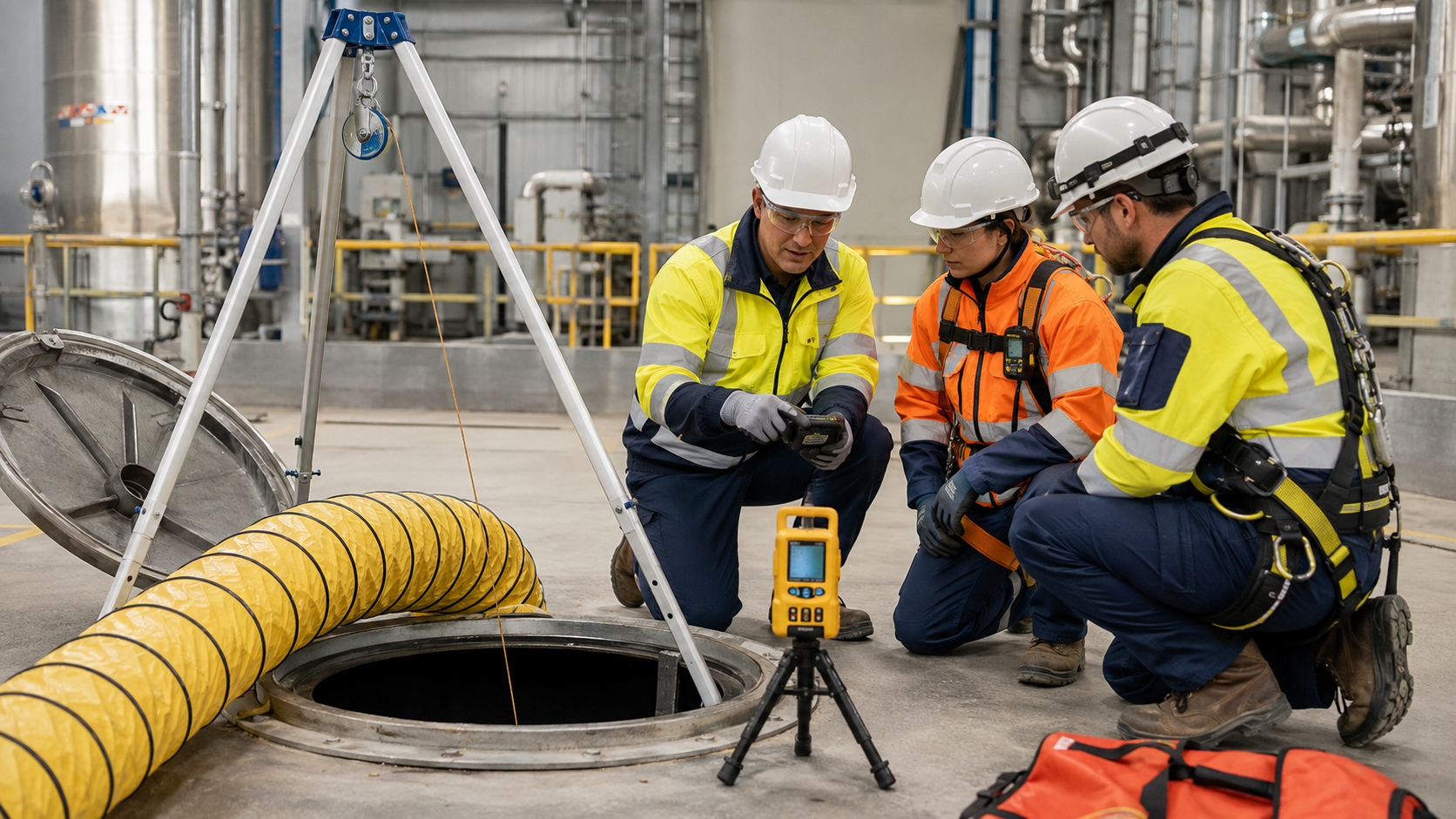
Search Intent: Which confined space training should employers choose when workers need to test the atmosphere, use ventilation, and keep monitoring conditions during entry, and why does that decision matter before the permit is signed?
Who This Affects
This article is for employers, safety managers, EHS coordinators, construction supervisors, maintenance leads, utility departments, municipal crews, facility managers, and contractors that send employees near tanks, pits, vessels, sewers, vaults, crawl spaces, pump stations, bins, digesters, and other spaces where the atmosphere can change faster than the work plan.
It also affects buyers who are trying to decide whether an awareness course is enough or whether their team needs permit-required confined space training, supervisor training, competent person training, or a multi-role plan. The answer depends less on job title and more on assigned duties. A worker who only needs to recognize confined space hazards has a different training need than a worker who will place a probe into a space, interpret meter readings, operate ventilation, authorize entry, or stop work when readings drift.
Atmospheric testing is one of the places where this distinction becomes clear. Many employers own a gas monitor, keep a blower in the shop, and have a permit form on a clipboard, but the practical question is whether the people using those tools understand what the readings mean and what to do when the readings do not match the plan. Training should help workers recognize that air testing is not a paperwork step. It is a decision point that affects whether entry is allowed, whether controls are adequate, and whether the crew must stop and reassess.
For employers purchasing training, this topic matters because a certificate of completion alone does not make the site ready. The employer still has to assign roles, provide equipment, verify procedures, address site-specific hazards, and make sure workers can apply the training to the actual spaces they face. A strong course-selection decision helps the company build that foundation before a crew is standing at an open hatch with production pressure building.
The Confined Space Compliance Issue
Confined spaces can contain hazardous atmospheres because of what is inside the space, what work is being performed, what materials were stored there, how the space is connected to other systems, or how the space is affected by nearby operations. A space may look clean and familiar while still having too little oxygen, too much oxygen, a flammable concentration, or a toxic contaminant. Conditions can also change after the first test. Welding, cleaning, coating, pumping, biological activity, sludge disturbance, residue, exhaust, and nearby process lines can all affect the atmosphere during the job.
That is why employers cannot treat pre-entry testing, ventilation, and continuous monitoring as isolated equipment tasks. They are part of the overall confined space entry system. The employer must identify whether the space is a permit-required confined space, evaluate the hazards, prevent unauthorized entry, control hazards before entry when required, and make sure authorized entrants, attendants, entry supervisors, and other affected employees understand their responsibilities.
For general industry, OSHA's permit-required confined spaces standard is found at 29 CFR 1910.146. For construction, confined spaces are addressed under 29 CFR 1926 Subpart AA. These standards are not identical in structure, but both emphasize hazard evaluation, assigned responsibilities, communication, rescue planning, and controls appropriate to the work. Training should be OSHA-aligned, but employers should avoid assuming that an online course replaces the need for a site-specific entry procedure or hands-on familiarization with the equipment workers will actually use.
The common compliance issue is not simply whether a meter was turned on. The issue is whether the employer has a reliable method for deciding when entry can begin and when it must stop. That includes knowing what to test for, where to test, in what order to test, how to account for stratified atmospheres, how ventilation affects readings, how often to monitor, who watches the readings, who has authority to halt entry, and what the crew does when alarm conditions occur.
In a permit-required space, atmospheric testing often influences multiple decisions at once. It can confirm whether a hazardous atmosphere is present, show whether ventilation is improving conditions, reveal whether work inside the space is creating a new hazard, and provide evidence that the permit conditions are being maintained. If the crew does not understand those decisions, the permit can become a form that is completed after the real choices have already been made by habit.
This is especially important for employers with mixed crews. A maintenance mechanic may be an authorized entrant on one task, an attendant on another, and a supervisor on a third. A construction foreman may coordinate subcontractors who bring their own monitors. A municipal department may have employees who enter sewers, vaults, and lift stations with different hazard profiles in the same week. Training should help those workers understand their assigned role for each entry, not just their general familiarity with confined spaces.
What Employers Should Check
Before selecting training or sending a crew to perform confined space work, employers should check whether their atmospheric testing and ventilation process is clear enough to survive a busy day in the field. A useful review includes the space, the task, the workers, the equipment, and the authority structure.
- Identify the space classification. Decide whether the location is a confined space and whether it is permit-required based on actual or potential hazards, including hazardous atmosphere, engulfment, inwardly converging walls, sloped floors, or other serious hazards.
- Identify likely atmospheric hazards. Consider oxygen deficiency, oxygen enrichment, flammable gases or vapors, toxic substances, residues, decomposition, process chemicals, cleaning agents, welding or cutting, coatings, fuel-powered equipment, and connected systems.
- Decide who is qualified to test. Do not rely on the nearest available employee unless that employee has been trained on the role, the employer's procedure, and the specific monitoring equipment.
- Confirm meter readiness. Check calibration status, bump test requirements, sensor condition, battery charge, sample pump function if used, tubing condition, alarm settings, and whether the instrument detects the hazards expected for the space.
- Test before entry from outside the space when feasible. Employees should understand that a safe-looking opening is not proof of safe air. Remote sampling, probe placement, and patience during sample draw time matter.
- Account for vertical and horizontal differences. Atmospheres can be stratified. Testing only at the opening can miss hazards lower in a pit, farther inside a tank, or around corners and connected piping.
- Ventilate intentionally. Confirm that the blower size, duct placement, air source, and discharge path fit the space and task. Ventilation should not introduce contaminants, push hazards toward workers, or create a false sense of control.
- Retest after ventilation. Ventilation is a control, not a shortcut. The crew should understand whether readings have stabilized and whether the permit conditions are satisfied before entry begins.
- Decide whether continuous monitoring is required. Many entries need monitoring during the job because work activities or changing conditions can create new atmospheric hazards after entry.
- Assign someone to watch changing conditions. The attendant, entry supervisor, or another designated person must know what readings or alarms require action and how to communicate with entrants.
- Define stop-work triggers. The crew should know what happens when a monitor alarms, ventilation fails, work scope changes, a new chemical is introduced, a rescue concern appears, or an unplanned hazard is discovered.
- Connect records to the entry permit. Testing results, ventilation status, entrant names, role assignments, communication method, rescue plan, and supervisor authorization should be understandable after the job, not only during it.
This checklist is not a substitute for the employer's written program, but it helps expose training gaps. If the answer to several items is "we usually figure that out at the jobsite," the employer probably needs more than awareness training for the people managing or performing the entry.
Which Training Fits This Situation
The right training path depends on what each person will do around the confined space.
Awareness training fits employees who need to recognize confined spaces, understand basic hazards, avoid unauthorized entry, and know when to escalate the situation. It is useful for workers who may encounter tanks, pits, vaults, or crawl spaces but are not assigned to enter, monitor, supervise, or control the work. Awareness training is usually not enough for a worker who will conduct atmospheric testing, complete an entry permit, operate ventilation as part of a permit entry, or serve as an attendant.
Permit-required confined space entry training fits authorized entrants and attendants who are part of the entry operation. Entrants need to understand the hazards they may face, how atmospheric monitoring protects them, what alarms mean, how to use assigned PPE and retrieval equipment, and when to exit. Attendants need to maintain an accurate count of entrants, communicate with them, monitor conditions outside the space, recognize symptoms or warning signs, keep unauthorized people away, and summon rescue services without entering unless properly trained and equipped for rescue duties.
Entry supervisor training fits the person who authorizes the entry and verifies that required precautions are in place. This person needs enough knowledge to review the permit, confirm that tests have been completed, verify that ventilation and rescue arrangements are ready, check that entrants and attendants understand their roles, and cancel or suspend the entry when conditions are not acceptable. The entry supervisor role is not just a seniority label. It carries decision authority.
Competent Person training is especially relevant in construction settings where someone must identify existing and predictable hazards and has authority to take prompt corrective measures. For confined space work under construction conditions, the competent person may be involved in evaluating spaces, coordinating employers, recognizing changes, and ensuring protective measures are used. Employers should match this training to the worker's actual responsibility and authority on the site.
A multi-role plan often makes the most sense for employers whose crews rotate duties. A small facility maintenance team may need awareness for general staff, permit-required entry training for entrants and attendants, supervisor training for leads who authorize entry, and competent person training for the person responsible for construction-related confined space evaluation. Municipal and utility crews may need a similar plan because the same employee may encounter different spaces, different hazards, and different roles across a month of work.
The course-selection decision should also consider delivery format. Online training can provide consistent foundational instruction, support records, and help workers understand regulatory concepts and role duties. Employers may also need site-specific instruction, equipment practice, rescue coordination, and hands-on verification with their own monitors, blowers, harnesses, tripods, permits, and communication methods. A buyer should look for a training path that supports both the certificate of completion and the employer's practical implementation needs.
For confined-space.com course selection, the practical approach is to start with the role. If the employee only needs to recognize and avoid unauthorized entry, choose Awareness. If the employee enters or attends a permit-required space, choose Permit-Required Entry training. If the employee authorizes entries or manages the permit process, include Supervisor training. If the work is construction-related and the employee is expected to identify hazards and take corrective measures, include Competent Person training. If several of those duties exist in the same crew, build a combined plan instead of forcing everyone into a single generic course.
Common Mistakes to Avoid
One mistake is buying a gas monitor and assuming ownership equals readiness. The instrument is only useful when workers know its limits, alarms, sensors, sampling method, maintenance needs, and role in the entry procedure. A monitor that is not bump tested, not calibrated according to the employer's program, not equipped for the expected hazard, or not understood by the user can create confidence without control.
Another mistake is testing once and treating the result as permanent. A space that is acceptable before entry can become hazardous during entry. Work can disturb residue, consume oxygen, produce vapors, or interfere with ventilation. Continuous monitoring or periodic retesting should be based on the hazards and the task, not convenience.
Employers also get into trouble when they ventilate without a plan. Air movement is helpful only when it is directed, adequate, and clean. Poor duct placement may fail to reach the work area. A blower intake placed near exhaust or chemical vapors can introduce a new hazard. Ventilation that changes readings near the opening may not prove that the atmosphere is acceptable where the entrant will work.
A fourth mistake is letting the permit become a signature exercise. The permit should reflect real conditions and controls. If atmospheric test results are copied from habit, if the supervisor signs before equipment is ready, or if the attendant does not know what conditions require evacuation, the form is not doing its job.
Some employers under-train attendants. The attendant is not a passive observer. This role is central to communication, monitoring, accountability, and emergency response activation. If the attendant is also distracted by production tasks, traffic control, paperwork, or tool running, the entry loses an important layer of protection.
Another common problem is unclear authority. Workers may know that a reading is abnormal but hesitate to stop the job because the schedule is tight or the supervisor is elsewhere. Training and procedures should make stop-work authority explicit. Entrants should know they can exit. Attendants should know they can order evacuation. Supervisors should support those decisions when conditions change.
Finally, employers should avoid language that overstates what training can do. OSHA-aligned training and a certificate of completion support employer compliance, but OSHA does not certify, approve, endorse, or accredit a private course or provider for the employer's specific entry. The employer remains responsible for applying the training to its spaces, hazards, equipment, permits, and rescue arrangements.
Next Step
Before the next confined space entry, list every worker who may test the air, operate ventilation, watch readings, enter the space, attend the entry, authorize the permit, or evaluate construction-related hazards. Match each worker to the course that fits the duty: Awareness for recognition and avoidance, Permit-Required Entry for entrants and attendants, Supervisor for permit authorization and oversight, Competent Person for construction hazard evaluation and corrective authority, or a multi-role plan when one crew performs several duties.
Then compare that course plan with the employer's site-specific needs. Confirm that workers can use the actual monitor, understand the ventilation setup, follow the permit, communicate during entry, recognize stop-work triggers, and preserve completion records for audits and internal review. The best next step is not simply choosing the longest course. It is choosing the right confined-space.com training path for the role each worker will perform before anyone enters the space.
Ready to Get Your Crew Confined Space Certified?
Explore our OSHA-aligned online courses for Awareness, Permit-Required Entry, Supervisor, and Competent Person roles with instant certification.
Explore Courses & Pricing