Combustible dust can turn a confined space task into a fire or explosion emergency unless the plan addresses the material, atmosphere, and ignition sources. A vessel, hopper, duct, collector, bin, mixer, or process enclosure may hold settled dust even when production has stopped, and ordinary maintenance can disturb that material into a hazardous cloud.
The confined space program and the combustible dust program should meet before an entry permit is authorized. Treating them as separate paperwork systems can leave gaps in isolation, cleaning, ventilation, equipment selection, atmospheric evaluation, hot work control, rescue planning, and communication with contractors.
This discussion supports planning, but it does not replace a site-specific hazard analysis by qualified people. Dust characteristics, process conditions, space geometry, ignition sensitivity, electrical classification, and applicable standards vary. Employers should use reliable material and process information and obtain specialized assistance where the hazard cannot be confidently evaluated.
Who This Affects
Manufacturing, food processing, agriculture, woodworking, plastics, metalworking, recycling, chemical handling, pharmaceutical, paper, rubber, and wastewater operations can create or handle combustible particulate solids. Maintenance employees may enter equipment that normally contains powder or dust even if their regular job is not described as dust work.
Authorized entrants, attendants, entry supervisors, rescue personnel, operators, sanitation crews, industrial hygienists, electricians, contractors, and facility managers all influence the decision. Production personnel often know where material bridges, leaks, or accumulates. Maintenance teams know which tasks disturb residue. Safety and engineering staff may hold the process, ventilation, electrical, and testing information needed to connect those observations.
Host employers and contractors need coordinated information. A contractor may bring a vacuum, light, camera, grinder, fan, or communication device that is suitable for an ordinary area but not for the identified conditions. The host may know the process history, while the contractor knows how the task changes the space. Both sides need a shared understanding before entry.
The Confined Space Compliance Issue
OSHA's permit-required confined space standard requires employers to evaluate workplace spaces, identify permit spaces, prevent unauthorized entry, and develop a program when employees will enter. A permit space can contain or have the potential to contain a hazardous atmosphere, contain engulfment potential, have an internal configuration that could trap an entrant, or contain another recognized serious hazard.
Combustible dust can contribute to more than one part of that evaluation. A dispersed cloud may present a fire or explosion hazard. Settled material can be disturbed by walking, brushing, compressed air, ventilation, cleaning, or tool use. Material in a hopper or bin can also shift, flow, bridge, or engulf. Residue may conceal mechanical hazards or contaminate entry equipment.
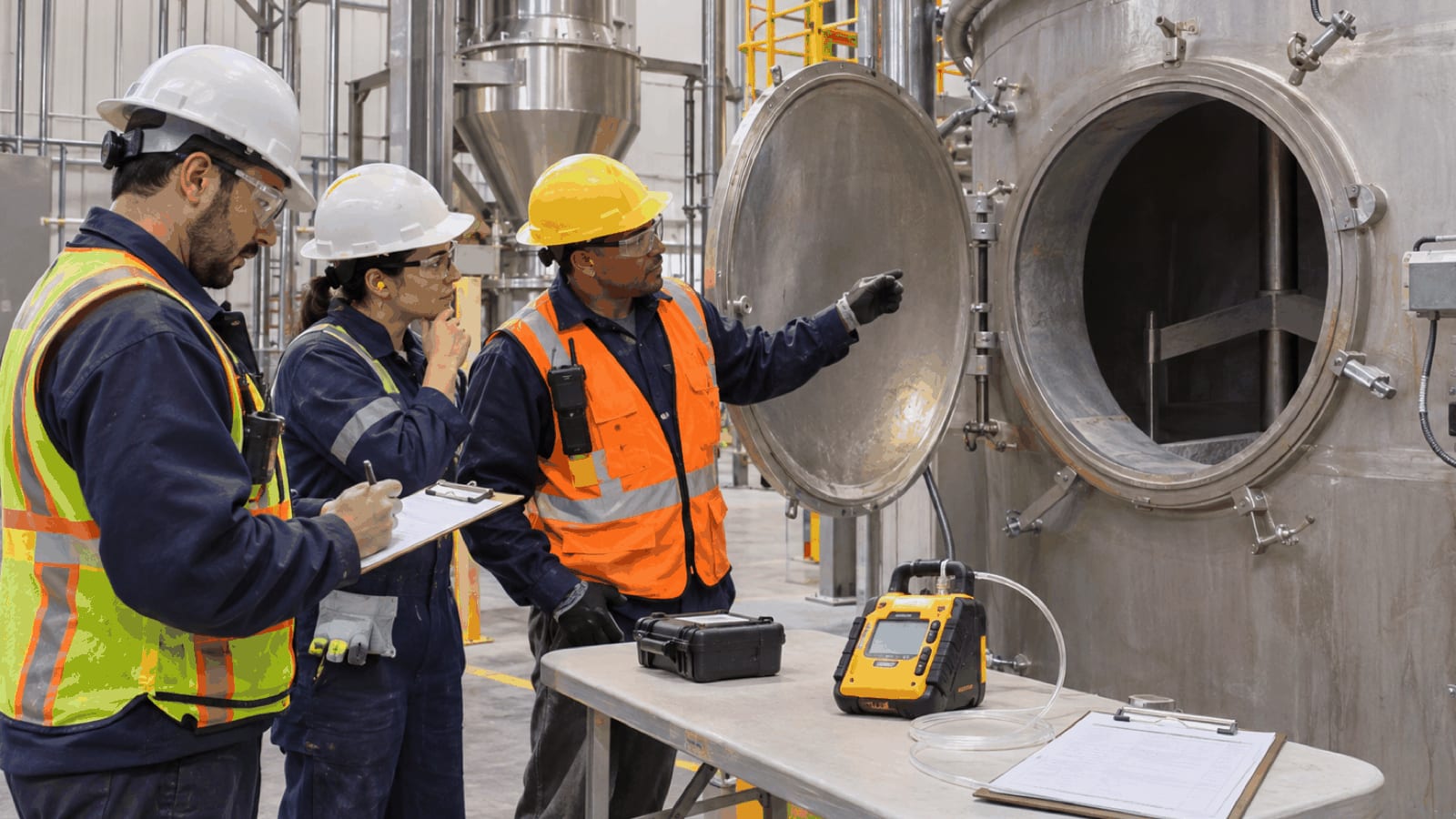
Atmospheric testing needs a hazard-based strategy. A standard four-gas monitor does not determine whether a particular dust is explosible or whether a dust concentration is below a safe limit. Oxygen, flammable vapor, and toxic gas readings can still be essential, but they do not answer every dust question. The employer should determine what information, instruments, sampling methods, and qualified interpretation fit the material and task.
Ignition sources extend beyond open flames. Hot surfaces, welding, cutting, grinding, static discharge, electrical equipment, powered tools, lighting, batteries, and mechanical sparks can matter. The employer should evaluate equipment and work methods against the actual area and hazard classification rather than assuming that low voltage or portable equipment is automatically acceptable.
Cleaning can reduce fuel, but the method can create a larger hazard if it disperses dust, damages equipment, or places workers in an unsafe position. Dry sweeping or compressed air can suspend settled material. An inappropriate vacuum can introduce an ignition source. Wet methods may be incompatible with the product or process, create slips, or cause a chemical reaction. The method should be selected through the facility's hazard review.
Ventilation also requires care. Air movement can dilute some airborne contaminants, but it can stir settled dust, move material into concealed areas, or affect process isolation. Fans, ducts, and controls must be suitable for the identified hazard and arranged so they do not introduce contaminated air or create a new ignition concern. Ventilation is not a substitute for controlling the source or completing required isolation.
What Employers Should Check
Identify the material and process history. Confirm what products, intermediates, additives, fines, residues, and cleaning agents have been present. Review safety data sheets, process safety information where applicable, previous testing, incident records, and supplier or laboratory data. Do not rely only on the product's common name, since particle size and process conditions can affect behavior.
Inspect from outside before opening or entry. Look for dust leakage, deposits on ledges, damaged seals, bridged material, blocked vents, corrosion, unusual heat, evidence of smoldering, and changes from the normal process condition. Opening a hatch can change airflow or release material, so the sequence for access should be planned and controlled.
Verify isolation. Mechanical movement, material flow, pneumatic transfer, dust collection, cleaning cycles, heating, inerting, and connected vessels or ducts may need control. Lockout or tagout, blanking, disconnecting, blocking, line breaking, or other methods should match the equipment and energy. A stopped control screen is not proof that stored energy and incoming material are isolated.
Define the task precisely. Inspection, scraping, vacuuming, coating, repair, cutting, sensor replacement, and liner removal can disturb different amounts of dust and introduce different equipment. The permit and hazard review should describe the work closely enough that a change in method is recognized as a change in conditions.
Evaluate the atmosphere and the dust hazard before and during entry as required by the program. Establish what will be tested, where, when, with which instruments or methods, and who interprets the results. Consider stratification, dead spaces, internal compartments, changing ventilation, and the entrant's work location. Record results in a form the entry supervisor can use.
Review all equipment entering the area. Include lights, communications, cameras, monitors, fans, vacuums, extension cords, tools, retrieval devices, clothing, footwear, and cleaning equipment. Confirm compatibility with the identified electrical and ignition hazards. Inspect condition and grounding or bonding arrangements where the facility's analysis requires them.
Plan housekeeping without creating a dust cloud. Define how material will be captured, contained, removed, and disposed of. Address inaccessible ledges and overhead deposits if they can affect the work. Specify when employees must stop because deposits, leakage, heat, odor, sparks, monitor alarms, or other conditions differ from the plan.
Confirm entry roles and communications. The attendant must know the hazards, signs of exposure, prohibited actions, and evacuation triggers. Entrants should understand how their task can disturb dust and which tools are approved. The entry supervisor should verify that controls are in place and terminate or cancel entry when unacceptable conditions arise.
Coordinate rescue. The rescue plan should consider visibility, access size, internal obstructions, product movement, atmosphere, ignition control, and the possibility that a rescue action could disperse dust. Rescue services need timely information and an opportunity to evaluate the space and task. A retrieval system should not be assumed feasible without checking geometry and hazards.
Which Training Fits This Situation
Awareness training helps employees recognize confined spaces, combustible dust indicators, permit boundaries, and the need to avoid unauthorized entry. This level can fit production employees, visitors, and support personnel who encounter spaces but do not perform entry duties.
Permit-required confined space training is needed for employees assigned as entrants, attendants, entry supervisors, or rescue personnel under the employer's program. Instruction should cover the facility's hazards, duties, equipment, communication methods, permit process, testing approach, evacuation triggers, and rescue arrangements. Generic examples should be connected to the actual vessels and materials at the site.
Task-specific combustible dust training supports employees who inspect, clean, maintain, or repair affected equipment. It should explain the facility's dust hazard analysis, approved housekeeping methods, ignition controls, equipment restrictions, and reporting expectations. Specialized electrical, industrial hygiene, fire protection, rigging, respiratory protection, or lockout training may also apply depending on the job.
Contractor orientation should address both the space and the process. Review entry procedures, known hazards, simultaneous operations, emergency contacts, equipment restrictions, and how the parties exchange findings after the work. A contractor's prior confined space experience does not replace this facility-specific briefing.
Common Mistakes to Avoid
Do not assume that visible dust must be airborne before it matters. Settled material is fuel that can become suspended, and layers in hidden or elevated locations can contribute to a secondary event. The evaluation should look beyond the floor.
Do not use a normal four-gas reading as a complete dust clearance. The monitor may provide critical atmospheric information, but its displayed values do not characterize every combustible dust hazard. Testing decisions should follow the material and process analysis.
Do not begin cleaning before isolation and ignition control are established. Cleaning is work, and it can be the step that disperses material. Approved methods, equipment, sequencing, and stop conditions should be part of the permit planning.
Do not add ventilation without checking its effect. A fan can disturb dust or move hazards through a connected system. Suitability, placement, discharge location, and electrical characteristics should be reviewed.
Do not authorize hot work because the equipment appears empty. Residue in seams, ducts, collectors, or connected spaces can remain. Hot work controls and the confined space program must address the actual condition and applicable requirements.
Do not let the task drift beyond the permit. If inspection becomes grinding, dry brushing, liner removal, or another dust-disturbing activity, stop and reevaluate. The original authorization should not be stretched to cover a materially different job.
Next Step
Select one space where combustible particulate material is produced, transferred, collected, or stored. Bring together the entry procedure, dust hazard information, equipment list, isolation method, and rescue plan. Walk the job from shutdown through permit closeout and identify where one program assumes that another group has already controlled the hazard.
Resolve those handoff points before the next entry. Update the permit prompts, approved equipment list, training scenarios, contractor briefing, and stop-work criteria so the crew receives one coherent plan. The goal is not more forms. It is a defensible entry decision that accounts for both the confined space and the combustible dust.
Sources
Electronic Code of Federal Regulations, 29 CFR 1910.146 Permit-Required Confined Spaces - https://www.ecfr.gov/current/title-29/subtitle-B/chapter-XVII/part-1910/subpart-J/section-1910.146
OSHA, Combustible Dust Standards - https://www.osha.gov/combustible-dust/standards
OSHA, Protecting Workers from Combustible Dust Explosion Hazards - https://www.osha.gov/sites/default/files/publications/OSHA3878.pdf
OSHA Technical Manual, Section IV Chapter 5 Combustible Dusts - https://www.osha.gov/otm/section-4-safety-hazards/chapter-5