Corroded grating, weakened floors, loose scale, and damaged supports can turn a planned confined-space entry into a structural emergency without warning.
Atmospheric testing, isolation, ventilation, communication, and rescue planning are essential, but they do not answer whether the surface beneath an entrant will hold or whether an overhead component can fall. Tanks, vaults, bins, digesters, pits, sewers, and process vessels may deteriorate internally where routine exterior inspections cannot see. Residues, moisture, chemicals, temperature cycles, vibration, and long service can affect coatings, fasteners, ladders, platforms, walls, and structural members. The entry evaluation should address those physical conditions before an employee places weight on them.
This article provides general educational information about federal confined-space planning. Employers must determine which standard applies, evaluate the actual space and task, and use qualified structural, engineering, corrosion, or inspection support when conditions exceed the entry team's expertise. A permit and training record do not certify structural integrity.
Who This Affects
Entry employers, host employers, facility owners, maintenance supervisors, entry supervisors, authorized entrants, attendants, rescue providers, engineers, and inspection contractors may each hold part of the information. The facility owner may know the vessel's age and service history. Operations may know about leaks, upsets, or chemical changes. Maintenance may have repair photographs. Entrants may be the first people able to see interior deterioration. Those facts should be brought together before authorization, not discovered one at a time after entry begins.
The issue is relevant in both general industry and construction. A crew repairing an operating facility may be covered by the general-industry permit-space program, while construction activity in a confined space may fall under 29 CFR 1926 Subpart AA. The employer should identify the applicable duties instead of assuming the same permit form answers every situation. Multi-employer work also requires coordinated exchange of known hazards and entry information.
Rescue teams are affected because a weak floor, falling scale, damaged ladder, or obstructed platform can change the removal route. A tripod and retrieval line do not solve every structural hazard. The line may drag across a sharp corroded edge, and a collapsed internal surface may prevent an unconscious entrant from reaching the opening. Rescue feasibility should be reviewed using the actual interior condition.
The Confined Space Compliance Issue
OSHA's permit-required confined-space standards require employers to identify and evaluate hazards before entry and to establish procedures and conditions for safe operations. A permit space includes a space with a hazardous atmosphere, engulfment potential, an internal configuration that can trap or asphyxiate, or another recognized serious safety or health hazard. Structural deterioration can fit that final category when it creates fall, struck-by, collapse, entrapment, or access hazards.
The evaluation should not be limited to whether the shell might collapse as a whole. Local deterioration can be enough to injure or trap a worker. A small section of grating may not support body weight. A ladder rung can separate under load. A platform connection can fail when tools are staged. Corrosion scale can break loose overhead. A false bottom, bridging residue, thin cover, or deteriorated liner can conceal a void. Even if the main vessel remains stable, these localized conditions can defeat the entry plan.
Changes in service history matter. A tank designed for one material may later hold another. Cleaning chemicals, process temperature, water intrusion, microbiologically influenced corrosion, abrasion, and repeated washdown can affect materials differently. Long periods out of service can allow standing water and condensation. A prior coating repair may conceal the extent of metal loss. The employer should obtain process and maintenance information rather than treating age alone as the risk indicator.
Structural hazards also interact with atmospheric and energy hazards. Striking scale or cutting a damaged member can release residue, disturb dust, create sparks, or change ventilation. Removing an internal obstruction may affect support. Welding or grinding adds heat and fumes. If the work changes the condition that justified the permit, the entry should be reevaluated and the permit revised, suspended, or terminated as the program requires.
What Employers Should Check
Review history before opening the space
Gather available drawings, inspection reports, thickness readings, coating records, repairs, leak history, process changes, cleaning methods, photographs, and prior entry permits. Identify the materials of construction and known corrosion or erosion mechanisms. Ask whether the space experienced an overpressure, vacuum event, impact, fire, prolonged flooding, chemical upset, or extended shutdown since the last inspection.
Do not assume that a prior "acceptable" report applies forever. Check the date, scope, areas inspected, methods used, limitations, and recommended reinspection interval. A remote visual survey may not have assessed hidden connections. A thickness grid may not cover the access ladder or internal platform. Record what is known and what remains uncertain.
Inspect remotely before committing an entrant
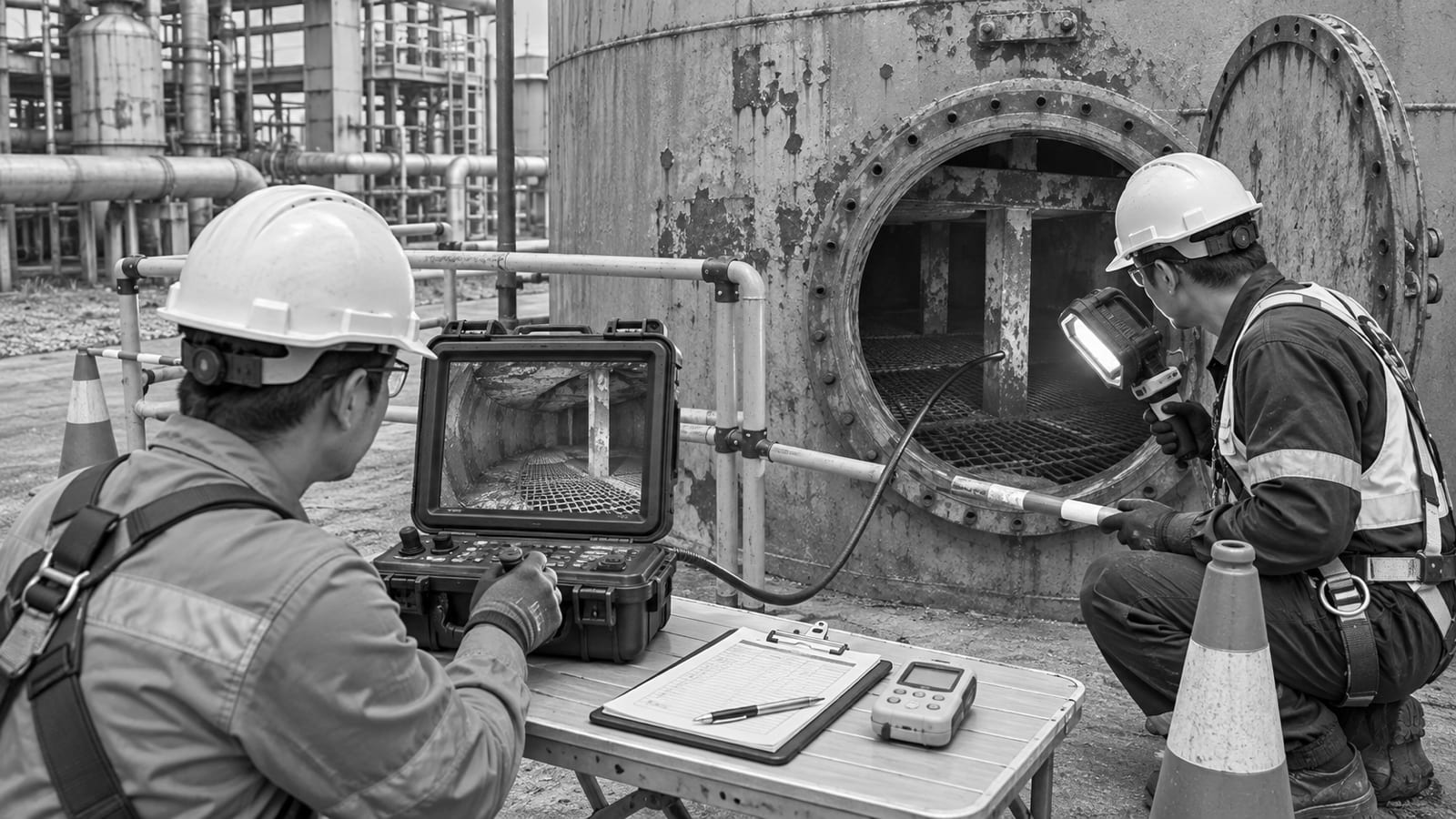
Where feasible, use external observations, cameras, borescopes, lighting, mirrors, robotic devices, or other remote methods after the space is isolated and the opening is controlled. Look for section loss, pitting, holes, cracked welds, loose fasteners, displaced members, delamination, blistered coatings, bowed surfaces, damaged grating, missing clips, loose scale, and debris that may conceal the walking surface.
Remote inspection does not automatically establish capacity. Image perspective, dirt, coatings, and limited access can hide deterioration. If the findings raise questions about load capacity or stability, obtain review by a person qualified for that decision. The entry supervisor should not convert a visual impression into an engineering conclusion.
Trace the entrant's complete route
Evaluate the opening, ladder, landing, platforms, handholds, walking surfaces, work position, and exit route. Consider the entrant's weight plus clothing, tools, materials, hoses, and rescue forces. A surface that carries one person may not safely carry two workers or equipment. Mark areas that cannot be loaded and use barriers or a controlled plan so the warning is not lost once work starts.
Check overhead and adjacent surfaces as well as the floor. Loose refractory, rust scale, deposits, internal piping, baffles, and abandoned components can fall or shift. Verify whether product bridging or a crust could conceal empty space. Evaluate standing water, sludge, and low visibility that may hide defects. Cleaning the area may itself be a task that changes hazards and requires a revised plan.
Coordinate structural findings with isolation and rescue
Structural inspection should not lead workers to bypass isolation because the entry is described as "visual only." An employee is entering when any part of the body breaks the plane of an opening under the applicable definition. Isolation, atmospheric evaluation, opening control, attendant duties, and rescue planning still apply as required.
Rescue plans should address whether the route can support rescuers, a litter, lifting forces, and movement around obstructions. If a platform is questionable, adding more people during an emergency can worsen the failure. Determine whether non-entry retrieval is feasible without dragging the entrant across sharp edges or unstable surfaces. The designated rescue service needs accurate information about the structural limitations.
Define stop-work conditions
The permit or task plan should identify conditions that require evacuation or prevent entry. Examples include movement, cracking, falling material, unexpected holes, new deflection, loose grating, failed ladder components, unusual vibration, loss of visibility, or findings outside the inspected route. Entrants should not continue farther merely to get a better look when the basis for safe travel is uncertain.
Establish who can evaluate a newly discovered condition and how the area will remain controlled while that review occurs. Photograph and locate the finding without overstating what the image proves. If repairs are planned, develop a separate procedure that addresses the hazards created by cutting, welding, rigging, removal, or temporary support.
Which Training Fits This Situation
Authorized entrants need role-based training on the known structural hazards, approved travel path, load restrictions, communication methods, exit triggers, and actions prohibited without authorization. They should understand that a corroded surface can look solid and that probing, striking, or cleaning may change the condition. Attendants need to recognize reports that require evacuation and should not enter to investigate.
Entry supervisors need permit-required confined-space training tied to the employer's program and the actual space. They should be able to verify that known hazards, isolation, atmospheric testing, equipment, roles, rescue, and structural limitations are addressed before signing. Training should also teach the boundary of the role. An entry supervisor who is not qualified to determine structural capacity should obtain the needed evaluation rather than making a field guess.
Awareness training fits employees who identify spaces, report damage, or prevent unauthorized entry but do not perform permit duties. Inspection specialists may need additional qualifications for nondestructive examination, coatings, corrosion, welding, concrete, or structural analysis. Rescue personnel need practice with the space configuration and credible failure scenarios. Course completion supports knowledge, but the employer still must provide site-specific procedures, hands-on equipment training, and demonstrated proficiency for assigned duties.
Common Mistakes to Avoid
One mistake is treating atmospheric clearance as proof that the space is safe. A meter cannot evaluate grating capacity, ladder attachment, falling scale, or a hidden void. Another is assuming that exterior paint or a clean shell indicates a sound interior. Coatings may hide section loss, and deterioration can be localized around drains, welds, supports, liquid levels, or chemical interfaces.
Teams also rely too heavily on an old inspection without checking its scope. A report may cover the vessel wall but not internal access components. A prior entry may have followed a different route. Another mistake is sending a worker inside to "see how bad it is" before the structural question is resolved. Remote methods and qualified review should be considered first.
Other errors include placing two workers or heavy equipment on an unverified platform, using a damaged fixed ladder because retrieval equipment is present, disturbing bridged material, and staging rescue on the same questionable surface. Generic permit language such as "watch for corrosion" is not a control. The plan should identify the location, restriction, inspection basis, and response.
Finally, do not let schedule pressure collapse the distinction between evaluation and repair. Once workers start grinding, cutting, washing, or removing members, the hazards can change. Update the permit and controls, confirm temporary support where needed, and reassess atmosphere, fire prevention, falling objects, and rescue.
Next Step
Select one aging tank, vault, or vessel and perform a records-to-route review before its next entry. Compare drawings, service history, prior findings, repairs, and photographs with every surface the entrant and rescue team would use. Identify where the evidence is current, where it is limited, and who is qualified to resolve each uncertainty.
Then revise the entry checklist so structural condition is a specific evaluation item rather than a vague catchall. Include remote inspection, route confirmation, load restrictions, stop-work triggers, communication, rescue implications, and change management. If the team cannot explain why the access route and work surface can be used as planned, entry is not ready for authorization.
Sources
Occupational Safety and Health Administration, 29 CFR 1910.146 Permit-Required Confined Spaces: https://www.osha.gov/laws-regs/regulations/standardnumber/1910/1910.146
Occupational Safety and Health Administration, 29 CFR 1926.1204 Permit-Required Confined Space Program: https://www.osha.gov/laws-regs/regulations/standardnumber/1926/1926.1204
Occupational Safety and Health Administration, Permit-Required Confined Spaces Guide: https://www.osha.gov/sites/default/files/publications/osha3138.pdf