Static electricity can become an ignition source in a confined space, so employers must connect atmosphere evaluation, equipment selection, and work controls.
A spark that is harmless in ordinary conditions can be dangerous where flammable gas, vapor, mist, or combustible dust may be present. Confined spaces can concentrate these hazards while limiting escape. Cleaning, product transfer, ventilation, clothing, hoses, portable tools, and equipment movement can all affect whether charge develops or an ignition source is introduced.
The answer is not to attach a cable to every object and assume the entry is safe. Employers need a complete hazard evaluation that identifies possible fuels, likely release mechanisms, oxygen conditions, ignition sources, conductive and nonconductive equipment, hazardous locations, and the work that employees will perform. Bonding or grounding may be part of the control strategy when technically appropriate, but it does not replace isolation, ventilation, atmospheric testing, equipment approval, or a permit process.
Who This Affects
This issue affects employers planning entry into tanks, vessels, pits, vaults, bins, silos, mixers, process equipment, and other spaces that contain or may release flammable material. It can also affect spaces where cleaning agents, coatings, fuels, powders, residues, or work-generated vapors change the atmosphere after entry begins.
Entry supervisors should understand which ignition sources are prohibited and which controls must be verified before authorization. Authorized entrants need to know how their tools, clothing, hoses, and movements fit the plan. Attendants should recognize prohibited conditions and order evacuation when required. Maintenance, electrical, engineering, industrial hygiene, and process personnel may need to help evaluate equipment and bonding or grounding methods.
Contractors deserve particular attention. A host facility may know the process history while the contractor controls portable equipment and work methods. Both sides should exchange hazard information and coordinate the permit program. An entry team should never infer that a vessel is free of flammable residue merely because it was drained or opened.
The Confined Space Compliance Issue
OSHA's permit-required confined spaces standard requires employers to identify and evaluate permit-space hazards before entry, specify acceptable entry conditions, isolate the space, control atmospheric hazards, provide needed equipment, and verify acceptable conditions throughout entry. A hazardous atmosphere includes flammable gas, vapor, or mist above the standard's threshold, as well as combustible dust at a concentration that meets or exceeds its flammable limit.
The standard defines hot work as operations such as welding, cutting, burning, heating, or riveting that can provide an ignition source. Ignition control is broader than hot work. Ordinary electrical equipment, switches, damaged cords, battery connections, portable lights, friction, impact, and electrostatic discharge can also matter when a flammable atmosphere is possible.
OSHA's example permit programs state that when dangerous air contamination is attributable to flammable or explosive substances, appropriate electrical equipment is necessary and ignition sources must not be introduced. The example is useful for planning, but the employer still must evaluate the actual space, industry, material, and standards that apply.
Static electricity is an accumulation of electrical charge. Bonding connects conductive objects so they remain at the same electrical potential. Grounding connects conductive objects to ground. These techniques can help control static electrical hazards in suitable systems, but their effectiveness depends on continuity, material conductivity, connection points, environmental conditions, and the process. They require competent technical design and verification.
Nonconductive hoses, liners, containers, coatings, powder streams, or clothing may not be controlled by attaching a ground to a nearby metal object. A cable with paint, corrosion, dirt, or a loose clamp at the connection may not provide the intended path. Employers should use manufacturer instructions, safety data, engineering information, and recognized technical practices rather than improvised connections.
What Employers Should Check
Begin with the material and process history. Identify what the space contained, how it was emptied, what residues remain, whether lines can release material, and whether cleaning or work will create vapors or dust. Review safety data sheets and process knowledge for flammability, ignition sensitivity, vapor density, reactivity, and incompatibilities. Isolation should address energy and material sources that could reintroduce the hazard.
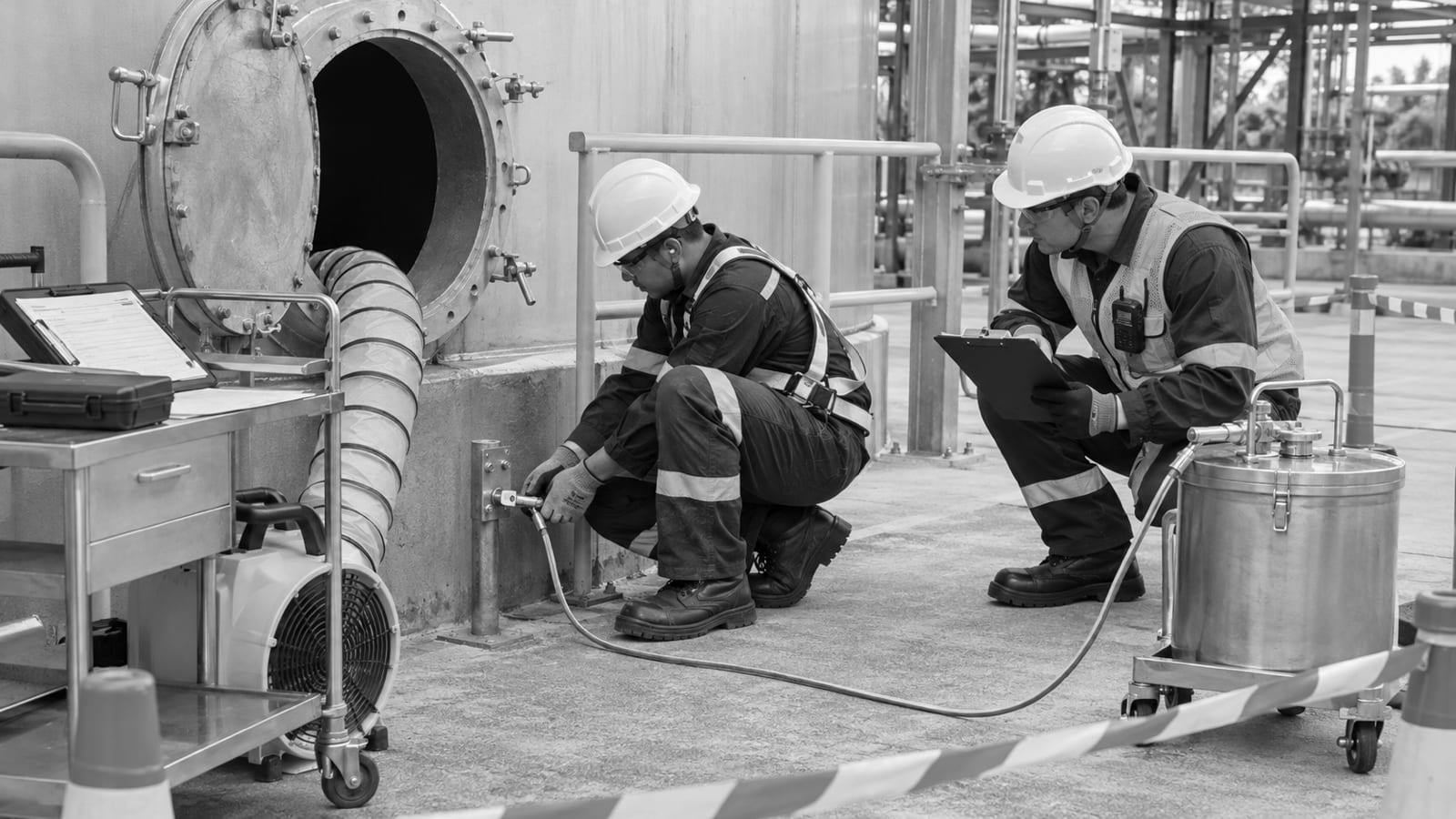
Define acceptable atmospheric conditions and the testing method. Pre-entry testing should use calibrated direct-reading equipment for oxygen, flammable gases and vapors, and potential toxic contaminants in the required order. The plan should account for layering, remote areas, residues, and the possibility that the work itself changes conditions. Monitoring needs to continue as necessary to verify that acceptable entry conditions are maintained.
Review every potential ignition source. Include temporary lighting, ventilation equipment, cameras, radios, phones, gas monitors, pumps, vacuums, extension cords, battery tools, clothing, footwear, containers, hoses, and the task equipment. Equipment approval must match the classified or hazardous location and the possible material. An intrinsically safe label for one application should not be treated as universal approval.
Where bonding or grounding is part of the plan, identify the objects to be connected, approved connection points, cable and clamp requirements, continuity-verification method, inspection frequency, and person responsible. Connections should be made according to the technical procedure before the operation that can generate charge. The arrangement should remain protected from damage and should not create a trip, entanglement, or retrieval hazard.
Ventilation must be planned around the hazard. The air supply should come from a clean source and should not increase hazards. Air movement can dilute a flammable contaminant, but it can also move vapor to another location or disturb combustible dust if poorly designed. Ventilation is not proof that a space is safe. Atmospheric test results and continuing evaluation determine whether acceptable conditions exist.
The permit should identify prohibited conditions and the required response. Unexpected flammable readings, loss of ventilation, damaged bonding equipment, an unapproved tool, a product release, or a changed task may require entrants to leave. The entry supervisor should not authorize a quick equipment substitution without reevaluating the hazard.
Which Training Fits This Situation
Confined space awareness training fits employees who need to recognize spaces, signs, access restrictions, and the employer's basic rules but do not perform entry duties. It does not prepare someone to approve electrical equipment or design a static-control system.
Permit-required confined space training should be role-based. Entrants need to understand atmospheric and ignition hazards, equipment use, communication, warning signs, and evacuation. Attendants need to monitor inside and outside conditions, prevent unauthorized entry, maintain communication, and order evacuation when a prohibited condition occurs. Entry supervisors need to verify tests, equipment, permits, and control measures before authorization.
Employees handling flammable liquids, combustible dusts, or process residues need hazard-specific instruction. That may include material transfer procedures, container and hose limitations, bonding and grounding steps, cleaning methods, spill response, and equipment approval. Qualified electrical or engineering personnel should handle decisions that require expertise beyond the entry team's role.
Hands-on practice should use the actual equipment. Workers can inspect clamps and cables, locate approved connection points, check continuity using the specified method, route cables without affecting retrieval, and identify prohibited substitutions. A useful exercise introduces a nonconductive hose or painted connection point and asks why the visible cable may not prove effective control.
Training records help document instruction, but performance matters more than attendance. Supervisors should verify that each person can explain the permit conditions and stop-work triggers. Refresher training may be needed after equipment changes, deviations, near misses, program reviews, or evidence that an employee has not retained the required understanding.
Common Mistakes to Avoid
The most common mistake is treating bonding and grounding as interchangeable with atmospheric control. A grounded vessel can still contain a flammable atmosphere. Isolation, cleaning, ventilation, testing, monitoring, and ignition control must work together.
Another mistake is assuming all metal parts are electrically continuous. Gaskets, flexible connectors, bearings, paint, coatings, corrosion, and mechanical joints can interrupt a path. The procedure should identify how continuity is established and verified rather than relying on appearance.
Crews may also overlook nonconductive components. A plastic liner, hose, filter, container, or protective garment may accumulate charge under some conditions. Connecting a nearby frame to ground may not control the nonconductive surface. The employer should use technical information appropriate to the material and operation.
Unapproved personal electronics and battery tools are another gap. Familiar equipment may still be an ignition source. The permit program should control what crosses the entry boundary, including contractor devices, cameras, and temporary lighting. Employees need a clear process for obtaining approved alternatives.
Some teams test the atmosphere once, then begin a task that introduces solvent vapor, dust, heat, or a material release. Monitoring must reflect the changing work. When conditions or tasks change, the entry supervisor should reevaluate the permit rather than assume the original readings remain representative.
Finally, a bonding cable can create its own physical hazards if it crosses the access path or retrieval line. Cable routing should support the static-control plan without interfering with entry, exit, attendant visibility, communication, or rescue equipment.
Next Step
Select one permit space where flammable material is possible and conduct an ignition-source walkthrough before the next entry. List the residue and release scenarios, required atmospheric tests, ventilation arrangement, portable equipment, clothing, tools, hoses, containers, bonding or grounding provisions, and prohibited conditions.
Bring operations, entry supervision, safety, electrical, and process knowledge together. Verify that equipment ratings and static-control procedures match the actual hazard. Inspect the physical connection points and trace how cables will be routed. Confirm who tests continuity, how results are documented, and what change forces a new evaluation.
The practical goal is not a vessel covered in cables. It is an entry where the employer has identified possible fuel and ignition sources, selected controls that work for the process, verified acceptable conditions, and trained each role to stop when the plan no longer matches reality.
Sources
OSHA, 29 CFR 1910.146 Permit-Required Confined Spaces | https://www.osha.gov/laws-regs/regulations/standardnumber/1910/1910.146
OSHA, Appendix B Procedures for Atmospheric Testing | https://www.osha.gov/laws-regs/regulations/standardnumber/1910/1910.146AppB
OSHA, Appendix C Examples of Permit-Required Confined Space Programs | https://www.osha.gov/laws-regs/regulations/standardnumber/1910/1910.146AppC
OSHA, Technical Manual Section IV Chapter 6 Combustible Dusts | https://www.osha.gov/sites/default/files/otm_secIV_chap6.pdf
OSHA, Technical Manual Section IV Chapter 5 | https://www.osha.gov/otm/section-4-safety-hazards/chapter-5