A confined-space opening that admits a worker may still be too small or poorly configured for retrieval equipment, patient packaging, and emergency access.
Portal size is only one part of the problem. The opening may be horizontal or vertical, elevated above grade, surrounded by piping, obstructed by a ladder, crossed by cables, or positioned where a rescue device cannot be anchored. An entrant who passes through while upright may not fit through in a harness, with protective equipment, or while immobilized. Employers should evaluate the complete route before authorizing entry, not discover the restriction during an emergency.
This article provides general educational information about federal permit-required confined-space requirements. Employers must determine whether general industry or construction rules apply, evaluate the actual space and work, and coordinate with qualified rescue providers. A course certificate, permit form, or equipment purchase does not by itself establish that entry or rescue is feasible.
Who This Affects
Entry employers, host employers, facility owners, entry supervisors, attendants, authorized entrants, rescue services, safety professionals, maintenance planners, and equipment providers all may hold part of the answer. Facility personnel may know the portal dimensions and internal obstructions. The entry employer knows the task, tools, clothing, and number of entrants. The rescue provider should determine whether its equipment, staffing, and techniques fit the actual space.
Portal planning matters in tanks, vessels, silos, vaults, pits, sewers, digesters, crawl spaces, boilers, tunnels, utility structures, and other spaces with limited entry or exit. A nominal opening dimension can be misleading when a flange, hinge, neck, ladder, pipe, platform, or guard reduces the usable clearance. The smallest part of the route may be inside the space rather than at the first opening.
Contractors are affected when they receive only a generic space inventory. A record that says "24-inch manway" does not describe whether the cover opens fully, whether a tripod can stand over it, whether traffic passes nearby, or whether an entrant must turn immediately after crossing the plane. The host and entry employer should exchange enough information to evaluate the planned work and rescue method.
The Confined Space Compliance Issue
OSHA's general-industry permit-space rule requires employers to identify and evaluate hazards before entry, provide necessary equipment, establish rescue and emergency procedures, and verify that conditions are acceptable. The construction rule contains parallel planning and coordination duties for confined spaces in construction. Limited or restricted means for entry or exit is part of the confined-space definition, so access is not a secondary detail.
For rescue evaluation, OSHA's nonmandatory Appendix F to 29 CFR 1910.146 describes portal size, space access, elevation, internal configuration, and hazards as factors. It treats a portal of 24 inches or less in the least dimension as restricted for the evaluation framework and notes the difficulty of moving a rescuer using self-contained breathing apparatus or normally packaging an injured employee. That description is not a universal approval threshold. A larger portal can still be unusable because of shape, location, obstructions, or the entrant's equipment.
The rule requires employers selecting an outside rescue service to evaluate whether it can respond in time and perform the required tasks. Rescue teams must have access to permit spaces as necessary for planning and practice. Representative practice spaces must simulate the opening size, configuration, and accessibility of the spaces from which rescue may be performed. A drill through a large, unobstructed training opening does not test readiness for a narrow side portal with an internal ladder and sharp turn.
Non-entry retrieval is required when it would facilitate rescue, unless the equipment would increase overall risk or would not contribute to rescue. The employer must evaluate that question for the actual configuration. A retrieval line can snag on an internal obstruction, pull an entrant into a harmful position, or fail to guide a person through an offset portal. Those issues do not justify ignoring rescue; they require a different, documented method and appropriately capable service.
What Employers Should Check
Measure the usable opening and route
Record the least clear dimension, shape, flange depth, cover swing, hinges, bolts, guards, ladders, handrails, piping, cables, and nearby structures. Measure after the opening is configured as it will be for entry. A circular diameter or rectangular width and height should not include space occupied by fixed components. Photograph the opening from outside and, where safe methods allow, document the interior transition without making an unplanned entry.
Trace the entire route from the work area to the final safe location. Note vertical drops, horizontal crawls, turns, elevation changes, platforms, narrowing sections, and internal obstacles. Consider whether an unconscious person can be aligned with the opening and whether rescuers can reach, package, and move that person. The route should be evaluated with realistic clothing, harnesses, respiratory protection, supplied-air lines, tools, and other equipment.
Evaluate the entrant and task profile
Entry feasibility changes with the individual and the job. Bulky chemical protective clothing, welding gear, fall protection, a respirator, cooling equipment, or tools can increase the entrant's profile. A worker may enter under their own control but become difficult to remove after an injury, loss of consciousness, swelling, contamination, or entanglement.
Plan how tools and materials will cross the portal without blocking it or striking the entrant. Keep the exit route available during the task. If scaffolds, ladders, hoses, ventilation ducts, lighting, or temporary equipment are added inside, evaluate whether they change rescue access. The entry supervisor should not authorize a configuration that has drifted from the reviewed plan.
Match retrieval equipment to the geometry
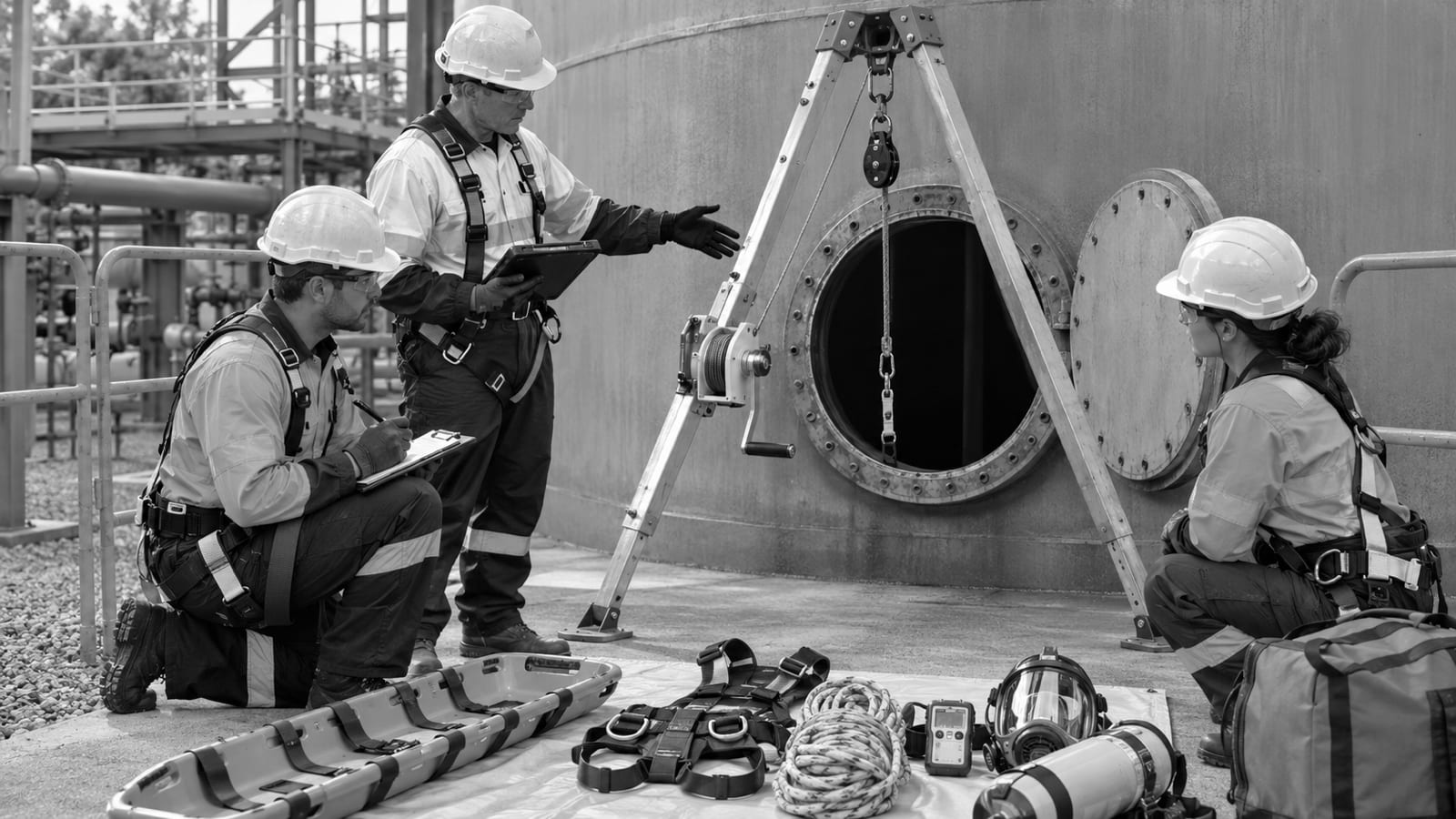
Verify the anchor or mechanical device location, rated capacity, line path, clearance, and stability. For vertical-type permit spaces more than five feet deep, the general-industry standard requires a mechanical device to be available for retrieval. A tripod may be appropriate for some top entries, while a davit or engineered anchor may better fit others. Side entries can require different line management and patient movement.
Conduct a no-load setup before entry and confirm that the device can be positioned without creating a fall, traffic, electrical, or struck-by hazard. Check whether the line rubs across an edge or crosses the ventilation duct. Verify that barriers protecting the opening do not prevent rescue deployment. Follow manufacturer instructions and the employer's inspection procedures for harnesses, connectors, lines, winches, anchors, and patient-packaging equipment.
Involve the rescue service before the permit is issued
Provide the rescue service with dimensions, photographs, drawings, hazards, isolation information, access restrictions, expected entrant equipment, and the proposed work. Allow the service to inspect representative spaces and determine the techniques and resources needed. Confirm availability for the scheduled entry and the method for summoning the service.
The rescue provider should be able to explain how it will reach the site, control hazards, enter when necessary, package the patient, pass the restricted portal, and transfer the person to medical care. If the plan depends on removing a cover, ladder, handrail, or obstruction, verify who can do that, how long it takes, and whether removal changes the space or exposes workers to another hazard.
Practice the difficult part
Rescue practice should reproduce the portal and route constraints, not merely demonstrate that a winch turns. Use an appropriate mannequin or training method and protect participants from drill hazards. Test line routing, communications, patient orientation, edge transition, obstructions, and equipment handoffs. Record limitations and corrective actions.
If the drill reveals that the patient cannot clear the opening, pause entry planning. Options may include different retrieval equipment, revised work equipment, an engineered temporary opening, removal of an obstruction under controlled conditions, a different rescue service, or completing the task without entry. Any physical modification should be reviewed for structural, energy, atmospheric, and process consequences.
Control the area outside the opening
An opening can be restricted by the environment around it. Vehicle traffic, process piping, handrails, low overhead clearance, electrical conductors, slippery surfaces, weather, or limited floor space can prevent rescue equipment from being deployed. OSHA requires barriers as necessary to protect entrants from external hazards, and removed covers must be guarded under applicable procedures.
Define a clear equipment and rescue zone. Keep stored materials, carts, hoses, and unrelated workers out. Plan lighting, communications, and access for emergency responders. If the portal is elevated, determine how rescuers and the patient will move from the opening to grade. If it is below grade in a roadway, integrate traffic control without blocking response vehicles.
Put portal facts on the permit and inventory
The space inventory should include more than a name and location. Record portal dimensions, orientation, elevation, cover type, internal configuration, fixed obstructions, access limitations, anchor information, representative-space group, rescue method, and date verified. Link drawings and photos to a stable asset identifier.
The entry permit should identify the rescue service, communication method, retrieval setup, and any configuration-specific restrictions. If a new ladder, scaffold, duct, or hose changes the route, the entry supervisor should reevaluate the permit conditions. Canceled permits and drill records can reveal recurring access problems that deserve a permanent correction.
Which Training Fits This Situation
Authorized entrants need training on space hazards, equipment, communications, exit conditions, and the limits of the portal. Attendants need to keep the opening and rescue zone controlled, maintain accountability, recognize when conditions change, and summon rescue without delay. Entry supervisors need to verify that the permit, equipment, tests, isolation, rescue availability, and actual configuration agree before entry begins.
Permit-required confined-space entry training should include the employer's program and the specific roles assigned. Rescue personnel need hands-on training and periodic practice with spaces that simulate the openings, configurations, and accessibility they may encounter. Equipment familiarization alone is not the same as demonstrating rescue capability.
Training scenarios can compare a top-entry vault, a side-entry tank, and an elevated vessel manway. Ask learners to identify the least clear dimension, line path, patient orientation, external hazards, and information the rescue service needs. Include a change during the exercise, such as adding a ventilation duct that narrows the opening. The team should practice stopping and revising the plan.
Employers should retain records consistent with the applicable standard and company program. A certificate can document completion of a course, but the employer still must evaluate employee proficiency, assign duties, provide equipment, and train on the actual workplace procedures. No course can approve a portal or guarantee a successful rescue.
Common Mistakes to Avoid
One mistake is assuming that if a worker can squeeze through, rescue is feasible. Another is recording the manufacturer's nominal manway size without measuring the usable opening. Teams may also stage a tripod before checking whether the line aligns with the entrant, or assume a harness attachment point will automatically produce the correct removal profile.
Other mistakes include relying on the fire department without a prior evaluation, practicing at a training prop that does not match the facility, placing ventilation ducting through the only rescue path, blocking the opening with tools, and failing to account for respiratory protection or protective clothing. A rescue plan copied from another space may look complete while ignoring the one dimension that controls removal.
Do not treat Appendix F's portal categories as a pass-fail design table. They support evaluation of rescue capability. The employer must consider all hazards, the specific configuration, applicable standards, and qualified technical judgment. Avoid promises that a device or class makes every entry safe.
Next Step
Select one permit space with the most restrictive opening and conduct a tabletop and physical setup review before the next entry. Measure the clear portal, map the route, stage the actual retrieval and ventilation equipment, and have the rescue provider explain how a nonresponsive entrant would be removed. Record every interference or unanswered question.
Then update the space inventory, permit template, representative-space groups, and drill plan. Resolve gaps before entry authorization, and repeat the review when equipment, configuration, staffing, or work changes. Portal planning is successful when access and rescue are proven features of the entry plan rather than assumptions left for the emergency.
Sources
Occupational Safety and Health Administration, 29 CFR 1910.146 Permit-Required Confined Spaces: https://www.osha.gov/laws-regs/regulations/standardnumber/1910/1910.146
Occupational Safety and Health Administration, Appendix F to 29 CFR 1910.146 Rescue Team or Rescue Service Evaluation Criteria: https://www.osha.gov/laws-regs/regulations/standardnumber/1910/1910.146appf
Occupational Safety and Health Administration, Permit-Required Confined Spaces Publication: https://www.osha.gov/sites/default/files/publications/CONFINED_SPACE_PERMIT.pdf