
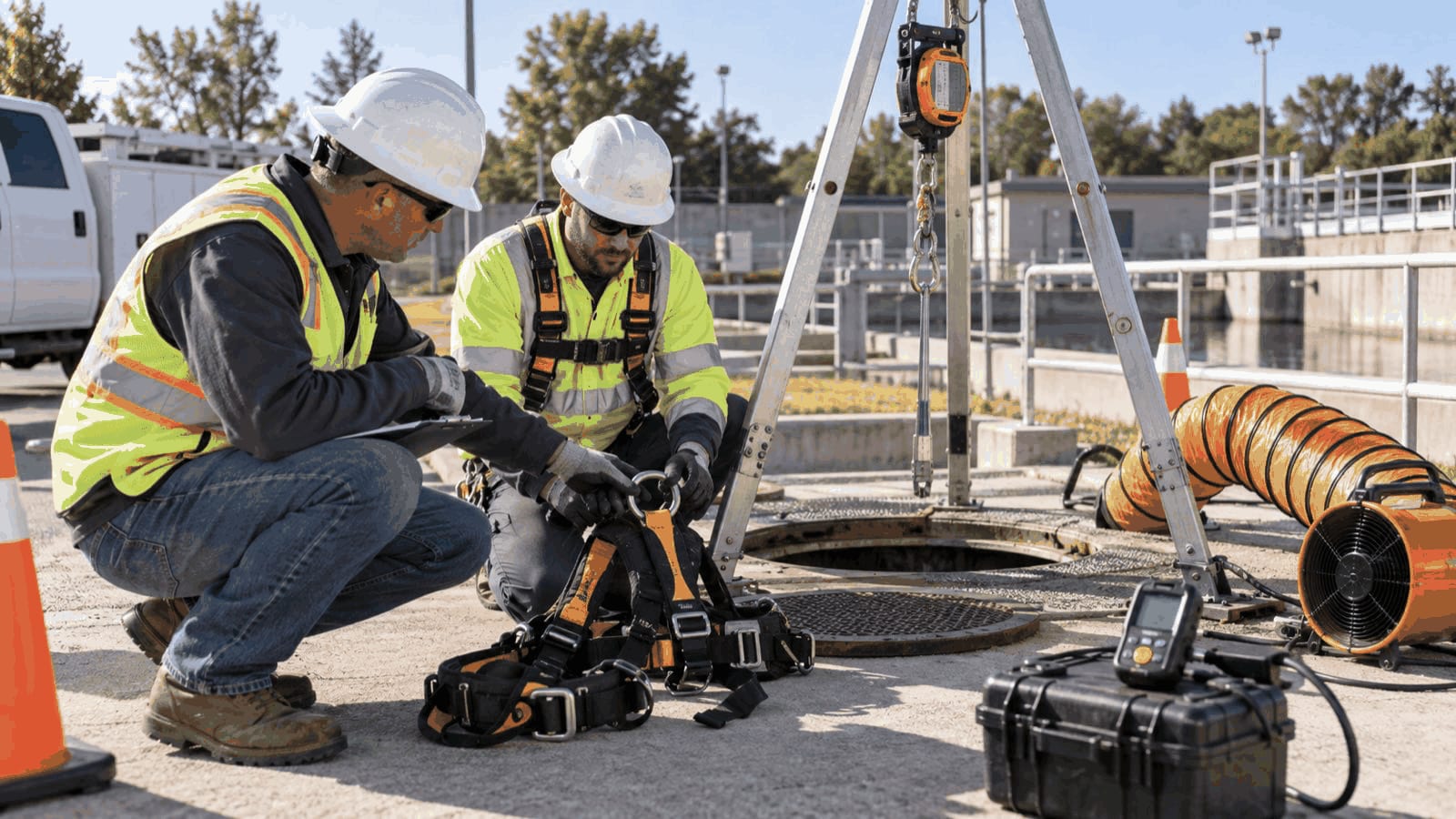
Before dispatch, employers should verify that confined-space entry, testing, ventilation, communication, and rescue equipment match the space and hazards.
Equipment readiness is a program responsibility, not a last-minute search through a truck. A gas monitor with a low battery, a blower without a suitable duct route, or a retrieval system that cannot reach the entrant can create a dangerous gap even when the permit looks complete. The entry supervisor, attendant, entrant, and rescue personnel need equipment they understand and can use for the specific job.
Who This Affects
This issue affects construction contractors, maintenance departments, utility crews, municipalities, facilities teams, and employers who send workers into tanks, vaults, manholes, pits, sewers, crawl spaces, and other enclosed areas. It also affects contractors working at a host facility, because several employers may divide responsibility for the space, the equipment, the permit, and the rescue plan.
Small crews face the same decision points as large programs. A three-person team may have one entrant, one attendant, and one entry supervisor, but it still needs a reliable way to evaluate the atmosphere, communicate, ventilate, summon help, and recover a worker if the plan requires retrieval. Online training can build knowledge, while site-specific practice confirms whether the team can use the equipment under real conditions.
The Confined Space Compliance Issue
Confined-space hazards can change faster than a pre-entry checklist suggests. Oxygen deficiency, toxic gases, flammable vapors, engulfment, electrical energy, moving equipment, heat, flooding, and unexpected process releases can affect the space or the entry route. OSHA construction requirements appear in 29 CFR 1926 Subpart AA, while general industry permit-required space requirements appear in 29 CFR 1910.146. Employers must identify which framework and duties apply to their work.
The equipment list should follow the hazard assessment. Atmospheric testing may require a calibrated instrument capable of measuring oxygen, flammable gases, and the contaminants reasonably expected in the space. Ventilation may require a blower, ducting, power source, grounding, and a method to keep the supply air from drawing in vehicle exhaust or another contaminant. Retrieval may require a harness, lifeline, tripod, winch, anchor, or another arrangement that fits the opening and the entrant’s position.
Testing equipment is only useful when someone knows its limitations. Bump testing, calibration, sensor life, sampling locations, response time, alarm settings, interference, and maintenance records matter. Test the atmosphere at the top, middle, and bottom when stratification is possible. Continue monitoring when conditions can change, and make sure the attendant can see or hear alarms and understands the action required when one occurs.
Ventilation is not automatically a control. The air source must be clean, the duct must reach the intended area, and the flow must not create a new hazard or disturb a material that can become airborne. If ventilation is required to maintain acceptable conditions, the employer needs a plan for loss of power, duct movement, blower failure, or a change in the work that generates contaminants.
Rescue equipment must be selected around the retrieval path. A tripod over a vertical opening may not help with a horizontal tunnel, a baffle, a ladder obstruction, or an entrant who cannot wear a harness as planned. Employers should know when non-entry retrieval is feasible, when a trained rescue team is needed, and how medical, fire, or facility responders will be contacted. Calling emergency services is not the same as having a rescue plan.
What Employers Should Check
Use a dispatch review that connects the equipment to the space and the role assignments:
- Confirm the space inventory, entry purpose, expected hazards, isolation steps, and entry classification.
- Check that the atmospheric monitor is the right type, has a current calibration or bump-test status, and has enough battery for the job.
- Confirm that sampling tubing, filters, probes, and alarm settings fit the planned testing method.
- Inspect blowers, ducts, power cords, guards, and grounding, and identify the clean-air intake.
- Check communication devices in the space, at the opening, and at the rescue contact point.
- Inspect harnesses, lifelines, tripods, winches, anchors, and connectors for damage and compatibility.
- Confirm that barriers, lighting, traffic controls, and fall protection protect the opening and the attendant.
- Verify lockout, blanking, line breaking, ventilation isolation, and other energy-control equipment.
- Review the permit, attendant instructions, emergency contacts, and stop-work triggers.
- Confirm the rescue provider, response time, access route, and practice expectations.
The attendant needs equipment that supports the actual duty. A radio that cannot reach the entrant, a monitor alarm that cannot be heard over a pump, or a permit stored in a truck away from the opening can undermine the role. The attendant should not be burdened with unrelated work that competes with continuous observation and communication.
The entry supervisor should verify that the team can explain the equipment sequence. Who tests first? Where will the probe go? When will ventilation start? What happens if the alarm sounds? Who stops the work? Who calls rescue? When is the permit canceled? A short verbal walk-through can reveal gaps that a signature does not.
For multi-employer work, equipment ownership should be clear. The host may provide the space information and isolation, while the contractor provides monitoring, ventilation, and retrieval. Put those boundaries into the coordination process. If the contractor assumes the host is handling rescue, or the host assumes the contractor is testing the atmosphere, the permit can create false confidence.
After the job, inspect and reset equipment. Record monitor readings, alarms, defects, battery replacement, calibration needs, and any change to the space. Clean and store equipment so the next crew does not receive a contaminated hose, damaged harness, or depleted cylinder. Near misses and failed checks should lead to a program improvement, not just a note in a folder.
Which Training Fits This Situation
Confined Space Awareness Training is appropriate for workers who need to recognize spaces, hazards, warning signs, and prohibited entry without performing the entry. Permit-Required Entry Training fits entrants and attendants who will participate in a controlled permit process and need role-specific knowledge about testing, communication, alarms, and evacuation.
Supervisor training is useful when a person authorizes entry, verifies controls, coordinates employers, or cancels the permit. Competent Person training may be appropriate for construction roles that identify confined spaces, evaluate hazards, and support the entry program under Subpart AA. A multi-role plan can be more practical than giving every worker the same course, because each person receives instruction connected to actual duties.
Online training can establish a common baseline and produce certificates of completion for employer records. It should be paired with site-specific procedures, equipment familiarization, drills, and any hands-on or rescue practice required by the employer’s hazard assessment. Employers should also confirm language access, refresher expectations, and how training records are reviewed during audits.
Common Mistakes to Avoid
One common mistake is buying equipment before defining the space and hazards. Another is treating the monitor as a magic answer while ignoring isolation, engulfment, mechanical, or structural hazards. Employers also sometimes stage a tripod without proving that it fits the opening, or list rescue on the permit without confirming who will arrive and how they will reach the entrant.
Avoid assigning the attendant additional work that distracts from the entry. Do not place the monitor where it cannot sample the work area, and do not assume one reading remains valid after ventilation stops, a process changes, rain enters, or the crew begins hot work. Never allow a worker to improvise a connection, bypass an alarm, or continue after a stop-work trigger without reassessment by the responsible supervisor.
Equipment checks should also account for the work itself. Welding, cutting, coating, cleaning chemicals, pressure washing, sludge disturbance, and battery-powered tools can change the atmosphere or create new energy sources. The entry plan should identify those changes before the work starts and define whether additional testing, ventilation, fire prevention, respiratory protection, or a revised permit is required. If the job changes, the equipment review should change with it.
Employers can make this routine easier by storing a current equipment inventory with inspection dates, manufacturer instructions, replacement parts, and contact information. A simple staging photograph or sign-out record can show what traveled with the crew. The purpose is not bureaucracy. It is to prevent a worker from discovering at the opening that the needed probe, hose, radio, harness, or rescue connection was left at the shop.
Next Step
Before dispatch, compare the equipment, roles, permit, and rescue plan against the actual space. If the team cannot explain how it will test, ventilate, communicate, evacuate, and obtain rescue, pause the entry preparation and close that gap.