
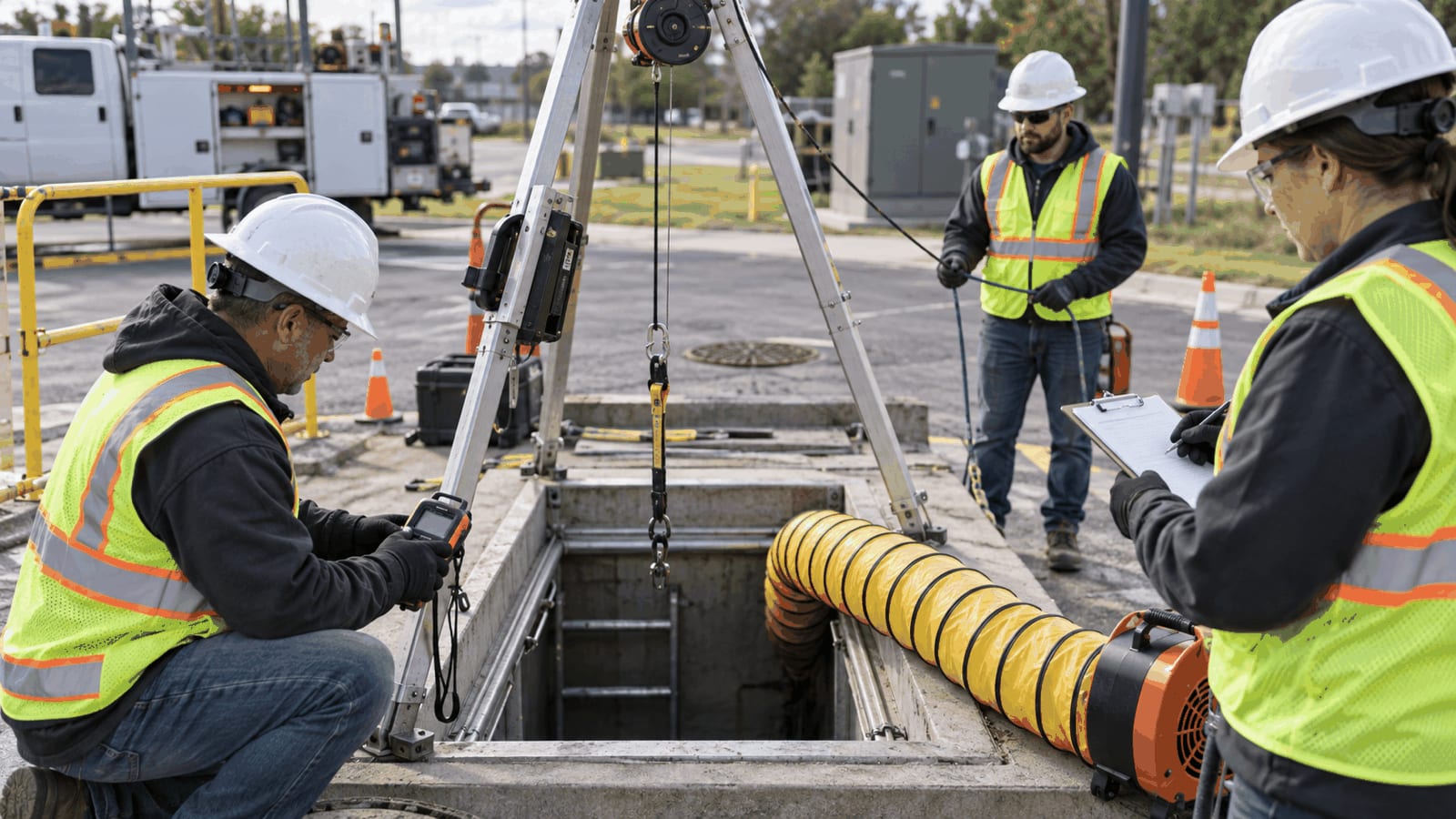
When ventilation fails during confined space entry, crews must protect entrants, direct the attendant, and give supervisors authority to stop work.
Ventilation is often treated as equipment that gets turned on before entry and forgotten. In reality, the air-moving system is part of the entry control. A duct can shift, a fan can lose power, a damper can close, a hose can collapse, or the work itself can create contaminants faster than the system can remove them. A space that was acceptable during the pre-entry test may no longer be acceptable after the control changes.
Employers should train people to recognize ventilation failure as a condition that requires action, not a minor equipment inconvenience. The response depends on the hazards, the permit, the monitoring plan, and the employer's procedures. It may include stopping work, ordering entrants out, moving to a safe position, testing the atmosphere, restoring ventilation, or cancelling the entry. Online training can establish role knowledge, but it should be connected to site-specific procedures, equipment checks, and rescue planning.
Who This Affects
The issue affects any employer whose workers enter tanks, vaults, manholes, pits, sewers, crawl spaces, vessels, or other spaces where ventilation is used to control atmospheric hazards. Construction employers may work under 29 CFR 1926 Subpart AA, while general industry employers may work under 29 CFR 1910.146. The applicable rule and the employer's written program must be reviewed for the work being performed.
Entrants need to know what the monitor means, where to move, how to communicate, and when to exit. Attendants need to recognize alarms, loss of airflow, unusual odors, symptoms, or changes in the work process without entering the space to investigate. Entry supervisors need to verify that the permit conditions remain satisfied and must have the authority to terminate the entry. A Competent Person or other designated evaluator may also have duties under the employer's program, especially on construction sites.
Contractors and host employers share practical responsibilities when work crosses organizational boundaries. A facility may provide power and ventilation equipment while a contractor supplies entrants and an entry supervisor. The parties need to agree on who monitors the atmosphere, who responds to an alarm, who controls the space, and who calls for rescue. Training gaps often appear when each employer assumes the other team understands the response.
The Confined Space Compliance Issue
Atmospheric conditions can change quickly. Welding, coating, cleaning, cutting, curing compounds, pumping, biological activity, nearby combustion, or a product release can consume oxygen or add contaminants. Ventilation may dilute or remove some hazards, but it is not automatically a substitute for elimination, isolation, testing, or personal protective equipment. The employer must evaluate the actual hazard and follow the applicable program.
The first control is recognizing what failure looks like. A failure may be obvious, such as a fan stopping, or subtle, such as a duct pulling away from a low point, a filter clogging, a generator losing fuel, or airflow no longer reaching the entrant's breathing zone. A monitor alarm is another form of failure because it shows that the expected control is no longer producing acceptable conditions. The crew should not wait for a person to feel ill before acting.
Pre-entry testing establishes information at a point in time. Depending on the permit and hazards, testing may be performed at the top, middle, and bottom and may continue during the entry. Continuous monitoring can provide an alarm, but the alarm is useful only when people know what action follows it. The written procedure should identify alarm set points, communication methods, exit routes, and whether re-entry requires a new evaluation or permit decision.
Ventilation failure can also affect rescue. If an entrant is unconscious or cannot self-rescue, an attendant must not rush inside without authorization and appropriate controls. An unplanned entry by an unprotected rescuer can create a second victim. Employers should coordinate non-entry retrieval when feasible, identify the rescue service, and confirm that the rescue team understands the space, access, hazards, equipment, and time constraints.
The permit should help the team see the control relationship. It can identify the space, work, hazards, isolation measures, testing results, ventilation method, communication method, rescue arrangements, and people assigned to each role. A permit is not a guarantee that conditions will remain safe. It is a live planning document that must be suspended, revised, or cancelled when conditions change.
What Employers Should Check
Employers can use a ventilation-failure decision framework during planning and drills. The purpose is to make the first minutes of a response predictable.
- Identify the ventilation equipment, power source, duct route, intake location, exhaust location, and person responsible for checking operation.
- Inspect guards, connections, filters, fuel, cords, generators, grounding, and backup equipment before entry.
- Confirm that the airflow reaches the relevant work zone and does not simply move contaminated air toward another worker or opening.
- Define how an entrant will hear an alarm or receive an instruction if machinery, traffic, or distance makes voice communication unreliable.
- Set the immediate action for loss of airflow, monitor alarm, power interruption, unusual symptoms, or a change in the work process.
- Confirm that entrants can leave without crossing a new hazard and that the attendant can account for every person.
- Identify whether the space must be re-tested before work resumes and who can authorize that decision.
- Verify that a rescue service is available, informed, and equipped for the space rather than selected only from a general list.
- Document the response, equipment problem, atmospheric results, and corrective action after an event or drill.
The entry supervisor should ask whether the ventilation arrangement is still appropriate for the current task. A low-flow cleaning operation may differ from hot work. A second worker may change the load. A product line may be opened. A blockage may make the original test locations inadequate. The question is not simply whether the fan is running. The question is whether the planned control continues to address the identified hazard.
The attendant's role deserves special emphasis. The attendant should remain outside, maintain communication, track entrants, watch the conditions, and order evacuation when required. The attendant should not be assigned unrelated work that competes with those duties. If the attendant must leave, the employer should have a qualified relief attendant or terminate the entry. A training course should make that boundary clear because many incidents begin with a well-intended person trying to help from inside the space.
After an evacuation, employers should preserve useful information. Record the time, work stage, monitor readings, alarm, ventilation condition, entrant symptoms, actions taken, and people notified. The review should ask whether the original hazard assessment, equipment inspection, testing, communication, and rescue plan were adequate. A near miss is an opportunity to improve the program before the next entry, not proof that the crew can continue without changes.
Which Training Fits This Situation
Awareness training is appropriate for workers who may encounter a confined space or support work around one but will not perform the entry. It can explain the difference between ordinary work areas and spaces that require evaluation, why unauthorized entry is prohibited, and how to report a concern.
Permit-Required Entry training is more appropriate for entrants, attendants, and other workers who participate in the entry process. It should cover atmospheric hazards, testing, ventilation, communication, alarms, evacuation, personal protective equipment, and the limits of the attendant role. Workers should understand that an alarm or loss of ventilation is a signal to follow the procedure immediately.
Supervisor training fits people who authorize, coordinate, or terminate entries. It should connect the permit to the hazard assessment, isolation, testing, ventilation, rescue, contractor coordination, and post-entry review. A supervisor needs enough understanding to challenge an incomplete setup and stop the entry when the conditions no longer match the plan.
Competent Person training may be needed where construction work involves confined spaces and the employer assigns a person to identify hazards and take prompt corrective measures. The exact duties depend on the employer's program and the work. A multi-role plan is often the best fit for small crews because one person may have more than one qualification, but roles must still be clear during the entry and an attendant cannot perform incompatible duties.
Online training provides a practical foundation and a certificate of completion. It does not replace hands-on practice with the actual monitor, ventilation system, retrieval equipment, permit, or rescue communication used by the employer. A site-specific drill can close that gap by walking through the alarm, evacuation, accountability, power loss, re-testing, and notification process without placing anyone in a hazardous space.
Common Mistakes to Avoid
One mistake is treating a running fan as proof that ventilation is effective. Airflow needs to be checked in relation to the work and the space. Another is placing the monitor at the opening while assuming the reading represents the entrant's breathing zone. Testing and monitoring should follow the hazards and permit procedures.
Some employers rely on a single person to notice every problem. The entrant should be able to report a concern, the attendant should be able to order evacuation, and the entry supervisor should have clear authority to terminate the entry. A layered response is stronger than a plan that depends on one alarm or one individual.
Another mistake is restarting as soon as the fan comes back on. The team should determine why the control failed, confirm the atmosphere, check the work process, and follow the permit's re-entry requirements. The correction may require a backup power source, a different duct route, equipment repair, a changed work method, or a new hazard assessment.
Finally, employers should avoid assuming that a certificate alone demonstrates readiness. Training records are useful, but employers also need evidence that workers understand the site's equipment, communication method, permit, rescue arrangement, and stop-work expectations.
Next Step
Before the next entry, ask the team to describe exactly what happens when ventilation stops. If the answer differs by worker, contractor, or shift, the employer has a training and coordination need. Assign the right course by role, review the written program, inspect the actual equipment, and conduct a site-specific drill outside the space.
The safest response to ventilation failure is early, coordinated action. A trained entrant exits, a focused attendant remains outside and communicates, an authorized supervisor stops or evaluates the entry, and the employer corrects the cause before work resumes. That approach supports compliance planning and gives the crew a practical way to handle changing conditions.