
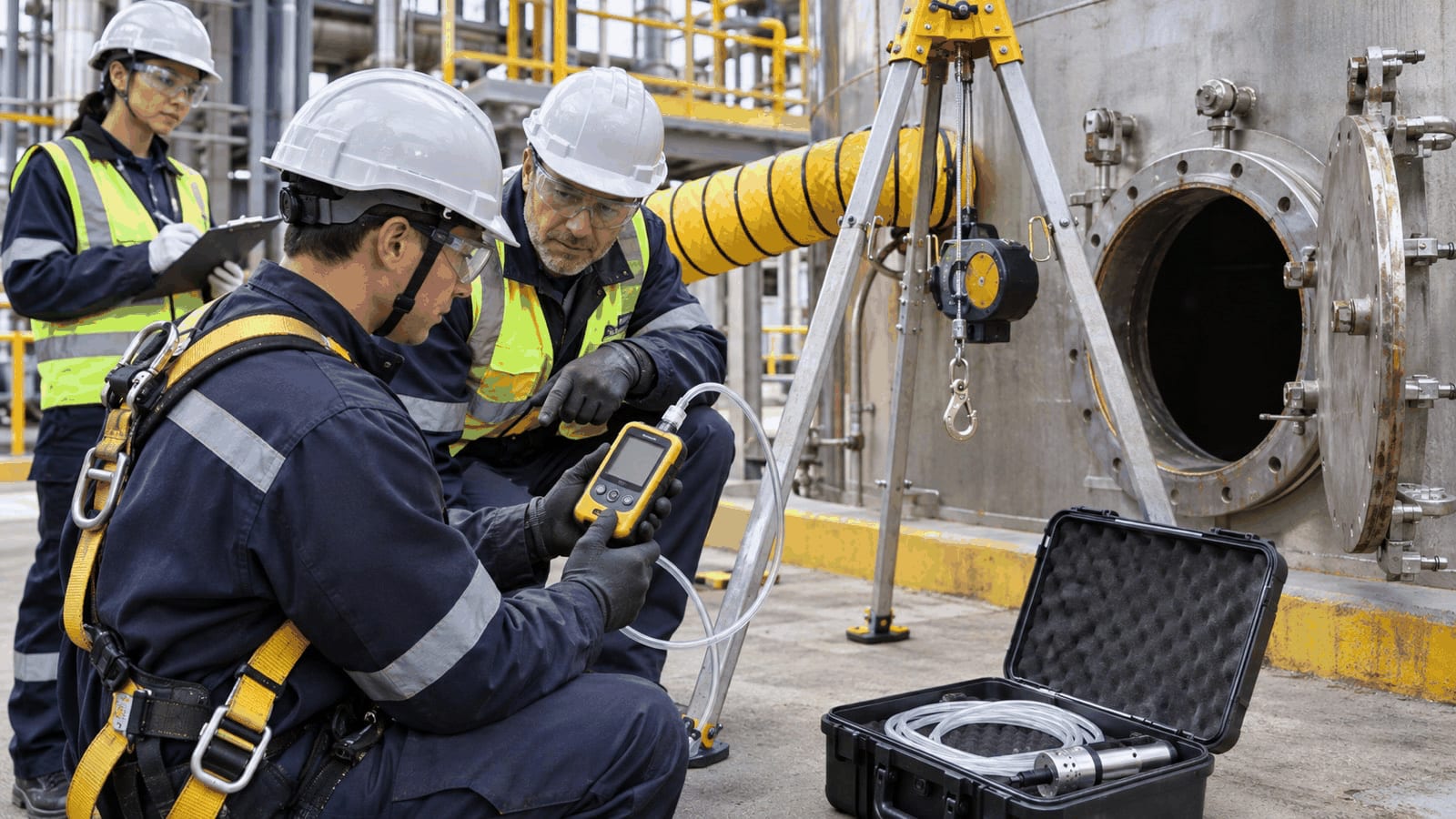
A gas monitor can display precise numbers and still miss the hazard if its sensors, sampling method, response time, or operating limits do not fit the space.
Portable multi-gas monitors are central to many permit-required confined space entries, but the instrument does not make the atmospheric decision by itself. Each installed sensor responds to particular gases under particular conditions. Sampling tubing adds travel time. Temperature, humidity, oxygen level, interfering chemicals, contamination, and a gas concentration outside the sensor's range can affect what the screen shows. A successful bump test confirms that sensors and alarms respond to the test gas; it does not prove the instrument can detect every substance the work may release. Employers need a hazard evaluation that identifies what could be present, then a monitoring plan and instrument configuration that can answer the right questions.
Who This Affects
This issue affects entry employers, host employers, entry supervisors, attendants, authorized entrants, safety professionals, industrial hygienists, instrument coordinators, and rescue services. It is especially relevant in tanks, vaults, pits, sewers, process vessels, digesters, silos, and utility spaces where the atmosphere can vary by depth or change as work proceeds. Contractors entering an unfamiliar facility need information about process chemicals, residues, cleaning agents, inerting, coatings, welding, and nearby operations. Facility owners need to share known hazards and changes. The person selecting the monitor needs enough technical information to decide whether standard oxygen, combustible-gas, carbon-monoxide, and hydrogen-sulfide sensors are sufficient or whether different detection equipment and qualified support are needed.
The Confined Space Compliance Issue
OSHA requires employers to evaluate permit-space hazards and test or monitor the atmosphere as necessary for safe entry. When atmospheric testing is required, the usual order is oxygen, combustible gases and vapors, then potential toxic contaminants. That sequence matters because many catalytic combustible sensors depend on adequate oxygen. An oxygen-deficient atmosphere can make the combustible reading unreliable. Extremely rich flammable atmospheres above a sensor's measurement range can also produce misleading behavior, depending on the technology. A normal-looking lower explosive limit reading should never be interpreted apart from oxygen, sensor type, known materials, and the manufacturer's instructions.
Sensor specificity is another limit. An electrochemical toxic-gas sensor may respond strongly to its target gas, weakly to another chemical, or be affected by cross-interference. A combustible sensor is often calibrated to a reference gas, but its response can differ for other fuels and vapors. Some higher-boiling vapors may condense in sampling lines. Silicone compounds, sulfur compounds, chlorinated hydrocarbons, acid gases, high humidity, or other contaminants can suppress or distort certain readings. A photoionization detector can broaden detection for some volatile organic compounds, but it also has response limits and does not identify a compound merely because it reports a concentration. Instrument selection should follow the hazard assessment, not habit.
Measurement range and display behavior also matter. A sensor may show an over-range symbol, latch an alarm, drift below zero, or take time to recover after a high exposure. Those conditions should be treated according to the manufacturer's instructions, not translated casually into a safe number. An instrument that has been exposed beyond its range may require fresh-air setup, bump testing, calibration, sensor replacement, or service before it can be trusted again. Teams should know which messages indicate a sensor fault, blocked flow, depleted battery, or concentration outside the measurable range. They should also understand that a reading of zero can mean no target gas was detected under the test conditions, not that the atmosphere contains no hazardous substance.
What Employers Should Check
Start by listing every credible atmospheric source: remaining product, sludge, corrosion, decomposition, displaced oxygen, cleaning chemicals, coating solvents, fuels, welding gases, refrigerants, nearby exhaust, and chemicals introduced by the job. Review safety data, process knowledge, prior permits, incident records, and information from the host employer. Then compare those hazards with the installed sensor list, measurement ranges, alarm settings, calibration gas, correction factors, environmental limits, and known interferences in the current instrument manual. If the comparison leaves a gap, obtain appropriate monitoring equipment or qualified industrial hygiene support before entry.
Check the instrument's readiness as a separate step. Confirm the monitor is within its calibration interval, perform the manufacturer-recommended pre-use check, verify battery condition, inspect filters and sampling lines, and make sure the pump draws correctly. Use the specified calibration gas and accessories. Record the instrument identity and actual test results on the permit where required. A passed check should not erase field clues. Unexpected odors, symptoms, process changes, visible vapor, a sluggish response, inconsistent readings, or an alarm from another instrument all justify stopping and reevaluating the entry.
Sampling technique determines whether the sensors encounter the atmosphere that matters. Test from outside the space before breaking the plane of entry when the procedure requires it. Sample at levels and locations where gases may collect, including the path entrants will travel and the place work will occur. Allow enough time for air to move through the full tubing length and for the slowest relevant sensor to respond. A quick sample at the opening can miss stratification, a remote pocket, or contamination behind an internal baffle. Continuous monitoring may be appropriate when conditions can change, but the monitor must remain positioned so it samples the entrant's actual exposure zone.
Ventilation does not eliminate the need to understand sensor coverage. Supply air can dilute one area while leaving a poorly mixed pocket elsewhere, and exhaust placement can draw contamination across an entrant's work zone. Duct movement, a fan failure, process release, residue disturbance, hot work, or cleaning can change the atmosphere after the initial test. The monitoring plan should specify whether the instrument stays with the entrant, remains at a fixed point, or is supplemented by remote sampling. It should also address multiple entrants at different elevations. When a space is large or internally divided, one monitor may not represent every location, even if it is functioning perfectly.
Records should preserve enough context for review. Along with concentrations, record the date, time, tester, instrument, sensor configuration, sampling locations, ventilation status, and any alarm or fault. If a correction factor, alternate sensor, or specialty instrument was used, note who selected it and why. This detail helps the entry supervisor confirm conditions and helps the employer improve future permits. It also prevents a bare set of numbers from being reused after the process, work method, or instrument has changed. Good records do not turn the permit into an instrument manual, but they should make the basis for authorization understandable.
The plan should also define what happens when a reading is unexpected. Entrants and attendants need clear alarm and evacuation instructions. The entry supervisor should know who can interpret a sensor error, over-range condition, negative drift, or conflicting measurements. Replacing a sensor, changing an instrument, ventilating the space, or restarting after an evacuation may require new testing and permit review. No one should silence an alarm or adjust a setpoint simply to continue work. If the instrument cannot reliably measure the suspected hazard, the entry conditions have not been verified.
Which Training Fits This Situation
Confined space awareness training helps employees recognize permit spaces and understand why atmospheric hazards cannot be judged by sight or smell. Permit-required confined space training should cover entrant, attendant, and entry-supervisor duties, permit controls, communication, evacuation, monitoring, and rescue planning. Workers assigned to test atmospheres need hands-on instruction for the specific instruments they use, including sensors, limitations, response time, sampling hose calculations, bump testing, calibration, alarms, maintenance, and documentation. Technical instrument training supplements the employer's entry program; it does not replace hazard evaluation or role-based permit-space training.
Scenario practice is useful because limitation problems often appear as confusing data rather than an obvious emergency. A team can work through an oxygen-deficient tank with a low combustible reading, a long sampling hose with inadequate wait time, a solvent not covered well by the installed sensors, or a monitor exposed to a known interfering chemical. The exercise should require the crew to stop, identify what the instrument can and cannot establish, seek competent technical input, and revise the plan. Training records should identify the equipment and skills covered so supervisors know whether an assigned tester is prepared for the specific task.
Common Mistakes to Avoid
Common mistakes include assuming a four-gas monitor detects every dangerous vapor, using one calibration gas as proof of equal response to all fuels, testing only at the opening, ignoring tubing delay, relying on a combustible reading when oxygen is too low for the sensor, and treating a bump test as a full hazard evaluation. Other errors include overlooking cross-sensitivity, using clogged filters, placing the monitor away from the worker, sampling after ventilation without checking whether conditions remain stable, and copying yesterday's readings onto today's permit. A monitor is a measurement system, not a universal safety detector. Its result is meaningful only when the team knows what was measured, where, when, and with what limitations.
Next Step
Before the next entry, compare one actual permit-space hazard assessment with the exact monitor model and sensors assigned to the job. Verify that the instrument can detect the credible hazards, that sampling locations and response times are written into the procedure, and that workers know how to respond to alarms, errors, and ambiguous readings. The objective is not to distrust monitoring. It is to use monitoring with enough technical discipline that a precise display supports a sound entry decision instead of creating false confidence.
Sources
OSHA Technical Manual, Section II, Chapter 3, Technical Equipment: https://www.osha.gov/otm/section-2-health-hazards/chapter-3
OSHA, Calibrating and Testing Direct-Reading Portable Gas Monitors: https://www.osha.gov/publications/shib093013
OSHA, Atmospheric Testing in Confined Spaces Fact Sheet: https://www.osha.gov/sites/default/files/publications/ATMOSPHERIC_TEST_CONFINED.pdf
OSHA, 29 CFR 1910.146, Permit-Required Confined Spaces: https://www.osha.gov/laws-regs/regulations/standardnumber/1910/1910.146