Confined space housekeeping is a life-safety control when hoses, tools, debris, and temporary services can block movement or delay emergency exit.
Housekeeping can sound secondary beside atmospheric testing, ventilation, isolation, and rescue. Inside a permit-required confined space, however, a small obstruction can have a large consequence. An entrant may have to move through a narrow portal while wearing protective equipment. A retrieval line may need a clear route. An attendant may depend on an unobstructed opening to maintain communication and summon help. Tools and debris that would be inconvenient in an open work area can become trip, entanglement, struck-by, ignition, or evacuation hazards inside a tank, vault, pit, boiler, vessel, or utility structure.
The permit-space program should connect housekeeping to the actual task and configuration. The goal is not a perfectly tidy worksite for appearance. It is controlled placement of everything that enters, leaves, or crosses the space so authorized entrants can work, communicate, and exit under both normal and emergency conditions.
Who This Affects
Maintenance employees, cleaning crews, inspectors, welders, coating workers, utility crews, contractors, attendants, entry supervisors, and rescue services may all be affected. Each role introduces or uses different items: air lines, welding leads, ventilation ducts, lighting, pumps, inspection cameras, cleaning hoses, tools, fasteners, absorbents, removed scale, and waste containers. Without a coordinated layout, one trade's service can become another trade's obstacle.
Host, controlling, and entry employers also need to exchange information. The host may know about fixed ladders, sumps, internal baffles, process residue, or narrow access points. The contractor may bring task-specific equipment and waste. The permit and pre-entry coordination should account for both the space and the work package rather than assume that housekeeping is solely the entrant's responsibility.
Rescue services need realistic information about the setup. A rescue evaluation performed with an empty vessel may not reflect the portal after three hoses, two leads, a ventilation duct, and a retrieval line are installed. The service should be able to assess whether the configuration preserves access and whether non-entry retrieval equipment can function without snagging.
The Confined Space Compliance Issue
The employer must identify and evaluate permit-space hazards, specify measures to control them, identify equipment needed for safe entry, and establish procedures for entry operations. Poor housekeeping can create or amplify hazards that belong in that evaluation. A blocked exit, unstable stack of removed material, tangled retrieval line, or combustible debris near hot work is not merely untidy. It can change whether acceptable entry conditions are maintained.
Housekeeping also interacts with the permit's task description. Cleaning may generate debris and liquid over time. Maintenance may require parts to be removed and new parts brought in. Welding or coating may add leads, hoses, containers, and ignition concerns. The initial layout can become unsafe even though no atmospheric alarm occurs. The attendant, entrants, and entry supervisor need criteria for recognizing when accumulation or routing requires a pause.
The attendant must perform no duties that interfere with the primary duty to monitor and protect entrants. An attendant should not be expected to sort tools, manage waste, or repair hoses in a way that distracts from entrant accountability and communication. Material handling should be planned and assigned to people who can perform it without compromising required roles.
Emergency response makes the issue especially important. Entrants must exit when ordered, when they recognize a prohibited condition, or when an evacuation alarm activates. A path that requires disconnecting lines, moving buckets, or climbing over debris delays that response. If non-entry rescue is used, retrieval equipment must remain available and usable throughout entry.
What Employers Should Check
Begin by listing what must enter the space. Include tools, parts, fasteners, containers, hoses, cords, leads, ducts, monitors, lighting, communication equipment, protective equipment, and waste handling supplies. Separate required items from convenient extras. Reducing the inventory reduces congestion and makes missing equipment easier to notice.
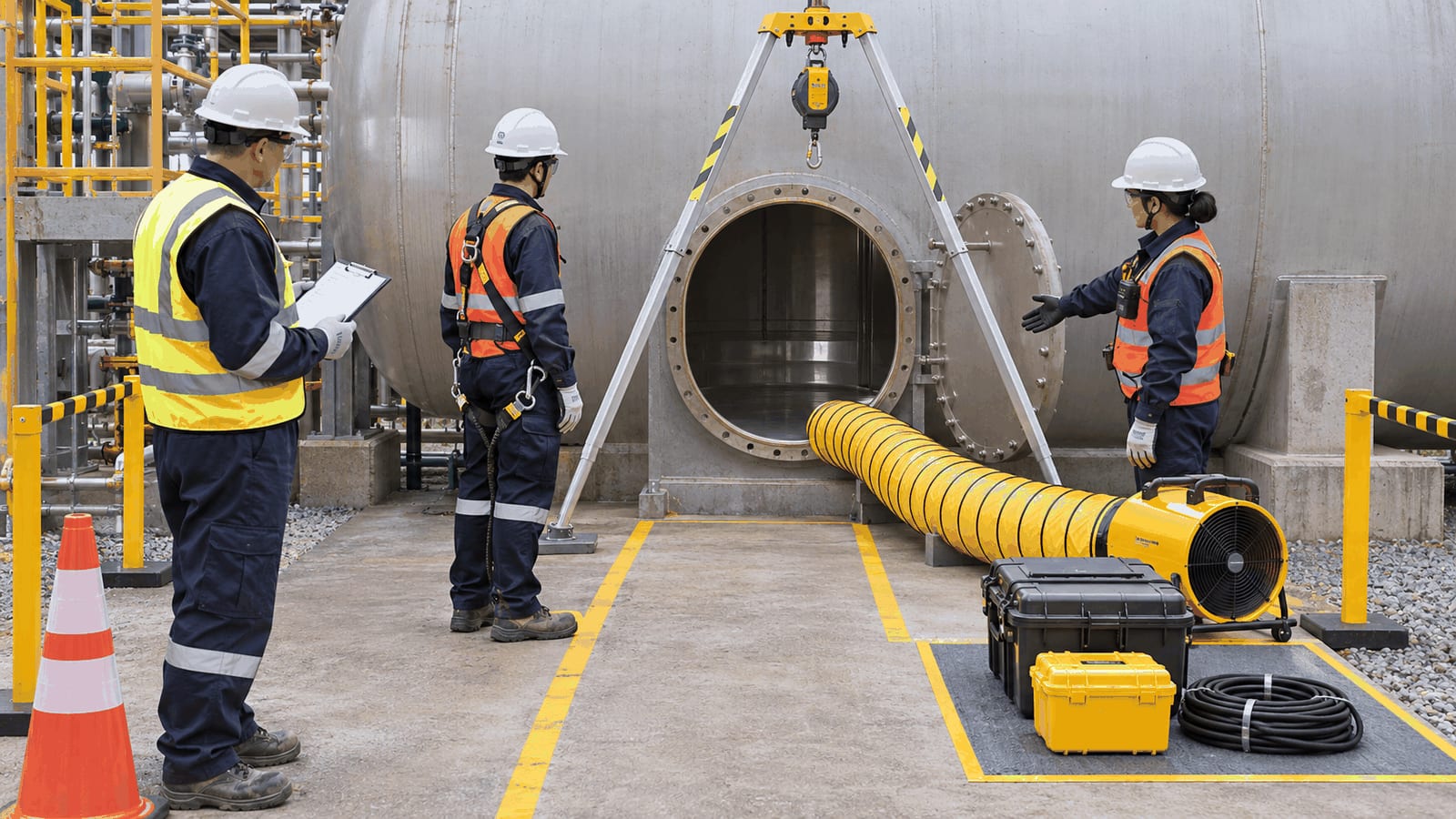
Map the route from staging area to work point. Identify the portal, ladder or access path, internal turns, baffles, elevation changes, and the location where the entrant will stand or kneel. Determine where each temporary service will run and how it will be protected from sharp edges, heat, moving parts, water, and traffic. The layout should keep the evacuation path and retrieval route clear.
Set limits for material accumulation. Cleaning, scraping, cutting, and repair can produce scale, sludge, insulation, spent absorbent, packaging, bolts, and scrap. Decide how often material will be removed, what containers are suitable, and how those containers will move through the portal. The plan should prevent piles from becoming unstable or blocking low points, drains, or walking surfaces.
Control small objects. Nuts, electrodes, blades, rags, and hand tools can fall to lower levels, enter machinery, or become difficult to recover. Tool bags, lanyards where appropriate, magnetic trays, parts counts, and closed containers can support accountability. Selection should consider dropped-object, entanglement, and compatibility hazards rather than applying one method everywhere.
Check walking and working surfaces. Liquids, residue, condensation, loose scale, hoses, and uneven floors can create slips and trips. Use task-appropriate cleanup and containment methods. Do not introduce a cleaning chemical, absorbent, or powered device without evaluating its atmospheric, compatibility, and waste implications.
Protect the portal. The opening should not become a shelf for tools or a crossing point for uncontrolled materials. Items at the rim can fall onto entrants. Services routed through the opening should be organized so they do not damage one another, interfere with communication, or force entrants against a pinch point.
Preserve visibility and communication. Equipment should not block the attendant's view where visual observation is part of the plan or cover fixed signs and labels. Noise-generating tools, ventilation, and movement of material may require a tested communication method. A housekeeping pause is appropriate if the attendant can no longer maintain reliable contact.
Recheck the layout whenever the task changes. The equipment for inspection may be very different from the equipment for repair. Adding a pump, grinder, coating pot, or welding lead can change hazards and congestion. The entry supervisor should determine whether the permit remains valid and whether controls or rescue arrangements need revision.
Which Training Fits This Situation
Authorized entrant training should cover the approved layout, equipment limits, waste route, tool accountability, and stop-work triggers. Entrants need to know that moving a hose or retrieval line for convenience can undermine the plan. They should report damaged routing, blocked access, unstable material, or a missing tool immediately.
Attendant training should address what can be observed from outside: items accumulating at the portal, services becoming tangled, entrants losing communication, waste transfers, and unauthorized equipment entering the space. The attendant should know who can correct the condition and when to order evacuation rather than entering or abandoning the post.
Entry supervisor training should connect housekeeping with permit verification. Before authorization, the supervisor can compare the planned inventory and layout with what is actually staged. During entry, the supervisor needs a process for approving changes and for suspending or canceling the permit when acceptable conditions cannot be maintained.
Workers who handle waste or operate lifting and transfer equipment need training appropriate to those tasks. Confined space training does not qualify an employee to handle hazardous waste, rig loads, perform electrical repairs, or manage chemicals. Role boundaries should be explicit so a cleanup need does not lead an unqualified employee into a different hazard.
Rescue training and drills should use representative clutter and services. The team can test whether a retrieval line remains clear, whether a stretcher fits the portal, and whether air lines or ducts must be moved before access. Any planned disconnection should account for what service it provides and whether removing it creates a greater hazard.
A pre-entry briefing should let workers walk the layout. Point out the clean access lane, tool staging point, waste container, service routes, and pause triggers. Ask entrants to describe how they will exit if visibility is lost or an alarm sounds. That conversation confirms that housekeeping expectations serve the emergency plan rather than a cosmetic standard.
Common Mistakes to Avoid
One mistake is placing every temporary service through the shortest part of the portal. The shortest route may cross the ladder, retrieval line, or entrant's shoulders. Layout should prioritize safe movement and equipment function, not only hose length.
Another mistake is waiting until the end of the job to remove debris. Accumulation can narrow the work area, cover hazards, increase combustible loading, and complicate exit. Set removal intervals or volume limits before work begins.
Crews may also bring extra tools inside to avoid repeated trips. The convenience can create clutter and make accountability harder. Stage backup equipment outside and transfer it through a controlled process.
It is unsafe to use the attendant as a general material handler when that duty interferes with monitoring. Assign support duties separately or pause entry during a transfer that requires the attendant's focused participation.
Another error is moving the retrieval line aside because it catches on work equipment. A snag indicates that the layout or rescue method needs reevaluation. The solution should preserve retrieval capability rather than defeat it.
Finally, some teams clean the space but ignore the staging area. A blocked portal, unstable pile, leaking container, or poorly placed vehicle outside can still obstruct rescue and evacuation. Housekeeping controls should extend from the internal work point to the external safe area.
Next Step
Choose one recurring entry and create a simple equipment-and-route sketch with input from entrants, the attendant, entry supervisor, and rescue service. Mark the portal, access path, retrieval system, ventilation, temporary services, tool staging, and waste route. Then conduct a dry setup before the next entry and correct conflicts while the space is empty. A ten-minute layout review can reveal obstructions that a generic permit checklist will not show.
Sources
Electronic Code of Federal Regulations, 29 CFR 1910.146 Permit-Required Confined Spaces: https://www.ecfr.gov/current/title-29/subtitle-B/chapter-XVII/part-1910/subpart-J/section-1910.146
OSHA, Confined Spaces Safety and Health Topics: https://www.osha.gov/confined-spaces
OSHA, Permit-Required Confined Spaces QuickCard: https://www.osha.gov/sites/default/files/publications/permit-required-confined-spaces.pdf
NIOSH, Confined Spaces and Safety Toolbox Talk: https://www.cdc.gov/niosh/publications/numbered/2026-109.html