Vehicle and generator exhaust can enter a vault, tank, or pit through ventilation equipment, turning clean-air placement into an entry-critical control.
Confined-space teams often focus on contaminants produced inside the space, yet an atmosphere can also be changed by equipment operating outside. A service truck idling beside a manhole, a portable generator powering a blower, a compressor near a tank hatch, or traffic moving through an adjacent lane can release combustion products where they are drawn into the opening or ventilation intake. Wind direction, building wakes, walls, grade changes, and temporary barriers can make the pathway difficult to see. Employers need a site-specific method to control external exhaust before entry and to detect changing conditions while employees remain inside.
This article provides general compliance-planning and training information, not legal advice or a substitute for a qualified hazard assessment. The employer must identify the hazards of each space and task, select acceptable entry conditions, provide required equipment, and maintain those conditions for the duration of entry. Atmospheric controls should be based on reasonably anticipated contaminants, applicable exposure requirements, equipment instructions, and actual field conditions.
Who This Affects
The issue affects municipal crews entering manholes, lift stations, meter vaults, and utility chambers; industrial teams entering tanks, pits, process vessels, and silos; contractors working in crawl spaces or below-grade mechanical areas; and construction crews entering confined spaces under Subpart AA. Entry supervisors, attendants, entrants, gas-monitor users, rescue personnel, traffic-control crews, facility operators, and equipment operators all influence whether exhaust stays outside.
The risk is not limited to gasoline vehicles. Diesel engines, propane-powered equipment, combustion heaters, pumps, welders, compressors, pressure washers, and portable generators can create exhaust. Nearby loading docks, emergency generators, building air discharges, or public traffic may add sources the entry contractor does not control directly. The host or controlling employer may need to coordinate shutdowns, relocation, barriers, or scheduling so the entry plan reflects the entire work area.
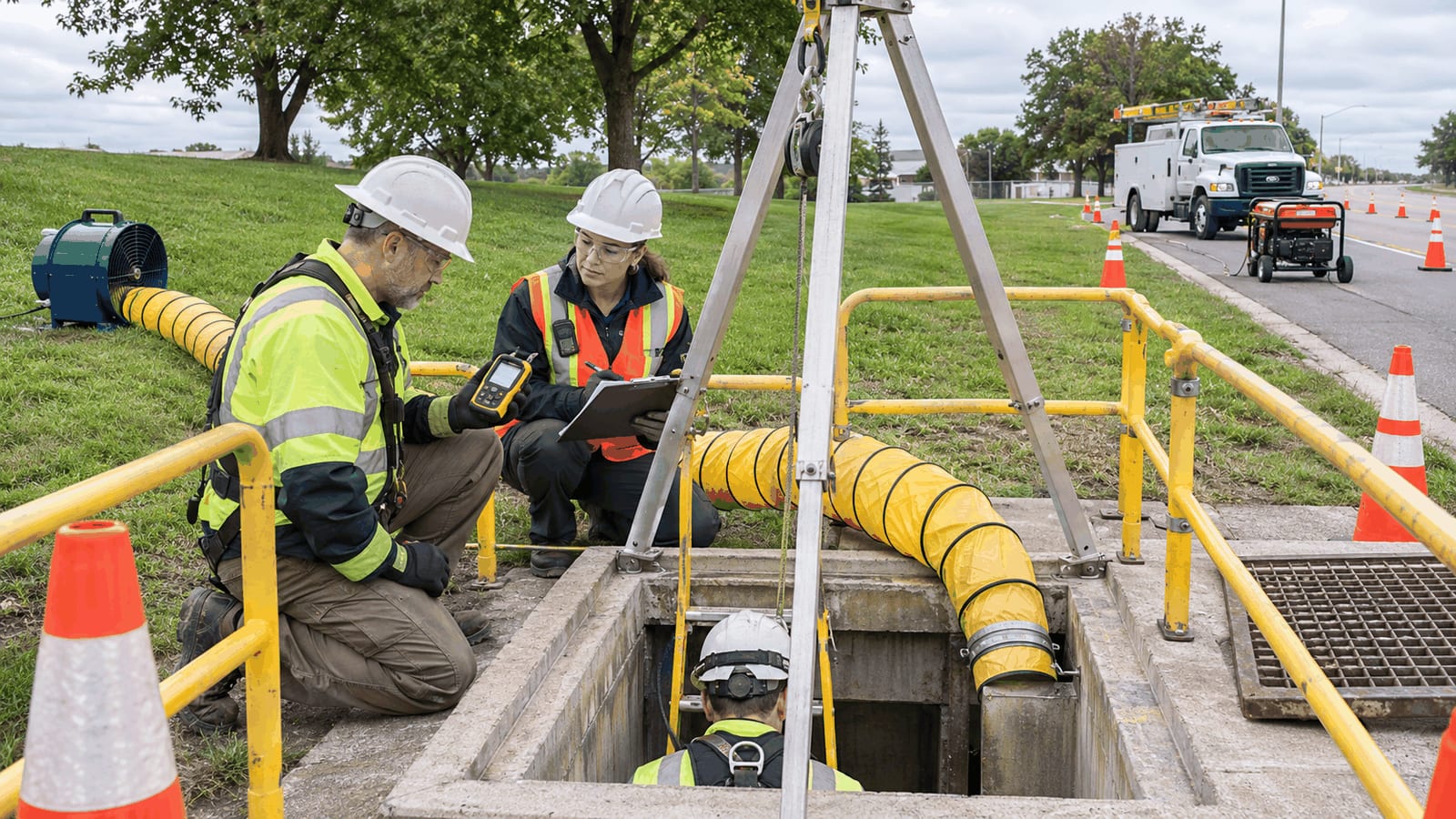
Supervisors should be especially cautious when the ventilation blower depends on a portable engine-powered generator. The equipment that supplies fresh air can become the contaminant source if the generator is placed near the intake. Long cords and remote placement may require planning, but convenience is not a reliable basis for locating combustion equipment. The clean-air source must remain clean as wind and traffic change.
The Confined Space Compliance Issue
OSHA's general industry permit-required confined-space standard requires employers to identify and evaluate hazards before entry, specify acceptable conditions, control atmospheric hazards, and verify that acceptable conditions are maintained. Under the alternate procedures for certain spaces, continuous forced-air ventilation must use air from a clean source and may not increase hazards. The standard also requires testing before entry and periodic testing as necessary. Full permit entry programs similarly require atmospheric testing or monitoring and ventilation as needed.
External exhaust can contain carbon monoxide, nitrogen oxides, particulates, and other contaminants depending on the fuel, engine, load, maintenance, and environment. A common four-gas instrument may include carbon monoxide, but its sensor selection does not prove that every exhaust-related hazard is covered. Cross-sensitivities, sensor ranges, response time, sample tubing, calibration, alarm settings, and the specific contaminants reasonably expected all matter. The employer should understand what the instrument measures and what it does not.
Air movement is part of the hazard evaluation. A blower intake placed upwind at setup can become downwind after a weather change or vehicle relocation. A wall or truck body can create recirculation. Exhaust can settle or travel along a grade, enter through a second opening, or be pulled into a space by mechanical airflow. Testing at the opening alone may miss conditions at the entrant's breathing zone, at a low point, or near the end of a ventilation duct.
The entry permit or alternate-procedure certification should reflect external sources when they are relevant. It should identify the controls, monitoring locations, ventilation arrangement, equipment restrictions, and evacuation criteria. A statement that ventilation is running is incomplete if the record does not show that the intake source is suitable and that operating conditions were checked. The entry supervisor should terminate or suspend entry when conditions no longer match the authorization.
What Employers Should Check
Begin with an exhaust-source survey around every opening and air intake. Look beyond the immediate barricade. Identify vehicles, generators, pumps, compressors, heaters, process vents, loading operations, traffic lanes, and emergency equipment that could operate during entry. Note fuel type, likely operating schedule, wind exposure, grade, walls, and alternate openings. Ask the host facility what can start automatically or be dispatched without notice.
Separate combustion sources from the opening and ventilation intake using distance, orientation, barriers, shutdowns, traffic controls, or relocation appropriate to the site. Do not rely on an arbitrary universal distance. The effective separation depends on source strength, wind, topography, structures, ventilation flow, and equipment instructions. Position exhaust outlets away from people and clean-air intakes, and prevent vehicles from idling in the controlled area.
Verify the ventilation path from source to entrant. The intake should draw from an uncontaminated location. Ducting should reach the area where employees are or will be present without short-circuiting air directly back out. Connections should be secure, bends should not collapse the duct, and the setup should not block access, retrieval, or traffic control. If ventilation stops, the entrant response should follow the permit and program rather than depending on someone noticing the blower sound.
Plan atmospheric testing for the space and expected exhaust sources. Test before entry using calibrated direct-reading equipment in the required order and monitor as necessary to ensure conditions remain acceptable. Sampling should represent the entrant's locations and account for stratification, remote sections, and changing tasks. Document instrument identification, bump-test or calibration status under the employer's procedure, sensor configuration, readings, times, locations, and alarms or unusual trends.
Check changes outside during entry. The attendant should watch for a truck arriving, a generator being moved, traffic backing up, a wind shift, a blower intake becoming obstructed, or an emergency engine starting. The attendant does not need to calculate dispersion, but must understand the prohibited conditions and communication method. The permit should state who can order a source shut down and when entrants must exit.
Coordinate rescue planning with the same external hazards. A rescue team approaching the opening could be exposed to exhaust, traffic, or equipment that also affected the entrant. Ventilation and monitoring needed during rescue should not depend on an engine placed where it worsens the atmosphere. Rescue access, retrieval equipment, traffic barriers, and clean-air equipment should remain available when the work zone changes.
Review the entry afterward when exhaust affected readings, an alarm occurred, a source entered the area, or the ventilation arrangement proved difficult to maintain. Preserve the permit and monitoring record under the program. Determine how the source reached the space, whether equipment or traffic layout should change, and whether procedures or training need revision before the next similar entry.
Which Training Fits This Situation
Awareness training helps employees who work near permit spaces recognize that parking, idling, or starting combustion equipment can affect an entry even if they never cross the opening. Facility drivers, traffic-control workers, and maintenance dispatchers should know the restricted area and whom to contact before bringing equipment close. Site orientation can communicate controls that general confined-space training cannot predict.
Permit-required entrant, attendant, and entry-supervisor training should address the actual program and assigned duties. Entrants need alarm and exit criteria. Attendants need to recognize external changes, maintain communication, and summon help without taking on conflicting duties. Entry supervisors need to verify ventilation, testing, source control, rescue availability, and permit completeness before authorizing entry and when responsibility changes.
Atmospheric-testing training should go beyond turning on a monitor. Users need to understand sensor selection, limitations, sampling order, response time, tubing, calibration checks, alarm response, documentation, and when a reading or trend requires evacuation and reevaluation. Ventilation training should cover clean-air intake selection, duct placement, airflow to the work zone, equipment inspection, power loss, and contamination pathways.
The appropriate course may therefore combine confined-space awareness, role-specific permit-required confined-space training, entry-supervisor instruction, atmospheric-testing practice, and rescue training for the designated personnel. Training supports the employer's program, but it does not certify that a particular setup is safe. The employer still has to evaluate the space, equipment, crew, and outside environment for each entry.
Common Mistakes to Avoid
One mistake is placing the generator beside the blower because the supplied cord is short. This creates a direct conflict between power convenience and clean-air control. Use equipment and a layout that allow the source to be positioned safely according to manufacturer instructions and the hazard assessment. Do not improvise electrical arrangements or extend cords beyond their ratings.
Another mistake is testing once, recording acceptable values, and treating the atmosphere as fixed. Vehicles arrive, engines cycle, wind shifts, and ventilation paths change. Monitoring frequency and location should reflect the hazards and entry conditions. An alarm, unexpected trend, ventilation failure, or prohibited outside change requires the response defined by the program, including immediate exit when a hazardous atmosphere is detected under applicable alternate procedures.
A third mistake is assuming a four-gas meter detects every relevant exhaust component. The instrument only measures the sensors installed and functioning within their capabilities. The employer should identify expected contaminants and consult reliable technical information when selecting equipment. Odor is not an adequate substitute for monitoring because some contaminants may not be recognized reliably by smell.
A fourth mistake is directing a tailpipe away from the opening while leaving the vehicle in a recirculation zone. Exhaust can travel around barriers or be pulled toward the intake. Source control, separation, airflow observation, and monitoring work together. A cone placed beside a generator does not control its emissions.
A fifth mistake is omitting outside operators from coordination. A delivery driver or facility employee may not know an entry is underway. Barriers, signs, dispatch notes, radio coordination, and host-employer procedures can prevent an engine from being started or parked in the controlled area. The plan should work during breaks and shift changes, not only while the entry supervisor is standing at the opening.
Next Step
Walk the next planned entry site before equipment is staged. Map the opening, alternate openings, clean-air intake, likely exhaust sources, traffic routes, walls, grades, and rescue access. Decide which sources will be shut down, moved, restricted, or monitored, and write those controls into the entry documents. Then brief every role that can change the outside environment. A confined-space atmosphere is influenced by more than the space itself, and clean-air planning remains active until the last entrant is out.
Sources
OSHA, 29 CFR 1910.146, Permit-Required Confined Spaces: https://www.osha.gov/laws-regs/regulations/standardnumber/1910/1910.146
OSHA, 29 CFR 1926 Subpart AA, Confined Spaces in Construction: https://www.osha.gov/laws-regs/regulations/standardnumber/1926/1926SubpartAA
OSHA, Permit-Required Confined Spaces QuickCard: https://www.osha.gov/sites/default/files/publications/OSHA3214.pdf
CDC/NIOSH, Confined Spaces and Safety Toolbox Talk: https://www.cdc.gov/niosh/publications/numbered/2026-109.html