Confined space PPE must match identified hazards without creating new problems for movement, communication, monitoring, retrieval, or rescue operations.
Personal protective equipment is only one part of a confined space entry system. A respirator, chemical suit, hearing protection, face shield, fall-arrest harness, or protective glove can reduce a specific exposure, yet the same item can restrict mobility, interfere with instruments, obscure communication, add heat stress, or complicate retrieval. Employers therefore need to evaluate the complete equipment combination against the space, task, entrant, permit conditions, and emergency plan before authorizing entry.
OSHA's permit-required confined space standard requires employers to identify and evaluate hazards before employees enter, establish acceptable entry conditions, isolate the space, control atmospheric hazards, and provide required equipment at no cost to employees. The standard lists personal protective equipment among the equipment that may be necessary for safe entry and requires proper maintenance and use. PPE selection should follow hazard control, not replace feasible isolation, ventilation, guarding, or other primary controls.
Who This Affects
This issue affects employers whose teams enter tanks, pits, vaults, sewers, process vessels, crawl spaces, silos, and similar spaces where hazards and physical constraints interact. It is particularly important for maintenance work involving chemicals, coatings, cleaning agents, biological material, hot work, abrasive tasks, energized equipment, sharp surfaces, or potential respiratory hazards.
Entry supervisors need enough information to confirm that required equipment is present, compatible, inspected, and reflected on the permit. Authorized entrants need to know how the selected PPE changes their movement, visibility, heat load, dexterity, and exit time. Attendants need to recognize distress when face coverings, hearing protection, or protective clothing make normal communication harder. Rescue services need to know what entrants are wearing because bulky clothing, air lines, or harness attachments can affect access and removal.
Safety professionals, industrial hygienists, respiratory-protection program administrators, equipment specialists, and facility owners may all contribute. Their work must connect at the entry point. A technically correct respirator choice can still fail as an entry solution if its hose snags, its facepiece prevents reliable radio use, or its service duration does not support the planned task and exit margin.
The Confined Space Compliance Issue
The compliance issue begins with hazard evaluation. Employers should identify atmospheric, chemical, physical, mechanical, electrical, thermal, biological, engulfment, and configuration hazards, then determine the controls needed to eliminate or control them. PPE should be selected for the residual exposure after isolation and engineering or administrative controls are considered. A generic entry kit is not a substitute for a space-specific and task-specific evaluation.
Compatibility has several dimensions. Equipment must be compatible with the hazard, such as glove material suitable for the chemical handled. Individual items must also be compatible with each other. Safety glasses should not break a respirator seal. A face shield should fit without pushing a hard hat or facepiece out of position. Hearing protection should not make the communication method unreliable. Protective clothing should not cover monitor inlets, block harness attachment points, or prevent an entrant from operating an escape device.
The equipment must fit the geometry. A bulky self-contained breathing apparatus may not pass through a narrow opening or around internal obstructions. A supplied-air line can become entangled with ladders, mixers, piping, or retrieval lines. Chemical-resistant suits can limit crawling or climbing. Oversized gloves can reduce grip on fixed ladders or tools. The employer must evaluate the route in, the work location, the route out, and the space needed for rescue, not only the exposure at the task point.
The combination must also remain workable over time. PPE can increase metabolic load and heat stress. Facepieces can fog. Gloves can fill with sweat or lose dexterity. Batteries and cartridges have limits. Protective garments can tear on edges. The permit and work plan should include monitoring, breaks, replacement criteria, and exit triggers that reflect these realities.
What Employers Should Check
Start with a written equipment matrix tied to the hazard assessment. For each task, record the hazard, primary control, residual exposure, PPE, limitations, inspection method, replacement criteria, and person responsible. Avoid copying yesterday's permit without checking whether the product, process, cleaning chemical, temperature, or work method has changed.
Check respiratory protection separately and carefully. The employer's respiratory-protection program should address medical evaluation, fit testing, selection, use, maintenance, and training where respirators are required. Confirm that the atmosphere has been characterized sufficiently to choose the appropriate protection and that the respirator does not conflict with other equipment. Facial hair, eyewear, hoods, and communication devices can affect a tight-fitting facepiece seal.
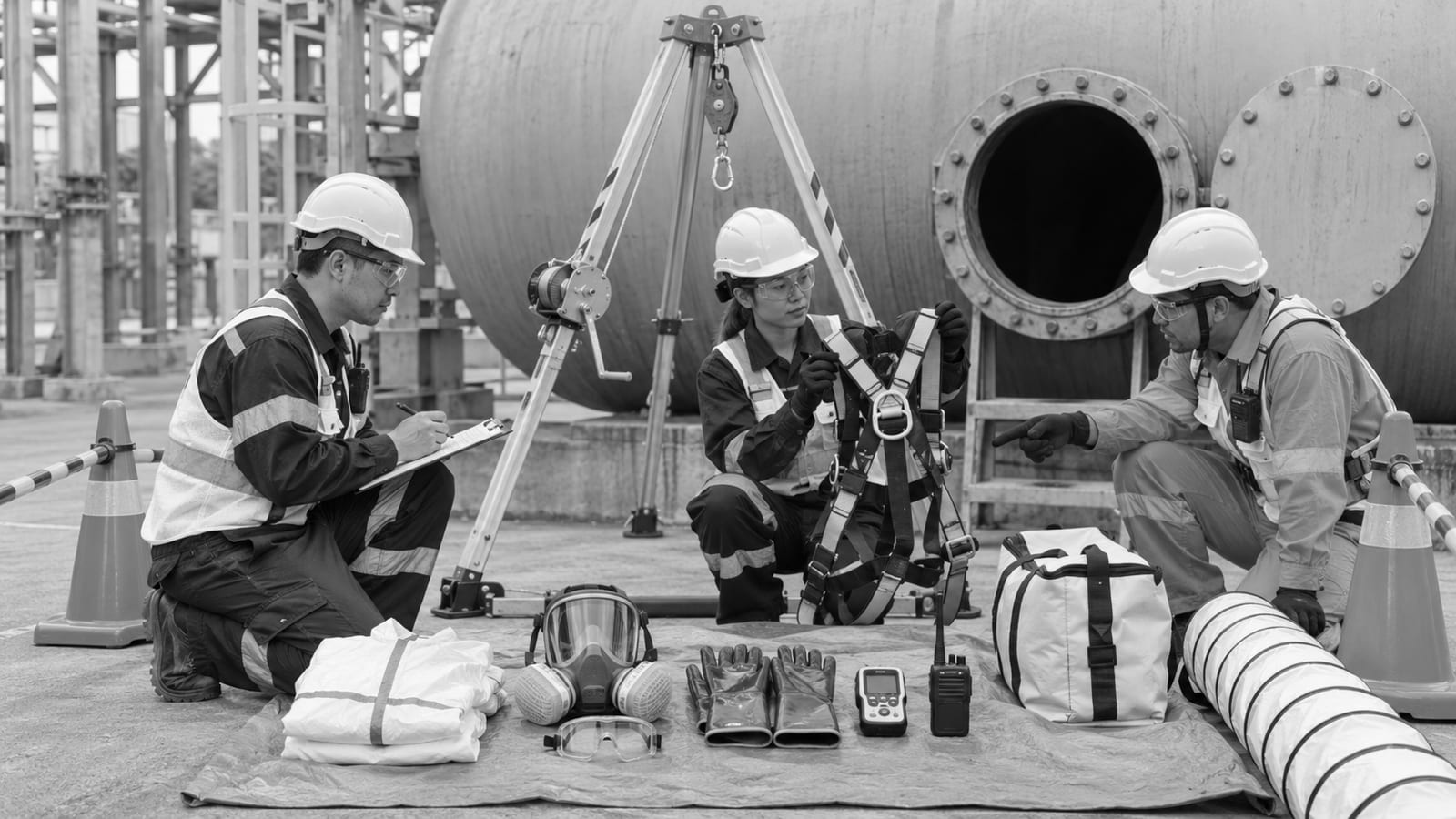
Inspect the full worn configuration before entry. Have the entrant don the clothing, harness, helmet, eye protection, hearing protection, gloves, footwear, monitor, lighting, radio, respirator, and escape equipment expected for the job. Verify attachment points remain accessible, monitor sensors are exposed, controls can be reached, and no strap or garment interferes with another item. A tabletop check cannot reveal every conflict that appears when equipment is worn together.
Test movement through a representative route when practical. The entrant should be able to climb, turn, kneel, reach, and pass through the opening without damaging equipment or losing protection. If the actual opening is the only representative route, conduct the check under controlled pre-entry conditions without exposing the entrant to the space hazards. Confirm that emergency removal through the same opening remains feasible.
Test communication with the PPE in place. Speech through a respirator or hood can be difficult to understand. Hearing protection and machinery noise may mask radio messages or alarms. Establish primary and backup communication methods, agreed signals, and a clear evacuation response when communication is lost. The attendant should be able to distinguish routine work noise from a call for help.
Coordinate atmospheric monitoring. Decide where the entrant's personal monitor will be worn and whether protective garments could impede sampling. Verify that alarms remain visible, audible, or tactile under the selected PPE. If remote sampling lines, pumps, or probes are used, keep them separated from air lines and retrieval systems as far as practical to reduce tangles and mistaken connections.
Coordinate retrieval and rescue. Confirm that the harness is rated and configured for its intended function, that retrieval connections remain accessible, and that clothing does not conceal or obstruct them. Review whether air lines, cooling lines, communication cables, or tool leads could cross the retrieval path. Rescue personnel should understand how the PPE affects patient packaging, decontamination, medical care, and the time needed for removal.
Finally, check maintenance and condition. PPE should be clean, inspected, stored appropriately, and within any applicable service-life or test limits. Damaged gloves, cracked face shields, contaminated clothing, discharged batteries, worn harnesses, and incomplete respirator assemblies should be removed from service. Record the inspection in the manner required by the employer's program and entry documentation.
Which Training Fits This Situation
Confined space awareness training fits employees who may encounter spaces but are not authorized to enter. They should recognize boundaries, warning signs, and the prohibition on unplanned entry. Awareness alone does not prepare a worker to select or use task-specific PPE in a permit entry.
Authorized entrant training should cover the hazards of the space, the purpose and limits of each item, pre-use checks, proper donning, communication, alarms, symptoms of exposure, exit triggers, and the effect of PPE on movement. Entrants should practice with the actual combination they will wear, not only view individual components in a classroom.
Attendant training should include how PPE changes entrant behavior and communication. An attendant should know when a garbled message, repeated radio loss, abnormal breathing, reduced coordination, or failure to respond requires an evacuation order. The attendant must also understand that entering the space to adjust equipment or help an entrant is not permitted unless the attendant has been properly relieved and authorized under the entry and rescue procedures.
Entry supervisor training should emphasize verification. The supervisor should be able to connect the hazard assessment, permit, atmospheric results, control measures, PPE matrix, rescue plan, and entry conditions. Supervisors need authority to withhold authorization when equipment combinations have not been tested or when a last-minute task change introduces a new exposure.
Specialized training may also be required. Respirator users and administrators need training under the respiratory-protection program. Employees exposed to chemicals need hazard communication. Fall protection, electrical safety, hearing conservation, chemical protective clothing, and rescue duties can each create additional training needs. The employer should map these requirements to roles rather than assuming one confined space course covers every equipment competency.
Common Mistakes to Avoid
One mistake is choosing PPE from a standard list without checking the actual task. A tank inspection and a solvent cleaning job in the same vessel can require different controls. Another is allowing PPE to become the main control while energy sources, process lines, atmospheric hazards, or moving parts remain insufficiently isolated.
A third mistake is testing equipment one item at a time. Gloves may work with the chemical, and a respirator may fit during fit testing, yet the combined hood, eyewear, facepiece, helmet, and hearing protection can create interference. Full-ensemble checks expose these conflicts before the entrant is committed inside the space.
Another mistake is overlooking the opening and travel path. Equipment that protects at the work location may prevent passage through a manway or become caught behind internal piping. Teams sometimes discover this only after an entrant is halfway inside. A route assessment and movement rehearsal can reveal the problem earlier.
Employers also make errors when they fail to update rescue planning. Adding supplied air, chemical clothing, or a different harness changes the rescue problem. The rescue service must be informed and capable of managing the new configuration. A retrieval line alone does not resolve entanglement, obstruction, medical, atmospheric, or decontamination challenges.
Finally, do not ignore wearer feedback. Entrants who report fogging, restricted movement, poor radio clarity, heat strain, pressure points, or difficulty reaching controls are identifying system weaknesses. Those reports should trigger evaluation and correction, not pressure to continue.
Next Step
Before the next entry, select one representative task and conduct a full-ensemble compatibility review. Put the actual PPE, instruments, communication devices, harness, and work tools on the entrant. Test movement, alarms, communication, retrieval connections, and exit timing. Record conflicts and revise the permit, equipment matrix, or rescue plan before authorization.
This review turns PPE from a collection of individually approved items into a coordinated entry system. The goal is not simply to wear more equipment. It is to ensure each control works with the others, remains usable in the space, and supports a prompt exit or rescue if conditions change.