
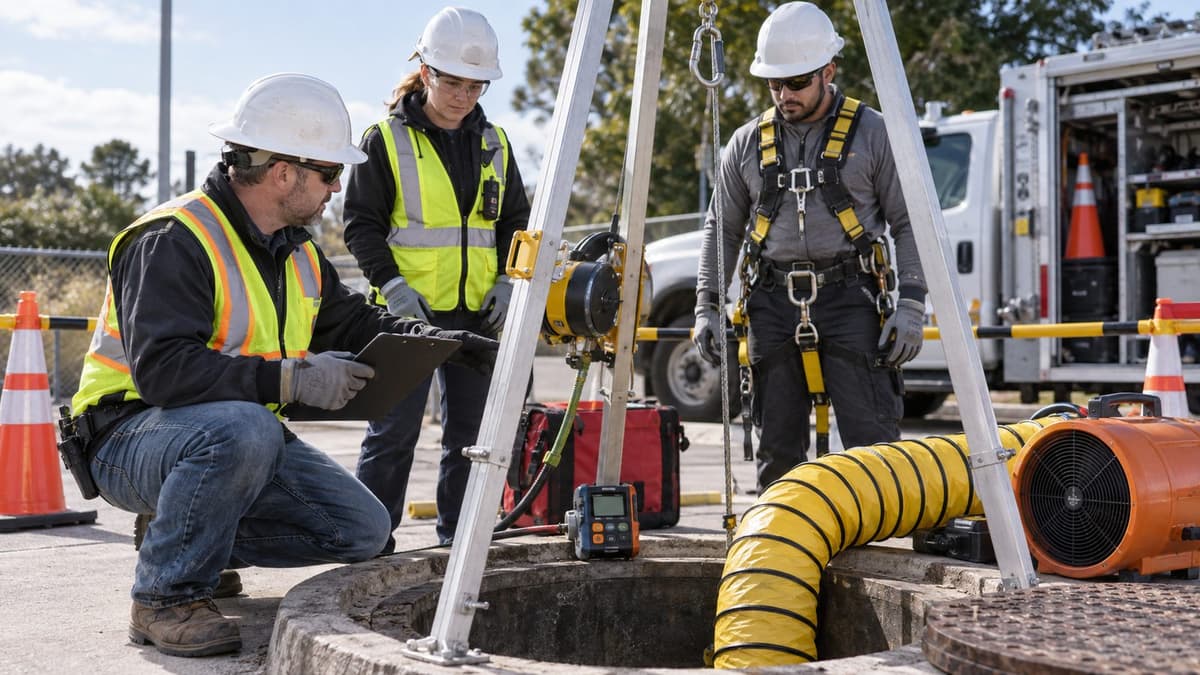
Contractors who enter tanks, pits, vaults, crawl spaces, process areas, utility rooms, and other limited-access spaces inside active facilities often face a confusing question: which confined space training is enough when the work site belongs to someone else? The answer depends on the space, the hazards, the employer roles, and the duties assigned to each worker. A certificate of completion can support readiness, but it does not replace site-specific evaluation, coordination, permits, rescue planning, and employer control.
This topic matters for maintenance contractors, construction crews, environmental service providers, utility technicians, cleaning contractors, mechanical firms, and facility managers who bring outside teams into occupied or operating buildings. A contractor may be highly skilled at the task itself and still need confined space training that matches entry duties. The host employer may know the building. The contractor may know the work. The entry team needs enough shared understanding to coordinate safely before anyone crosses the opening.
Who This Affects
This issue affects employers that send workers into client facilities and the facility owners or managers who control the site. Examples include mechanical contractors entering air handling units, plumbers working in pits, utility crews entering vaults, cleaning teams entering tanks, construction crews cutting into crawl spaces, and maintenance providers servicing equipment in areas with restricted entry or poor ventilation.
It also affects EHS managers, operations managers, project managers, entry supervisors, attendants, entrants, and competent persons who must decide what information must be exchanged before work begins. The most important question is not who owns the building. The important question is who controls the hazards, who directs the entry, who provides rescue arrangements, who verifies atmospheric conditions, and who has authority to stop work.
Small contractors can be especially exposed because one person may carry several responsibilities. A foreman may coordinate with the facility, supervise the job, and act as entry supervisor. A technician may be trained as an entrant on one project and as an attendant on another. Training should help these teams understand role boundaries before the pressure of the job blurs them.
The Confined Space Compliance Issue
Confined space rules for construction and general industry are built around identifying spaces, evaluating hazards, assigning roles, and controlling entry. Active facilities add coordination challenges. A process may be running nearby. A ventilation system may change during the shift.
Chemicals may be stored in adjacent rooms. Traffic, noise, heat, cleaning products, or mechanical energy can affect the space. The contractor cannot assume the facility's normal routine is safe for entry work.
Permit-required confined spaces can involve hazardous atmospheres, engulfment hazards, inwardly converging walls, sloped floors, or other serious safety hazards. Non-permit confined spaces may still need awareness, communication, and monitoring if conditions change. Contractors need training that helps them recognize when a space classification, permit, or control plan deserves a second look.
Coordination is also a compliance issue. The host employer and contractor must exchange information about known hazards, entry precautions, operations near the space, and any incidents or problems during entry. If multiple employers are present, communication becomes even more important. Training helps supervisors ask practical questions instead of relying on assumptions from a previous job.
No online course can certify a facility, approve a permit, or make a hazardous space safe by itself.
OSHA-aligned training supports employer compliance by giving workers and supervisors the knowledge to participate in the employer's confined space program. The employer still needs site-specific procedures, equipment, rescue arrangements, and hands-on practice where required by the work.
What Employers Should Check
- Identify whether each work area is a confined space and whether it is permit-required for this task.
- Confirm who is acting as entrant, attendant, entry supervisor, competent person, host contact, and controlling employer when applicable.
- Review atmospheric testing, ventilation, isolation, lockout, blanking, cleaning, draining, and other hazard controls before entry.
- Confirm the rescue plan is realistic for the space, location, equipment, and response time.
- Make sure contractors receive site-specific information about known hazards and operating conditions near the space.
- Verify training records match the assigned role, not only the employer's general training policy.
- Stop and re-evaluate if the job scope, atmosphere, ventilation, energy source, or facility operation changes.
The checklist should be reviewed before mobilization when possible. Waiting until the crew is standing at the opening creates pressure to accept incomplete information. A better process asks for space inventories, permits, drawings, prior test results, chemical information, and rescue expectations early enough to adjust staffing and training.
Which Training Fits This Situation
Awareness training can help workers and managers recognize confined spaces, understand warning signs, and know when not to enter. It is useful for staff who work near spaces or support projects without serving as entrants. Permit-required entry training is more appropriate for workers who may enter permit spaces or support entry operations.
Entry supervisor training supports the person responsible for confirming that permit conditions are met, required tests and procedures are complete, and entry is terminated when conditions require it.
Attendant and entrant training should match the specific duties workers perform. Competent Person training can be important in construction settings where the employer needs someone able to identify hazards and take prompt corrective measures.
For contractors working inside active facilities, a multi-role plan often works best. One worker may need entrant training, another attendant training, and the foreman supervisor training. Facility managers may need awareness or supervisor-level understanding so they can coordinate with outside employers without taking on duties they are not prepared to perform.
Confined-space.com training options can support these role-based decisions with OSHA-aligned course content and certificates of completion. Employers should pair that training with site-specific briefings, equipment practice, rescue planning, and facility coordination before authorizing entry.
Contractors should also decide how refresher training will be triggered. A new type of space, a different facility process, a near miss, a permit error, a rescue-plan change, or a long gap between entries can all justify retraining or at least a structured briefing. The point is to connect training to actual entry risk instead of treating it as a calendar-only requirement.
Active facilities also require careful handoff at the end of the job. The contractor should report any hazards encountered, unexpected atmospheric readings, equipment issues, interrupted ventilation, or changed conditions to the host contact. Training should make that closeout step feel normal because the next crew may depend on information learned during the current entry.
Common Mistakes to Avoid
One common mistake is assuming that because a contractor has worked in similar facilities, the next space has the same hazards. Another is treating the host employer's permit form as a substitute for the contractor's own understanding of duties. A permit is only useful when the people using it understand the hazards, controls, and conditions behind it.
A second mistake is training only the entrants. The attendant and entry supervisor are central to safe entry. If those roles are weak, the entrant may have no reliable support outside the space.
Contractors should also avoid assigning rescue responsibilities casually. Rescue requires planning, equipment, capability, and practice. Calling emergency services without confirming feasibility may not be enough.
Another mistake is ignoring work that changes the space. Welding, cleaning, coating, draining, pumping, pressure washing, or using gas-powered equipment can create new atmospheric or physical hazards. Training should help crews recognize that the classification and permit conditions can change during the job.
Next Step
Before a contractor enters a confined space inside an active facility, employers should map the roles, confirm the space classification, review the expected hazards, and choose training that fits each duty. The right next step is usually a role-based training plan supported by site-specific coordination. That approach helps contractors and facility teams work from the same safety expectations before entry begins.
A simple training matrix can make the decision easier. List each space type, likely hazard, worker role, required equipment, permit expectation, rescue arrangement, and responsible supervisor. Then compare that matrix to current training records. Gaps become visible before mobilization, which is far better than discovering them while the entry team is waiting at the opening.
Employers should also keep training records close to job planning. If records are stored in one office and entry decisions happen in the field, supervisors may rely on memory. A current roster of trained entrants, attendants, supervisors, and competent persons helps project managers staff the work correctly and avoid assigning a worker to a role that the worker has not been prepared to perform.
That roster should be reviewed whenever the contractor adds temporary labor, changes shift coverage, or accepts emergency work at a facility. Confined space duties depend on preparation, not job title alone.