
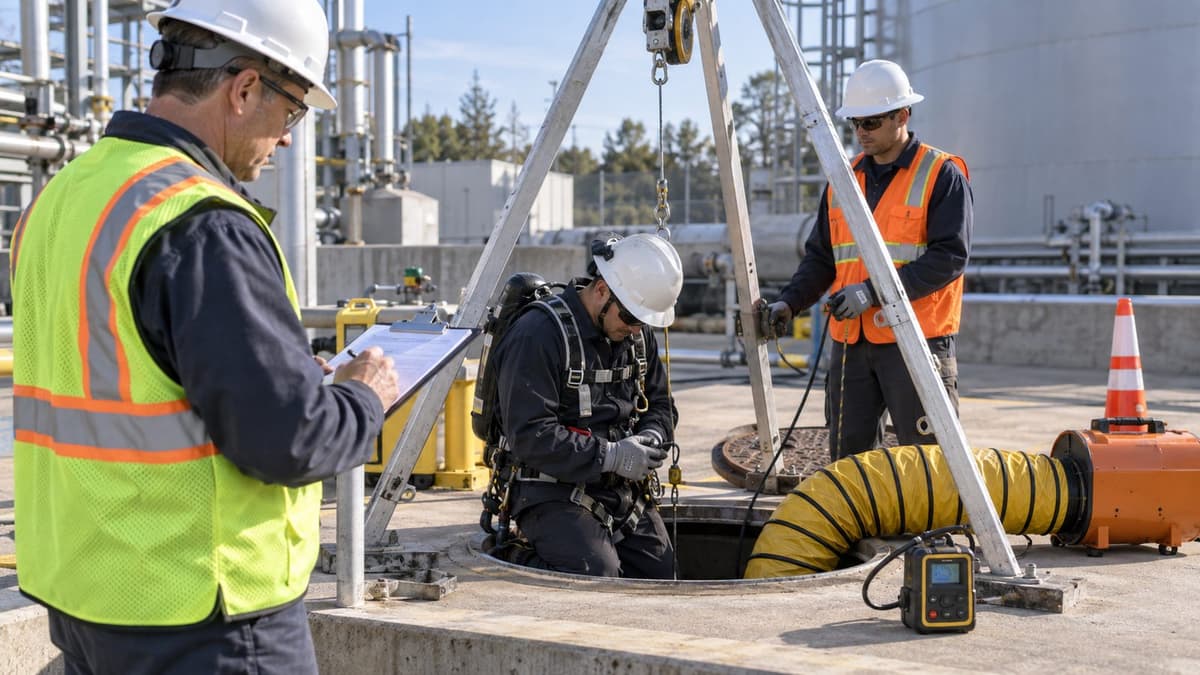
Many employers understand that a confined space atmosphere should be tested before entry. The harder question is what happens after the first reading looks acceptable. A tank, vault, sewer, pit, vessel, or crawl space can change while work is underway because of welding, cleaning, sludge disturbance, nearby engines, chemical residues, ventilation changes, or the space's own configuration. Continuous monitoring is the practical answer for many permit-required entries, but only when workers understand what the monitor can and cannot do.
For EHS managers, supervisors, contractors, utilities, municipalities, and maintenance teams, this topic affects training choices. Entrants need to understand monitor alarms and evacuation expectations. Attendants need to know what readings mean and when to call the entry supervisor. Entry supervisors need to verify that atmospheric testing, ventilation, rescue planning, and permit conditions remain valid throughout the job. OSHA-aligned confined space training helps those roles work from the same playbook instead of treating the first test as the finish line.
Who This Affects
Continuous monitoring affects any employer that sends workers into spaces where hazardous atmospheres could develop or return during the task. Construction crews may enter manholes, utility vaults, lift stations, trenches connected to enclosed structures, or crawl spaces. General industry teams may enter tanks, mixers, pits, bins, silos, process vessels, or wastewater structures. Municipal crews may handle storm, sewer, and water infrastructure where oxygen deficiency, flammable gases, or toxic contaminants are credible concerns.
The topic also affects contractors working under a host employer's control. A cleaning contractor, inspection team, maintenance vendor, or construction subcontractor may rely on information from the owner, but the entry team still needs to understand the conditions of its own work. If the task can introduce fumes, disturb residues, consume oxygen, or change airflow, the first atmospheric test does not answer every later question.
Supervisors and competent persons are especially affected because they often decide whether a space is permit-required, whether alternate procedures may be used, and what controls are needed. They must be able to connect monitor readings to ventilation, isolation, lockout, communication, retrieval equipment, and rescue planning. A monitor alarm without a trained decision process can become noise. A trained team treats it as a signal to follow the permit and leave the space when required.
The Confined Space Compliance Issue
Confined space rules are built around the idea that hazards must be identified, controlled, and communicated before and during entry. For permit-required confined spaces, atmospheric hazards are a major concern because workers may not be able to smell, see, or feel the danger before it affects them. Oxygen deficiency, oxygen enrichment, flammable gases, vapors, hydrogen sulfide, carbon monoxide, solvents, and other airborne contaminants require testing with appropriate instruments and a plan for response.
The compliance issue is that testing must match the actual hazard. A single reading at the opening may not represent conditions deeper in the space. Stratified atmospheres can produce different readings near the top, middle, and bottom. Pockets of gas can move as ventilation starts. Sludge, scale, residues, or process materials can release contaminants after workers begin disturbing them. Hot work, coatings, cleaning chemicals, or combustion equipment can introduce new hazards. Without continuous or periodic monitoring, the entry team may miss the moment when conditions cross the permit limits.
Training is also part of the issue. A gas monitor is not a magic shield. Workers need to know calibration or bump test expectations based on employer policy and manufacturer instructions, sensor limitations, sampling methods, alarm settings, battery status, tubing or pump issues, and where the device should be placed during work. They also need to know who has authority to stop entry. If an entrant hears an alarm but thinks the attendant will decide later, the response can be delayed. If an attendant sees a reading drift but does not understand the permit limits, the hazard may be normalized.
For construction employers, confined space requirements under 29 CFR 1926 Subpart AA place strong emphasis on coordination and communication among controlling contractors, host employers, and entry employers. For general industry employers, 29 CFR 1910.146 sets requirements for permit-required confined spaces. The details differ by setting, but the training need is similar: the team must understand the space, the hazards, the controls, and the entry roles before work starts.
What Employers Should Check
- Which confined spaces could develop atmospheric hazards during the task, not only before the task begins.
- Whether the space has been evaluated as permit-required or non-permit, and who made that decision.
- Which gases or vapors are credible based on the space, previous contents, work method, nearby operations, and introduced products.
- Whether the monitoring instrument is appropriate for those hazards and has been maintained according to policy and manufacturer instructions.
- How the atmosphere will be tested before entry, including vertical and horizontal sampling where needed.
- Whether continuous monitoring is required by the permit, employer policy, hazard assessment, or task conditions.
- Where the monitor will be located during entry so it represents the entrant's breathing zone or the relevant hazard area.
- What readings, trends, or alarms require evacuation, ventilation changes, supervisor review, or permit cancellation.
- How ventilation will be verified, maintained, and protected from blocked ducts, power loss, or intake contamination.
- Whether retrieval, communication, attendant duties, and rescue arrangements remain effective if the atmosphere changes.
Employers should also check whether workers have role-specific training. Awareness training may help a broad group recognize confined space hazards, but permit-required entry training is needed for employees who perform entry duties. Supervisors need enough depth to verify permit conditions, authorize entry, and stop work. A competent person or qualified evaluator may need more advanced instruction when classifying spaces and selecting controls.
Training records should identify the course, date, topics, and worker role. A certificate of completion can support documentation, but it does not replace site-specific instruction. Workers still need to know the employer's equipment, permit forms, alarms, evacuation routes, communication methods, and rescue procedure for the specific space.
Which Training Fits This Situation
For workers who may encounter confined spaces but do not enter them, awareness training can help them recognize warning signs, report hazards, and avoid unauthorized entry. This is useful for maintenance helpers, laborers, utility support crews, and facility staff who work near tanks, pits, vaults, or crawl spaces.
For entrants, attendants, and entry supervisors, Permit-Required Confined Space Entry training is usually the better fit. It should explain the permit system, atmospheric testing, ventilation, continuous monitoring, communication, attendant responsibilities, retrieval equipment, and emergency response limits. Entrants need to know when to evacuate. Attendants need to know how to maintain accountability and summon rescue. Entry supervisors need to know how to verify conditions and cancel or suspend entry when requirements are no longer met.
Supervisor training is valuable when managers or foremen are responsible for scheduling work, assigning roles, reviewing permits, coordinating contractors, or auditing entries. They need a broader view than individual task steps. They must understand how employer responsibilities continue after online training, including equipment selection, written procedures, rescue coordination, and field verification.
Competent Person training may be appropriate in construction settings where someone must identify existing and predictable confined space hazards and take prompt corrective measures. That training should connect confined space evaluation to the realities of a construction jobsite, including changing work, multiple employers, and spaces that are created or altered as the project progresses.
Common Mistakes to Avoid
One common mistake is relying on a clean initial test while ignoring the work that will happen inside the space. Cleaning, grinding, welding, coating, sludge removal, or equipment operation can change the atmosphere. The entry plan should consider the task, not only the empty space.
Another mistake is placing the monitor where it is convenient instead of where it provides useful information. A device clipped near the opening may not represent the breathing zone of a worker deeper inside. Tubing length, pump function, sensor response time, and airflow patterns matter. Employers should follow equipment instructions and train workers on the actual setup they will use.
A third mistake is treating alarm response as optional. If the permit or employer procedure says evacuate at a certain alarm or reading, workers need to follow that instruction immediately. The purpose of monitoring is to create time to leave before exposure becomes an emergency. Arguing with the instrument from inside the space defeats that purpose.
Employers should also avoid assuming that online training alone completes the program. OSHA-aligned training can build role knowledge, but the employer must provide site-specific procedures, equipment instruction, rescue planning, and supervision. A certificate of completion supports documentation. It does not certify the employer's space or guarantee compliance by itself.
Next Step
If your team enters tanks, vaults, pits, sewers, vessels, or other spaces where the atmosphere can change, review your current entry process against the monitoring decisions above. Identify who needs Awareness training, who needs Permit-Required Entry training, who supervises permits, and who evaluates spaces on construction or maintenance work. Then match each role to the training that supports its actual duty.
Continuous monitoring works best when people know what the readings mean and what action is required. The right confined space training helps employers turn a gas monitor from a piece of equipment into part of a disciplined entry system.