
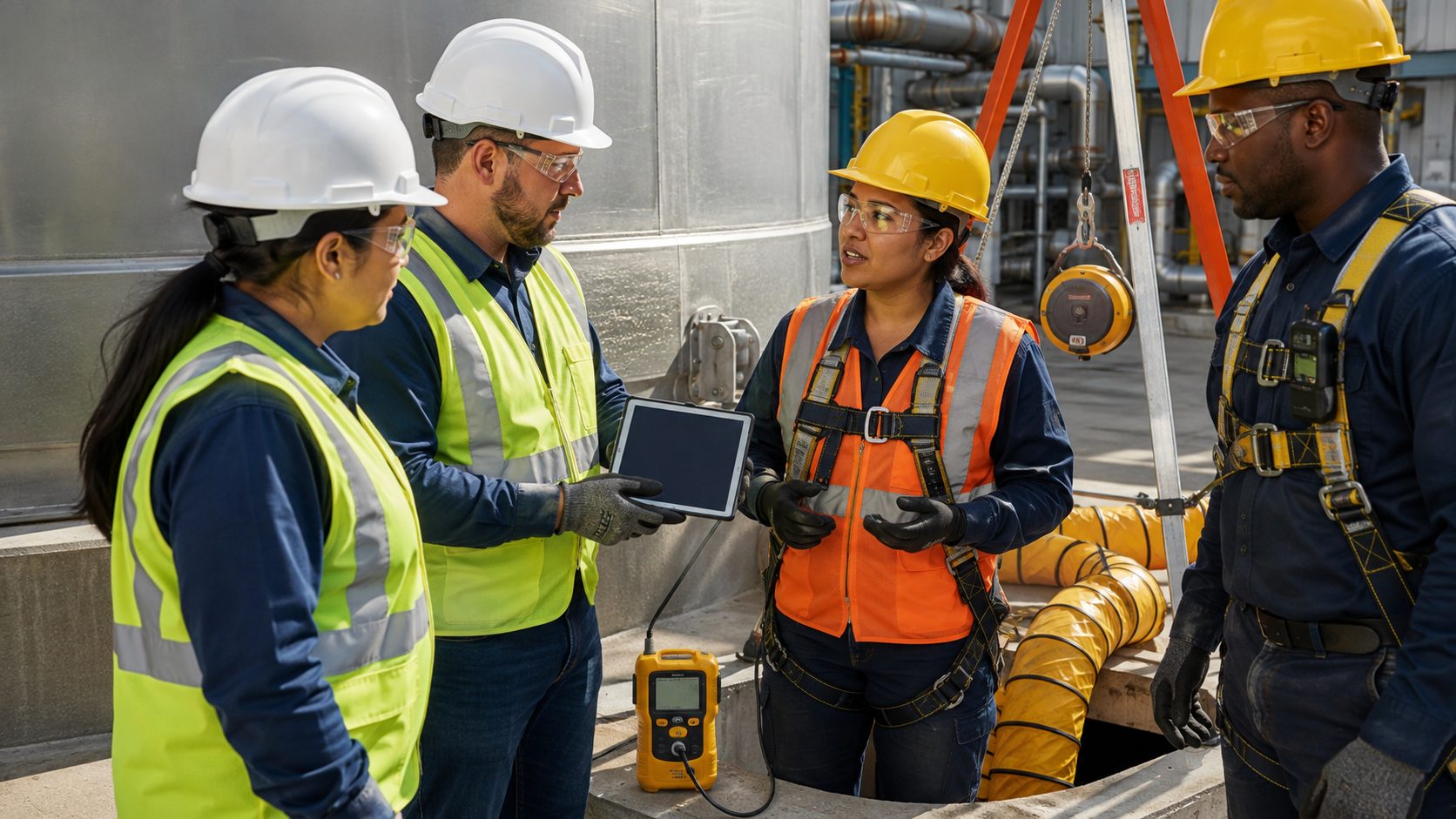
Search Intent: Employers with English and Spanish speaking workers often ask whether confined space training should be assigned by language, by job title, or by the specific duties each worker may perform. The practical issue matters because a crew can have the right equipment, the right permit form, and the right supervisor on paper, yet still lose control of the entry if entrants, attendants, and supervisors do not share the same understanding of hazards, instructions, and stop-work triggers.
Who This Affects
This issue affects construction employers, general contractors, specialty contractors, municipalities, utilities, manufacturers, facility maintenance teams, food and beverage plants, wastewater operations, tank cleaning contractors, property service companies, and any employer that sends mixed-language crews near tanks, vaults, manholes, pits, crawl spaces, silos, trenches, lift stations, utility structures, or process vessels.
It also affects safety managers who buy training for multiple jobsites, HR teams that manage completion records, supervisors who have to schedule entry work, and compliance coordinators who need documentation that makes sense during an audit or incident review. The training decision is rarely as simple as buying one course for everyone. Confined space work is role-based. A person who only recognizes the hazard and stays outside the entry operation does not need the same depth as an authorized entrant. An attendant needs more than basic awareness because that person watches conditions, keeps communication with entrants, controls access, and initiates the emergency response procedure when needed. An entry supervisor needs enough understanding to verify conditions, authorize entry, cancel entry when conditions change, and make sure the permit process is being followed.
Language access adds another layer. A worker may be highly skilled in construction, utilities, cleaning, maintenance, or production work, but still miss critical safety meaning if training is delivered in a language that does not match how that worker processes instructions under pressure. For confined space work, that gap is serious because the key decisions are often short, time-sensitive, and procedural: test before entry, ventilate as planned, maintain communication, leave when ordered, do not enter for rescue unless assigned and equipped, and stop the job when conditions are not controlled.
Employers with bilingual teams should treat language access as part of training fit, not as an afterthought. The goal is not just to show that a worker clicked through a course. The goal is to help each worker understand the hazards and duties attached to the role they may perform, then support that training with jobsite instructions, permits, briefings, and supervision that are clear to the actual crew.
The Confined Space Compliance Issue
Confined space training must match the employer's actual work. That is true whether the crew speaks one language or several. The employer still has to identify confined spaces, decide whether spaces are permit-required, assign roles, communicate hazards, control entry, and provide any site-specific instructions that the work requires. Online training can support that process by giving workers a consistent foundation, but it does not replace the employer's responsibility to apply the training to the workplace.
Mixed-language crews can struggle when training and field communication do not line up. A worker may complete a course in English but receive field instructions in Spanish. Another worker may learn a term in Spanish but see only English language labels on a permit, atmospheric monitor, or job hazard analysis. A supervisor may assume that bilingual employees will interpret safety instructions informally, even though those employees were not assigned or prepared for that responsibility. Over time, these gaps create inconsistent expectations.
For example, consider a maintenance team assigned to clean a process pit during a shutdown. The entrant may speak mostly Spanish, the attendant may be bilingual, and the entry supervisor may communicate mostly in English. If the training did not clearly define each role in a language the worker understands, the crew can become dependent on one bilingual employee to hold the entire system together. That may work during a calm planning meeting, but it is not a reliable control when gas readings change, ventilation is moved, a worker feels symptoms, or a rescue decision has to be made quickly.
The issue is not whether English or Spanish is better for a course. The issue is whether the worker can understand and apply the training. Employers should also avoid treating Spanish access as a separate or lower-level training track. A Spanish speaking authorized entrant still needs entrant-level content. A Spanish speaking attendant still needs attendant-level content. A Spanish speaking supervisor or competent person still needs training aligned with that role. The language should support comprehension of the same safety expectations, not reduce them.
Employers also need to be careful with how they describe training outcomes. Confined space courses can provide a certificate of completion and support an employer's OSHA-aligned training program, but the employer should avoid language that implies a government agency has certified, approved, endorsed, or accredited the private course or the worker. The employer remains responsible for determining whether the course fits the worker's assigned duties and whether additional site-specific, equipment-specific, rescue, or hands-on instruction is needed.
A strong language-access plan makes compliance more defensible because it connects course assignment, worker comprehension, jobsite communication, and records. It helps the employer answer practical questions: Which employees completed Awareness training? Which employees may enter a permit-required space? Which attendants understand their no-entry rescue role? Which supervisors can authorize or cancel entry? Which employees received training in Spanish? Which employees need bilingual field materials, translated permit briefings, or supervisor follow-up?
What Employers Should Check
Before buying or assigning confined space training for a mixed-language workforce, employers should slow down and map the training decision to the work. The following checklist can help safety and operations leaders choose a course path that supports real field performance.
- List the spaces workers may encounter. Include tanks, vaults, pits, manholes, crawl spaces, sewers, lift stations, silos, ductwork, process vessels, and other spaces that are large enough to enter, have limited entry or exit, and are not designed for continuous occupancy.
- Identify which spaces may be permit-required. Look for actual or potential hazardous atmospheres, engulfment hazards, inwardly converging walls, sloped floors leading to smaller areas, mechanical or energy hazards, chemical residues, poor ventilation, or other serious safety or health hazards.
- Separate awareness needs from entry duties. Some employees only need to recognize confined spaces, avoid unauthorized entry, and notify supervisors. Others may need to enter, serve as attendants, authorize permits, test atmospheres, supervise contractors, or evaluate construction confined spaces.
- Confirm each worker's preferred training language. Do not assume based on job title, seniority, or casual conversation. Ask which language best supports understanding of safety instructions and test questions.
- Match language access to role depth. Spanish access should be available where the worker needs it, but the course level still has to match the worker's duties. A Spanish language Awareness course is not a substitute for Permit-Required Entry training when the employee will act as an entrant or attendant.
- Review how field communication will work. Decide how entrants, attendants, and supervisors will communicate during normal entry, changing conditions, evacuation, and emergency response. Bilingual crews need a communication plan that does not depend on guesswork.
- Check whether supervisors understand the language issue. Supervisors should know which workers completed training in English or Spanish, what that training covered, and what follow-up instruction is needed before the job starts.
- Keep records clear. Completion records should show the course title, completion date, participant, and language when available. Records should help the employer explain why a given course was assigned to a given worker.
- Plan site-specific follow-up. Online training should be paired with the employer's space inventory, permit forms, atmospheric testing equipment, ventilation equipment, retrieval system, communication method, rescue plan, and jobsite rules.
- Avoid informal interpreter dependence. Bilingual employees can be valuable, but employers should not assume that an employee can translate technical safety instructions accurately under pressure unless that responsibility is planned, supported, and appropriate.
This review often reveals that a single purchase decision has to support several groups. A general contractor may need Awareness training for project managers and foremen who must recognize confined space concerns on a site. A municipal utility department may need Permit-Required Entry training for entrants and attendants who work around vaults and manholes. A plant maintenance team may need supervisor-level training for leads who authorize entries during shutdowns. A construction employer may need Competent Person training for people who evaluate confined spaces under construction work rules.
The best course plan is the one that helps the employer say, with evidence, that each worker received training aligned with the work they may actually do and in a language that supports comprehension.
Which Training Fits This Situation
For mixed-language crews, start with the job duties and then choose the language version that helps the worker understand those duties. That order matters. Language access improves training effectiveness, but it does not replace role selection.
Awareness training fits employees who need to recognize confined spaces and understand why unauthorized entry is dangerous. This can include laborers, maintenance helpers, project managers, estimators, site visitors, warehouse workers, janitorial teams, and supervisors who do not authorize or perform entry but need to know when a confined space issue should be escalated. For Spanish speaking employees, Spanish access can help make basic recognition more reliable: what a confined space is, why some spaces require permits, and why a worker should not enter without authorization.
Permit-Required Confined Space Entry training fits workers who may serve as authorized entrants, attendants, or entry supervisors in permit-required spaces. This course path should address role responsibilities, permits, atmospheric hazards, testing concepts, ventilation, communication, entry control, evacuation, and emergency procedures. If a Spanish speaking employee will enter a tank, vault, pit, manhole, or similar permit-required space, the employer should not assign only a general awareness course because it is available in Spanish. The correct match is a permit-entry course in the language the worker can use effectively, followed by employer-specific instruction.
Supervisor training fits people who oversee entry operations, verify that conditions are acceptable, coordinate equipment and permits, manage workers or subcontractors, and stop or cancel entry when conditions change. Supervisors on mixed-language crews need enough training to recognize when language barriers are affecting the permit briefing, atmospheric testing explanation, attendant instructions, or emergency plan. A supervisor who cannot communicate directly with every worker still needs a reliable method to confirm that each role understands the plan before entry begins.
Competent Person training fits construction situations where an employer needs someone with the ability to identify confined space hazards in construction, classify spaces, and take prompt corrective measures within the authority the employer provides. This may be relevant for general contractors, excavation crews, utility contractors, mechanical contractors, and construction supervisors who encounter confined spaces before permanent facility controls are in place. On bilingual jobsites, the competent person also needs to think about how hazard information is communicated to the people exposed to the hazard.
A multi-role plan is often the most practical approach. For example, a contractor with English and Spanish speaking employees might assign Awareness training to general field staff, Permit-Required Entry training to employees who will act as entrants and attendants, Supervisor training to foremen who authorize or coordinate entry, and Competent Person training to selected construction leaders who evaluate spaces. The employer can then use toolbox talks, permit briefings, equipment demonstrations, and jobsite drills to connect the online courses to local procedures.
This approach also helps buyers avoid overtraining and undertraining at the same time. Not every employee needs the most advanced course. But no employee should receive a lower-level course just because the higher-level decision was not mapped. The practical question is always: What might this person be asked to do around a confined space, and what training will help them do that safely and consistently?
Common Mistakes to Avoid
One common mistake is buying one English course for the whole company and assuming bilingual supervisors will handle the rest in the field. That leaves too much to informal translation and memory. If a worker needs Spanish language support to understand safety duties, the course assignment should reflect that need from the start.
Another mistake is treating Spanish access as only an HR accommodation rather than a safety control. For confined space work, comprehension affects whether a worker recognizes a permit space, understands atmospheric testing limits, obeys an evacuation order, communicates symptoms, and avoids unplanned rescue entry. Language access belongs in the safety planning conversation.
Employers also create risk when they assign Awareness training to workers who may perform entry duties. Awareness training is useful, but it is not the same as Permit-Required Entry training. If an employee may be an entrant, attendant, or entry supervisor, the course should match that role. Spanish access should support the correct role-based course, not become the reason for choosing a lighter course.
A related mistake is failing to train attendants with enough seriousness. The attendant may not enter the space, but that does not make the role passive. The attendant must understand communication, monitoring, access control, evacuation triggers, and emergency procedures. On mixed-language crews, the attendant may also be the communication bridge between entrants and supervisors. That role should be planned, trained, and supported.
Some employers keep records that show completion but do not show why the training was assigned. A spreadsheet with names and dates is better than no record, but it may not answer the most important question: did this person's training match the assigned duties? Stronger records connect the worker, course title, completion date, language, and role expectations.
Another mistake is forgetting that online completion is not the end of the process. Employers still need to cover site-specific spaces, permits, atmospheric testing equipment, ventilation setup, retrieval equipment, communication devices, rescue arrangements, contractor coordination, and any hands-on practice required for the work. The course creates a foundation. The employer builds the site-specific program on top of it.
Employers should also avoid unsupported claims in internal documents or purchasing notes. A completion certificate is not the same as an OSHA certification. A course can be OSHA-aligned and useful for employer compliance, but OSHA does not certify or endorse a private training course for the employer's specific jobsite. Clear language protects credibility.
Finally, do not assume that bilingual workers automatically understand technical terms in both languages. A person may speak conversational English and Spanish but still need safety terms explained consistently. Terms such as authorized entrant, attendant, entry supervisor, engulfment, hazardous atmosphere, isolation, retrieval, ventilation, and permit cancellation should be reinforced during jobsite briefings.
Next Step
Build the training plan around the roles your mixed-language crew actually performs. Start by separating Awareness, Permit-Required Entry, Supervisor, and Competent Person needs. Then choose English or Spanish access for each worker based on the language that best supports comprehension. Use the completion certificate as one record in the employer's larger program, and follow it with site-specific instruction on your spaces, permits, equipment, communication plan, and rescue procedure.
For a crew that only needs to recognize confined space hazards, Awareness training may be the right first step. For workers who will enter, attend, or supervise permit-required entries, choose Permit-Required Entry or Supervisor training aligned with those duties. For construction leaders responsible for identifying and controlling confined space hazards on active jobsites, consider Competent Person training. The practical decision is simple: assign the course by duty, deliver it in the language the worker can understand, and confirm the jobsite procedure before anyone approaches the space.