
Search Intent: What confined space training should an employer choose when the job involves retrieval equipment, rescue planning, or a permit-required space, and why does that decision matter before entry day?
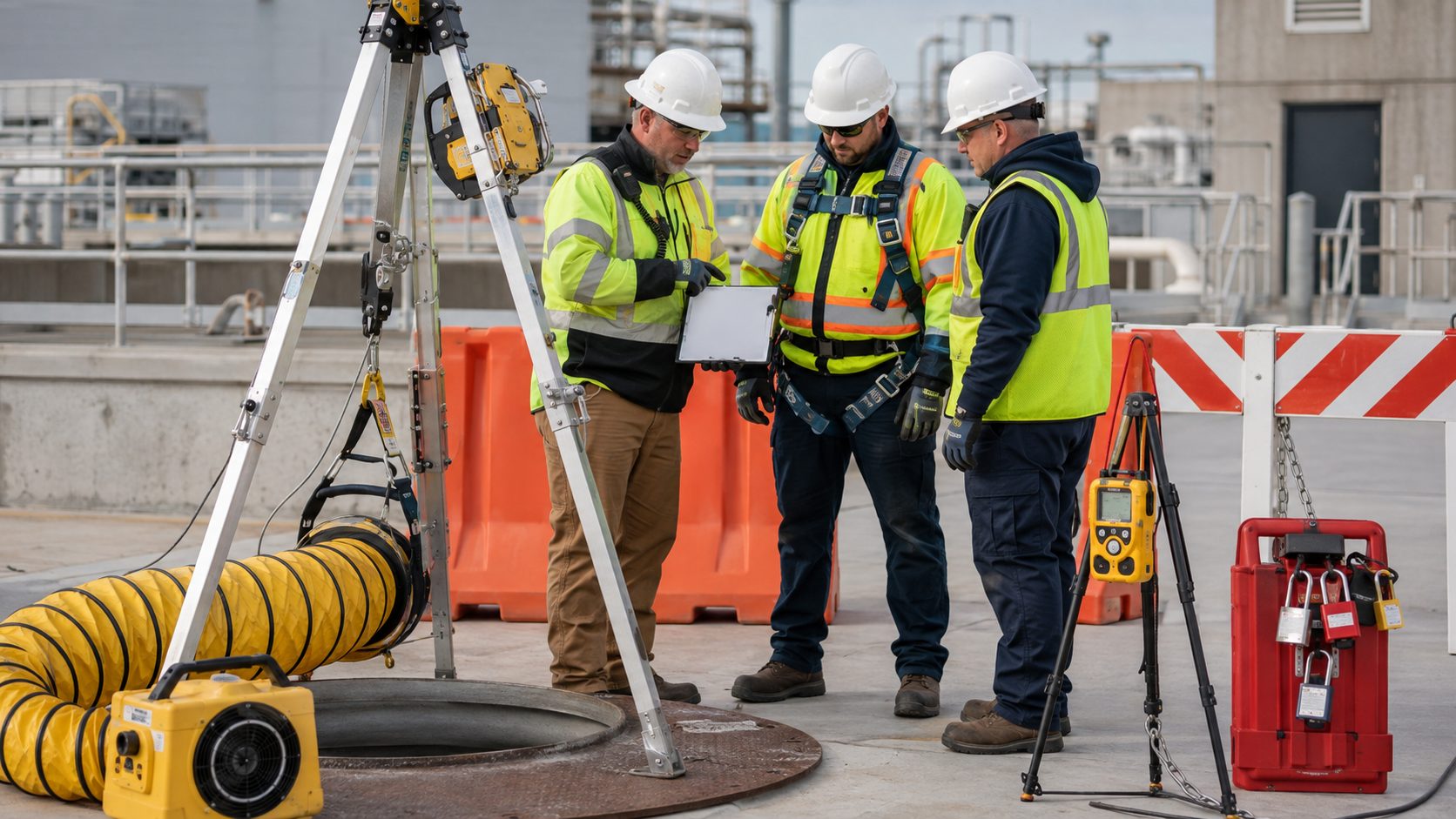
Employers often search for confined space training after they have already identified a tank, vault, pit, manhole, crawl space, vessel, or utility structure that workers may need to enter. The permit form may be drafted. The contractor may be scheduled. The tripod, winch, harnesses, blower, and gas monitor may already be sitting in the shop. At that point, the training question can feel simple: who needs a certificate before work starts?
Rescue planning makes that question more serious and more practical. A certificate of completion may document that a worker finished a course, but the employer still has to decide which workers are assigned to which duties, what training fits those duties, what site-specific procedures must be added, and whether the planned rescue approach is realistic for the space. Rescue is not a last-minute line on a permit. It shapes the whole entry plan.
This is where many organizations need a better course-selection decision. Awareness training may be enough for employees who only need to recognize confined spaces and avoid unauthorized entry. Permit-required confined space entry training fits workers who will enter, attend, supervise, or support permit spaces under an employer's written procedure. Supervisor training helps the person who authorizes entry understand permits, controls, role assignments, and stop-work decisions. Competent Person training is especially important in construction settings where someone must evaluate the space, hazards, and protective measures before work begins.
The right training path depends on job duties, not job titles alone. A maintenance lead, construction foreman, utility crew chief, EHS coordinator, facility manager, or general contractor may all touch rescue planning in different ways. The goal is not to turn every employee into a technical rescue team. The goal is to make sure the employer can show that people understand their assigned responsibilities, know the limits of non-entry retrieval, and do not improvise when conditions change.
Who This Affects
This issue affects employers and supervisors responsible for work in spaces where escape or rescue could be difficult. Common examples include tanks, vaults, bins, pits, sewers, manholes, lift stations, crawl spaces, ductwork, trenches with connected structures, processing vessels, silos, and below-grade utility spaces. Some of these spaces may be permit-required because of atmospheric hazards, engulfment hazards, inwardly converging walls, sloped floors, mechanical hazards, electrical hazards, chemical residues, heat, or other serious safety concerns.
It also affects buyers who are trying to choose confined-space.com training for groups with mixed duties. One employee may only need awareness. Another may be an authorized entrant. Another may stand as attendant. Another may sign or cancel the permit as entry supervisor. A construction supervisor may need a stronger understanding of the competent person role when evaluating work under 29 CFR 1926 Subpart AA. A facility or manufacturing team may be aligning procedures with general industry confined space requirements under 29 CFR 1910.146.
The buying decision often lands with an EHS manager, compliance coordinator, operations manager, HR training administrator, project manager, or contractor safety representative. These buyers are usually not asking for academic information. They need to know how to assign the correct training before crews mobilize. They also need records that support audits, customer prequalification, owner requirements, and internal safety reviews.
Rescue planning adds another layer because it reaches beyond the entrant. The attendant has to understand what to do if a worker stops responding. The entry supervisor has to verify that rescue and emergency services are addressed before authorizing entry. Workers using retrieval equipment need to understand how that equipment fits into the procedure and where its limits are. Managers need to know when outside rescue services, standby rescue, or additional hands-on practice must be coordinated.
This topic also matters for small employers and small crews. In a large organization, separate EHS, operations, rescue, and field supervision roles may exist. In a smaller company, the same person may schedule training, inspect the work area, prepare the permit, and supervise entry. Training has to be selected carefully so the organization does not confuse general awareness with duty-specific entry planning.
The Confined Space Compliance Issue
The central compliance issue is that rescue planning must match the actual space, hazards, personnel, and entry method. Employers should not assume that buying a tripod or listing a fire department phone number automatically creates a complete rescue plan. They should also avoid assuming that online training, by itself, covers every site-specific practice that a crew must perform in the field.
OSHA standards require employers to address permit spaces, entry procedures, atmospheric testing, attendants, supervisors, entrants, emergency procedures, and rescue-related arrangements where those requirements apply. Training supports employer compliance by helping workers understand the hazards and duties tied to their roles. It does not mean OSHA certifies the worker, certifies the employer, approves the course, or endorses a provider. Careful employers use OSHA-aligned training as one part of a broader program that includes procedures, equipment, site evaluation, records, and practical verification.
Retrieval is one area where misunderstanding is common. Non-entry retrieval can reduce risk when it is feasible, but it must be planned before entry and appropriate for the space. A harness and retrieval line may be useful for a vertical entry through a hatch or manhole, but the same setup may not work in a horizontal vessel, an obstructed tank, a long sewer run, or a space where internal equipment prevents movement. If the line can snag, if the entry opening is too small, if the worker's body position makes extraction difficult, or if rescue could expose others to the same hazard, the plan needs more thought.
Another compliance issue is role confusion. The entrant may believe the attendant can come in after them. The attendant may believe calling 911 is the entire rescue plan. The supervisor may assume the rescue service can handle the space without confirming availability, response capability, access, equipment, and practice. The competent person or supervisor may focus on atmospheric testing but overlook how entry configuration affects rescue. These are training and planning gaps.
For buyers, the practical question is whether their training plan reflects real job duties. A general awareness course may help employees recognize confined spaces and understand why unauthorized entry is prohibited. It is not the same as training an entrant, attendant, or entry supervisor for permit-required work. A permit-required entry course may cover the core roles and controls for entry. Supervisor or competent person training may be needed for people making higher-level decisions about authorization, hazard evaluation, and work control.
The compliance issue is therefore not just, "Do we have a training certificate?" It is, "Can we show that each person involved in this entry had training appropriate to assigned duties, and did the employer complete the site-specific planning needed for rescue and retrieval before entry began?"
What Employers Should Check
Before selecting training or authorizing entry, employers should check the work against a practical decision framework. The framework does not replace a written confined space program, but it helps training buyers identify who needs which course and what additional preparation may be required.
- Identify the space clearly. Record the location, normal use, entry opening, internal layout, depth, distance to the work area, access points, and any obstacles that could affect rescue.
- Decide whether it is a confined space. Confirm whether the space is large enough for bodily entry, has limited or restricted means of entry or exit, and is not designed for continuous employee occupancy.
- Decide whether it is permit-required. Look for actual or potential hazardous atmospheres, engulfment hazards, inwardly converging walls, sloped floors, mechanical or electrical hazards, hazardous residues, heat stress, traffic exposure, biological hazards, or other serious safety hazards.
- Identify the work activity. Cleaning, welding, cutting, coating, pump repair, inspection, valve work, line breaking, utility work, and maintenance can introduce hazards that were not present before work began.
- Assign roles before choosing courses. List who will be the entrant, attendant, entry supervisor, competent person where applicable, atmospheric tester, equipment user, permit preparer, contractor coordinator, and rescue contact.
- Separate awareness needs from entry needs. Employees who may encounter confined spaces but will not enter usually need a different level of training than workers assigned to permit-required entry duties.
- Confirm rescue strategy. Decide whether non-entry retrieval is feasible, whether outside rescue services are needed, whether standby rescue is required by the employer's assessment or customer requirements, and how communication will work.
- Evaluate retrieval equipment. Check the tripod, davit, winch, self-retracting lifeline, full-body harness, anchor point, lifeline routing, and opening configuration. Confirm equipment is compatible with the space and the worker's task.
- Confirm atmospheric controls. Testing, ventilation, isolation, lockout, blanking, purging, cleaning, and continuous monitoring can affect both entry and rescue decisions.
- Check contractor coordination. Host employers and contractors need clear communication about hazards, permits, procedures, rescue arrangements, training records, and who has authority to stop the work.
- Review records. Keep course completion records, role assignments, permits, rescue coordination notes, equipment inspections, refresher dates, and site-specific training records where they can be retrieved for audits or customer reviews.
- Decide what must be hands-on. Online training can support knowledge requirements and course documentation, but employers may still need practical demonstrations, equipment familiarization, drills, or site-specific instruction before workers perform entry tasks.
This framework helps prevent a common purchasing mistake: buying one course for everyone because it is administratively simple. A single training order may still be possible, especially for groups, but the course mix should reflect the actual duties workers will perform.
Which Training Fits This Situation
For rescue and retrieval planning, the best training path usually starts with role separation. The employer should decide who only needs to recognize confined spaces, who will enter, who will attend, who will supervise, and who will evaluate the job before entry. Once those roles are clear, course selection becomes much more defensible.
Awareness training fits employees who need to recognize confined spaces, understand why entry is controlled, report hazards, and avoid unauthorized entry. This may include maintenance helpers, custodial workers, facility staff, construction laborers, municipal employees, or supervisors who oversee locations where confined spaces exist but do not assign or authorize entry. Awareness training is useful for broad groups because it creates a common vocabulary. It should not be treated as a substitute for permit-required entry duties.
Permit-Required Confined Space Entry training fits workers involved in entry operations. This typically includes authorized entrants, attendants, and entry supervisors who need to understand permits, hazards, atmospheric testing concepts, ventilation, communication, isolation, entry conditions, monitoring, and emergency procedures. For a crew that will use retrieval equipment as part of a permit entry, this course is usually central because rescue planning is tied to the permit process and role responsibilities.
Supervisor training fits people who authorize entry, coordinate crews, review permits, stop work, and confirm that conditions are acceptable. A supervisor does not need training because of the word "supervisor" on a business card. The need comes from decision authority. If the person signs entry permits, directs attendants and entrants, coordinates contractors, or decides whether rescue arrangements are acceptable, supervisor-focused training can close important gaps.
Competent Person training is especially relevant for construction employers and contractors working under construction confined space requirements. A competent person has evaluation and hazard-recognition responsibilities that go beyond simply participating in the entry. When the work involves construction activities in sewers, vaults, manholes, tanks, pits, or similar spaces, employers should consider whether someone needs this level of training to support jobsite evaluation and protective decisions.
A multi-role plan often works best. For example, a municipal utility department might use Awareness training for employees who work near manholes but do not enter, Permit-Required Entry training for entrants and attendants, Supervisor training for crew leaders who authorize work, and Competent Person training for the person evaluating construction-related entries. A manufacturing plant might use Awareness training across maintenance support roles, Permit-Required Entry training for the maintenance crew, and Supervisor training for EHS or operations leaders who control the permit process.
Training buyers should also consider delivery format. Online training can help distributed teams complete OSHA-aligned coursework quickly and produce completion records. Group purchasing can simplify administration when multiple employees need the same course. Spanish-language access may be important for multilingual crews. SCORM or learning management system options may matter when an employer needs centralized tracking. Virtual or in-person instruction may be appropriate when the employer wants live discussion or hands-on reinforcement. None of these choices removes the need for site-specific procedures, but the right format can make compliance work easier to manage.
The most useful question is not, "Which course is the biggest?" It is, "Which workers need to know what before they perform this specific job?" Rescue and retrieval planning helps reveal the answer because it forces the employer to look at the space, the duties, the equipment, and the decision-makers before entry day.
Common Mistakes to Avoid
One common mistake is treating rescue as an emergency contact rather than a planned function. Writing a phone number on a permit does not verify that rescuers can enter the space, reach the worker, use appropriate equipment, arrive in time, or operate safely under the expected conditions. Employers should evaluate rescue capability before work begins.
Another mistake is assuming retrieval equipment solves every rescue problem. Tripods, winches, davits, and harnesses are important tools when the entry configuration supports non-entry rescue. They are not universal solutions. Horizontal entries, internal obstructions, sharp edges, deep offsets, multiple turns, sludge, water, equipment, or worker positioning can make simple retrieval unrealistic.
A third mistake is training only entrants. The entrant is important, but the attendant and entry supervisor carry critical responsibilities. The attendant must monitor conditions and workers, maintain communication, control access, and initiate emergency procedures without creating additional victims. The entry supervisor must verify entry conditions, role assignments, permits, and rescue arrangements before authorizing entry.
Employers also make mistakes when they use job titles as shortcuts. A foreman may need supervisor training if they authorize entry, but not every foreman has the same duties. A maintenance technician may be an entrant on one job and an attendant on another. An EHS coordinator may manage records but not supervise field entry. Training assignments should follow actual responsibilities.
Some organizations overlook contractor coordination. If a host employer hires a contractor for tank cleaning, utility work, inspection, or maintenance, both sides need clear communication about hazards and entry procedures. The contractor's training records do not remove the host's need to share known hazards and coordinate entry controls. The host's procedure does not remove the contractor's need to train workers for assigned duties.
Another mistake is relying on old training records without checking current duties. A worker who completed awareness training two years ago may now be assigned as an attendant. A supervisor who used to observe from a distance may now be signing permits. A crew that previously handled non-permit spaces may now be working in permit-required vaults. Refresher and upgrade decisions should be tied to changed assignments, observed gaps, new hazards, and employer policy.
Employers should also avoid language that overstates what training provides. A course can be OSHA-aligned and issue a certificate of completion. It should not be described as approval, accreditation, endorsement, or a credential issued by OSHA. Buyers should look for training that supports employer compliance while recognizing that the employer remains responsible for applying the training to its workplace.
Finally, do not let the training purchase happen after the permit is already complete. Training should inform the permit, not merely decorate the file. If the course makes a supervisor realize the rescue plan is weak, the entry opening is not compatible with retrieval, the attendant's duties are unclear, or the contractor coordination is incomplete, that is useful information before entry day.
Next Step
For a confined space job that involves rescue or retrieval planning, start by listing the exact spaces, hazards, work activities, and worker duties. Then choose training by role: Awareness for employees who need recognition and avoidance, Permit-Required Entry for entrants, attendants, and entry-team members, Supervisor training for people authorizing or controlling the permit process, and Competent Person training when construction confined space evaluation duties apply.
The practical course decision is simple: do not buy training based only on headcount. Buy it based on who will recognize the space, who will enter it, who will watch the entrant, who will authorize the permit, and who will decide whether rescue and retrieval arrangements are ready before work begins.