
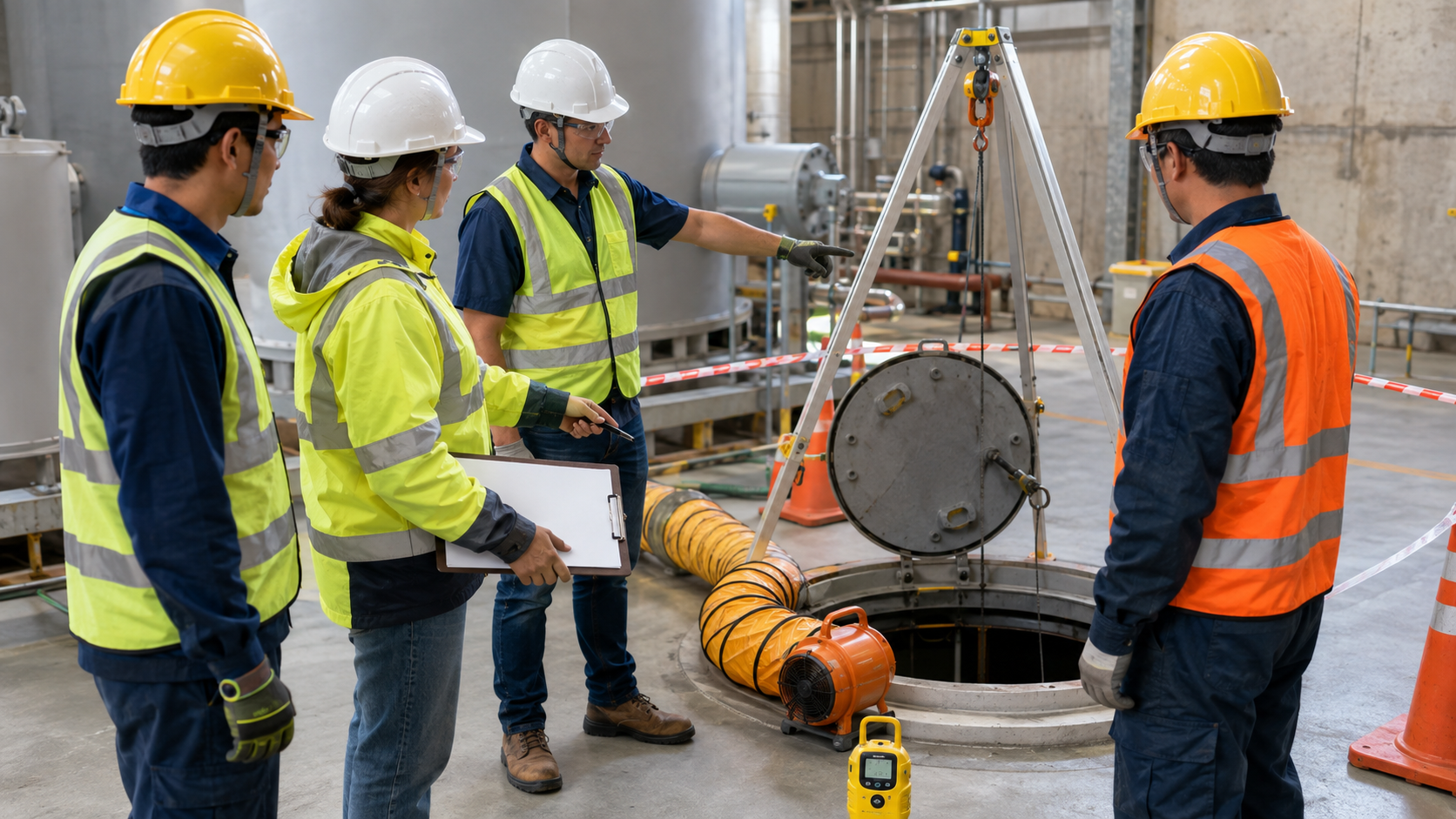
Search Intent: How should employers decide whether a confined space is permit-required or non-permit before assigning training, and why does that classification matter before crews enter?
Who This Affects
This article is for employers, safety managers, EHS managers, construction supervisors, maintenance planners, municipal departments, utility contractors, general contractors, plant managers, facility managers, compliance coordinators, and training buyers who must decide what confined space training fits the work actually being performed.
The issue comes up in many ordinary operations: a maintenance team opens a tank manway for inspection, a public works crew enters a valve vault, a contractor sends workers into a crawl space below a renovation project, a manufacturing supervisor assigns cleaning inside a process vessel, or a facilities group schedules work in a pit that normally stays covered. In each case, the space may look familiar to experienced workers, but the training decision should not be based on habit, job title, or the name of the location alone.
Employers often begin by asking a simple purchasing question: do we need confined space awareness training, permit-required confined space training, supervisor training, or competent person training? The better first question is whether the employer has a reliable method for classifying the space and the planned work. A space that is not designed for continuous occupancy, is large enough for a worker to enter, and has limited or restricted entry or exit may be a confined space. If it also contains, or has the potential to contain, serious hazards such as a hazardous atmosphere, engulfment, inwardly converging walls, sloped floors leading to a smaller section, or another recognized serious safety or health hazard, the training and control plan needs to reflect that permit-required status.
That classification affects who evaluates the space, who may authorize entry, what the entrant and attendant must understand, what the entry supervisor must verify, what rescue planning is realistic, what records should be kept, and whether a simple awareness course is enough for a worker's assigned duty. It also helps buyers avoid two common problems: buying too little training for people who will actually perform permit entry duties, or buying a broad course for everyone while still leaving supervisors unclear about site-specific authorization, permits, equipment, and rescue expectations.
The Confined Space Compliance Issue
Confined space classification is not a paperwork exercise performed after the job starts. It is a planning decision that shapes the entire work control system. The employer needs to know whether the space and task call for awareness only, evaluation by a competent person, a permit-required entry process, or a multi-role training plan covering entrants, attendants, entry supervisors, and management responsibilities.
The complication is that the same physical space can present different training needs depending on the work planned. A clean, open vault observed from outside may require awareness-level recognition for workers who never enter. The same vault may require permit-required confined space procedures when a worker enters and there is potential for atmospheric hazards, electrical hazards, flooding, traffic exposure, or restricted rescue access. A tank that was safe for visual inspection after cleaning may present a different risk when hot work, chemical residue, inerting, coating, solvent use, or sludge removal is involved. A crawl space on a construction site may shift from a low-hazard access area to a serious confined space concern when work introduces fumes, dust, electrical hazards, heat stress, or limited exit routes.
This is why employers should separate space recognition from role assignment. Awareness training helps workers recognize confined spaces, understand why entry controls matter, and avoid unauthorized entry. Permit-required confined space training goes deeper into the duties and controls used when actual entry occurs under a permit system. Supervisor training helps the person authorizing the work understand what must be checked before entry is allowed and when the entry must stop. Competent Person training is especially important in construction settings where a qualified evaluation is needed to identify confined spaces, evaluate hazards, and determine the appropriate controls before workers are exposed.
The issue is not whether one course can be helpful. It can. The issue is whether the employer has matched training to the decisions each person is expected to make. A worker who only walks past a tank farm does not need the same preparation as a supervisor signing an entry permit. A maintenance employee who enters a space does not need only awareness if that employee will be exposed to permit-required hazards. A foreman who directs construction work near a sewer structure may need stronger preparation than a general employee because the foreman may be expected to identify the hazard, coordinate controls, stop work, and confirm that the right people are assigned to the right roles.
For buyers, the commercial decision should follow the operational decision. If the employer is still unsure whether the planned work is permit-required, buying a single course for the whole group may not solve the real problem. The organization may need an OSHA-aligned training path that includes recognition, role-based instruction, supervisor expectations, and a follow-up site-specific briefing using the employer's actual spaces, equipment, permits, rescue resources, and procedures.
What Employers Should Check
Before assigning training or allowing work to proceed, employers should use a consistent classification and training decision framework. The goal is to connect the space, the hazards, and the worker's duty before the course is selected.
- Identify the space first.
Confirm whether the area is large enough for bodily entry, has limited or restricted entry or exit, and is not designed for continuous occupancy. Do not rely only on the common name of the location. Tanks, pits, vaults, vessels, bins, silos, crawl spaces, manholes, lift stations, tunnels, and similar areas can all require closer review.
- Separate observation from entry.
A worker who observes, barricades, delivers materials, or performs exterior support has a different training need than a worker who breaks the plane of the opening, climbs inside, tests the atmosphere from the opening, serves as an attendant, or authorizes the permit.
- Identify existing and potential hazards.
Consider hazardous atmospheres, oxygen deficiency or enrichment, flammable gases or vapors, toxic substances, engulfment, mechanical or electrical energy, poor ventilation, heat, noise, biological hazards, falls, poor lighting, flooding, traffic, moving equipment, and hazards introduced by the task itself.
- Ask whether the work changes the hazard profile.
Cleaning, welding, cutting, coating, chemical use, pressure washing, sludge removal, pumping, grinding, painting, and use of powered equipment can introduce hazards that were not present when the space was first opened.
- Decide whether permit-required controls are needed.
If the space has permit-required characteristics, the employer should plan around entry authorization, isolation, atmospheric testing, ventilation, communication, attendant coverage, rescue planning, and entry termination criteria. Training should support those duties rather than treating the space as a routine access point.
- Match training to assigned role.
List who will recognize the space, who will evaluate hazards, who will enter, who will attend, who will supervise, who will test the atmosphere, who will operate ventilation, who will coordinate rescue, and who will keep records. Then assign training that fits each role.
- Confirm the applicable work setting.
Construction work often raises competent person questions under confined space requirements for construction. General industry operations often focus on permit-required confined space programs, entry permits, entrants, attendants, and entry supervisors. Some employers operate in both settings and need a training plan that does not blur the differences.
- Review rescue before entry, not after entry starts.
Classification should drive rescue planning. A non-entry retrieval setup, a staged tripod, a harness, or a rescue service name on a form is not enough unless the plan fits the space, the hazards, the opening, the depth, the worker's body position, and the expected response time.
- Keep records connected to the decision.
Keep course completion records, worker role assignments, site-specific briefings, permits when used, atmospheric testing records, equipment checks, and supervisor authorization records organized enough to show why the employer chose the training path.
- Recheck classification when conditions change.
A space can require a different decision when the process changes, weather changes, adjacent work begins, a new contractor arrives, a product residue is discovered, ventilation fails, a monitor alarms, or the job scope expands.
This framework gives safety leaders and buyers a practical way to avoid treating training as a one-size purchase. It also helps managers explain why one employee receives Awareness training while another receives Permit-Required Entry training, Supervisor training, Competent Person training, or a combination.
Which Training Fits This Situation
The right confined space course depends on what the worker must recognize, decide, or perform. Employers should choose training by duty rather than by department.
Awareness training fits workers who need to recognize confined spaces, understand basic hazards, avoid unauthorized entry, know when to stop and ask for help, and understand why barricades, permits, attendants, and atmospheric testing exist. It is useful for employees who work near confined spaces, supervisors who need a baseline vocabulary, support staff, project coordinators, estimators, and workers who may encounter confined spaces but are not assigned permit entry duties.
Permit-Required Confined Space training fits employees who will participate in entries where permit-required conditions exist or may exist. These workers need to understand the permit process, entrant and attendant duties, atmospheric hazard controls, communication, ventilation, continuous monitoring, emergency procedures, entry cancellation, and the reasons entry must stop when conditions change. This path is appropriate when the employer knows that workers may enter tanks, vaults, pits, sewers, vessels, or similar spaces under a permit system.
Supervisor training fits the person who authorizes entry, verifies that controls are in place, confirms that acceptable entry conditions exist, removes unauthorized individuals, cancels entry when needed, and makes sure the permit process is followed. A supervisor may not be the most physically exposed person on the job, but the supervisor's decision-making has high consequence. If a foreman, lead, project manager, facility supervisor, or EHS representative is expected to sign or manage entry authorization, the training plan should reflect that responsibility.
Competent Person training fits construction employers and contractors who need a person capable of identifying confined spaces, evaluating hazards, determining whether permit-required conditions exist, and choosing protective measures before work proceeds. This course path is especially relevant for construction sites where spaces and hazards change as the project advances. A competent person may need to evaluate crawl spaces, pits, manholes, trenches connected to structures, storm systems, tanks, and other areas that appear during renovation, utility, or infrastructure work.
Many employers need a multi-role plan. For example, a municipal utility department might assign Awareness training to field employees who identify vaults and manholes, Permit-Required Entry training to entrants and attendants, Supervisor training to crew leads who authorize the permit, and Competent Person training to the person responsible for evaluating spaces during construction or repair projects. A manufacturing facility might train maintenance entrants and attendants on permit procedures, train supervisors on authorization and cancellation, and provide awareness-level training to production employees who work near process vessels but do not enter them.
The course decision should also account for language access, group purchasing, certificates of completion, refresher planning, online access, virtual instructor-led options, in-person support, and SCORM or bulk training needs. Those logistics matter because the best training plan is the one the employer can assign, track, reinforce, and connect to the actual jobsite procedure. Online training can support employer compliance by giving workers shared instruction and documentation, but the employer still needs to apply that learning to its specific spaces, equipment, permits, rescue resources, and authorized roles.
Common Mistakes to Avoid
The first mistake is assuming that every small or familiar space is non-permit. Familiarity does not remove atmospheric hazards, engulfment hazards, poor exit conditions, or hazards introduced by the task. Crews may have entered a location many times without incident, but the next job may involve different products, weather, tools, contractors, or isolation conditions.
The second mistake is treating a course certificate as job authorization. A certificate of completion documents that the employee completed assigned training. It does not, by itself, classify the employer's space, approve a specific entry, verify equipment, test the atmosphere, confirm rescue capability, or replace the employer's site-specific procedures.
The third mistake is using one generic course for everyone without role mapping. A broad assignment may look efficient, but it can leave entrants underprepared, attendants unclear about their duty to remain outside and monitor, supervisors unsure about permit cancellation, and managers without a clear record of why each person was assigned a role.
The fourth mistake is classifying the space once and never revisiting the decision. Conditions can change during maintenance, construction, cleaning, repair, or emergency response. A space that was acceptable for one task may become permit-required when new hazards are introduced or discovered.
The fifth mistake is ignoring the difference between general industry and construction responsibilities. Many employers have both types of work. A facilities team may perform routine maintenance under a general industry program while a contractor performs construction or renovation work in the same area. Training should help managers ask which rules and roles fit the actual work being done.
The sixth mistake is waiting until the day of entry to decide who is trained. By then, production pressure, customer deadlines, permit delays, and contractor scheduling can push people toward shortcuts. Training decisions should be made before the job is staffed so the right entrant, attendant, supervisor, and competent person coverage is available.
The seventh mistake is overlooking support workers. Workers who never enter may still need awareness training if they deliver materials, remove covers, set barricades, coordinate traffic, stage ventilation, or work around openings. They need to know when a space is off limits and who has authority to control entry.
The eighth mistake is using rescue language without confirming rescue practicality. If a permit-required confined space is involved, rescue planning should match the actual access point, depth, configuration, hazards, retrieval equipment, communication method, and available responders. Training should reinforce that rescue is planned before entry, not improvised during an emergency.
Next Step
Before buying confined space training, list the spaces your crews may encounter, decide which ones may become permit-required based on the hazards and task, and map each worker to a role. Assign Awareness training to employees who need recognition and avoidance, Permit-Required Entry training to entrants and attendants involved in permit entries, Supervisor training to people who authorize or manage entries, and Competent Person training where construction-site evaluation responsibilities apply. A practical course decision starts with classification, then follows the duties your crews will actually perform.
Ready to Get Your Crew Confined Space Certified?
Explore our OSHA-aligned online courses for Awareness, Permit-Required Entry, Supervisor, and Competent Person roles with instant certification.
Explore Courses & Pricing