
Search Intent
Safety managers and contractors often ask who needs confined space training when several employers share the same construction site. The practical question is not just whether the space is permit-required. It is whether the host employer, controlling contractor, entry employer, attendants, entrants, supervisors, and subcontractors understand what each party must communicate before anyone opens the hatch, enters the pit, or sends a worker into a tank, vault, sewer, crawl space, or process vessel.
Who This Affects
Multi-employer confined space work is common in construction, utilities, municipal work, manufacturing shutdowns, tank cleaning, mechanical upgrades, wastewater projects, and facility maintenance. A single entry may involve a facility owner or host employer, a general contractor acting as the controlling contractor, a specialty contractor that performs the entry, a rescue provider, a safety consultant, and several trades working nearby. Each group may use different terminology, different forms, and different supervisors. That is exactly why role-based training matters.
This affects host employers who know the site history, controlling contractors who coordinate the jobsite, and entry employers who send employees into or around the space. It also affects foremen who schedule work, competent persons who evaluate hazards, entry supervisors who authorize entry, attendants who stay outside the space, authorized entrants who perform the task, and project managers who assume a subcontractor already has the matter handled.
On a simple single-employer job, a confined space plan can still fail if the employer assigns the wrong people to the wrong course. On a multi-employer jobsite, the risk expands because one company may know the space has a history of low oxygen, another may control the schedule, a third may bring the ventilation equipment, and a fourth may create a hazard with welding, coating, cleaning, or equipment operation. Training has to support communication across those boundaries.
Employers buying confined space training should therefore think beyond one generic class. Awareness training may be enough for employees who need to recognize spaces and avoid unauthorized entry. Permit-Required Entry training may fit workers assigned as entrants or attendants. Supervisor training may fit people authorizing entry, cancelling permits, reviewing conditions, and making stop-work decisions. Competent Person training may fit construction leaders responsible for identifying confined spaces, evaluating hazards, and helping select protective measures before work begins.
The Confined Space Compliance Issue
The compliance issue is coordination. OSHA's construction confined spaces standard, 29 CFR 1926 Subpart AA, places specific emphasis on communication among host employers, controlling contractors, and entry employers. The general industry permit-required confined space rule, 29 CFR 1910.146, also requires employers to evaluate workplaces, identify permit spaces, prevent unauthorized entry, control hazards, train affected employees, and verify acceptable entry conditions. The exact standard that applies depends on the work and setting, but the operational problem is often the same: the people who have information about the space must get that information to the people who will make entry decisions.
In construction, a confined space is not treated as an isolated safety topic. It is tied to the structure of the jobsite. The host employer may have information about previous contents, known atmospheric hazards, energy sources, prior testing, drawings, or maintenance history. The controlling contractor may manage the sequence of work and must coordinate entry operations when more than one employer is involved. The entry employer must protect its own employees and must ensure entry operations are performed under a program that matches the hazards.
Training does not replace the confined space program, the permit, atmospheric testing, rescue planning, lockout or isolation, ventilation, barriers, or site-specific briefing. It should, however, give each role enough knowledge to perform its part of that system. A trained entrant should know how to recognize changing conditions and communicate with the attendant. A trained attendant should know when to order evacuation and why leaving the post can break the entire entry plan. A trained entry supervisor should know what must be verified before signing or authorizing the permit. A trained competent person or supervisor should know that subcontractor coordination is not a paperwork courtesy. It is part of preventing hazards from being missed or created by another crew.
The most common failure point is assuming that a subcontractor's certificate of completion means the jobsite is ready for entry. A certificate may document that a worker completed an OSHA-aligned course, but the employer still has to decide whether the course fits the worker's actual duties and then connect that training to the specific space. If a crew is entering a storm sewer during construction, a tank during a shutdown, or a vault while other trades operate nearby, the employer still needs a site-specific plan that addresses the actual hazards, the actual equipment, and the actual employer relationships.
Another issue is the handoff of information. If a host employer tells the controlling contractor about a known hazard, but that information never reaches the entry supervisor, the permit may look complete while the entry plan is weak. If an entry employer identifies a new hazard during the job but does not tell the controlling contractor or affected employers, another crew may enter later under bad assumptions. Training should prepare supervisors and competent persons to ask what has changed, who else is affected, and what information has to move before work continues.
What Employers Should Check
- Identify the employer relationships before selecting training. Name the host employer, controlling contractor, entry employer, rescue provider, and any subcontractors whose work could affect the space.
- Decide whether the work is construction, general industry, or another category before relying on a standard. Construction work in confined spaces generally points to 29 CFR 1926 Subpart AA, while many fixed facility operations point to 29 CFR 1910.146.
- Confirm which employees will only work near the space and which employees may enter it. Awareness training may fit workers who must recognize and avoid unauthorized entry. It is usually not enough for employees assigned as entrants, attendants, or entry supervisors.
- Match training to the assigned role. Entrants, attendants, entry supervisors, competent persons, and managers need different depth because they make different decisions.
- Ask what site-specific information must be added after online training. Examples include space inventory, known hazards, entry permit procedure, atmospheric monitor used on site, ventilation setup, rescue method, communications method, lockout steps, and evacuation triggers.
- Check whether the host employer has shared known information about the space. That may include prior contents, residues, oxygen displacement potential, configuration hazards, drawings, previous testing, isolation points, adjacent operations, or known engulfment hazards.
- Check whether the controlling contractor has a clear communication process. Information should move before entry begins, while entry is underway, and after entry ends if new hazards or problems were discovered.
- Verify who can authorize entry and who can cancel it. A worker may have experience, but that does not automatically make the worker the entry supervisor for the day.
- Review how other trades can affect entry conditions. Hot work, coatings, solvents, concrete cutting, generators, fuel-powered equipment, cleaning chemicals, bypass pumping, or nearby traffic can change the hazard profile.
- Confirm rescue and retrieval expectations before entry. Do not wait until the permit meeting to discover that rescue services, retrieval equipment, access geometry, or communications do not match the space.
- Keep training records tied to roles, not just names. A useful record shows who completed which course, when it was completed, what role it supports, and what additional site-specific briefing was provided.
- Plan for turnover. Multi-employer jobsites often change daily. New workers, replacement foremen, new subcontractors, and night-shift crews need the same communication discipline as the original team.
The decision framework should be simple enough for a project team to use quickly. First, identify the work and the standard likely to apply. Second, list the spaces and anticipated entries. Third, assign roles by name. Fourth, match each role to the right training level. Fifth, add the site-specific briefing, permit process, equipment review, and rescue plan. Sixth, document the communication among employers so that the plan survives shift changes and subcontractor changes.
Which Training Fits This Situation
For a multi-employer construction jobsite, a layered training plan usually works better than a single course for everyone. The right mix depends on who will enter, who will supervise, who will coordinate, and who only needs to recognize the hazard.
Confined Space Awareness training fits employees who may work around confined spaces but are not assigned to enter them or support entry. These employees need to recognize common confined spaces, understand why unauthorized entry is prohibited, follow signs and barriers, and know when to alert a supervisor. This may include laborers, equipment operators, inspectors, delivery personnel, or other workers who could encounter tanks, manholes, vaults, pits, crawl spaces, or utility structures during the job.
Permit-Required Confined Space Entry training fits authorized entrants and attendants. Entrants need to understand entry conditions, communication, symptoms of exposure, atmospheric testing observations, evacuation triggers, and their duty to follow the permit. Attendants need to understand monitoring from outside the space, maintaining an accurate count, communication, preventing unauthorized entry, ordering evacuation, and summoning rescue without entering the space unless specifically trained and equipped as part of a rescue plan.
Confined Space Supervisor training fits people who authorize entry or manage the permit process. The entry supervisor's decisions carry weight. That person may verify testing, confirm isolation, review ventilation, ensure rescue arrangements are in place, check that entrants and attendants understand duties, sign or authorize the permit, remove unauthorized individuals, cancel entry, and coordinate when conditions change. On a multi-employer site, supervisor training should also reinforce communication with the controlling contractor and affected employers.
Competent Person training is especially useful for construction leaders who must identify confined spaces, evaluate hazards, understand the difference between permit and non-permit spaces, and help determine protective measures. A competent person may not be the entry supervisor for every entry, but the role is important when the work changes, when a new space is discovered, or when a subcontractor's task creates a new hazard. For construction supervisors, foremen, and safety managers, this training can support better front-end planning.
Managers and coordinators may need more than awareness even if they never enter. A project manager who controls subcontractor sequencing, a general contractor superintendent who manages the site, or a facility representative who provides historical information may need enough training to understand why confined space communication cannot be reduced to a sign-in sheet. They should know what information must be exchanged and why entry cannot proceed when the handoff is incomplete.
A practical multi-role plan might look like this: awareness training for workers who may encounter spaces; Permit-Required Entry training for entrants and attendants; Supervisor training for employees who authorize or cancel entry; Competent Person training for construction leaders who evaluate spaces and coordinate field conditions; and a site-specific briefing for everyone whose work could affect the entry. That combination supports employer compliance without implying that any online course, by itself, makes the jobsite ready.
Common Mistakes to Avoid
One mistake is training only the entry crew while leaving the controlling contractor's field leadership out of the loop. If the general contractor or controlling contractor coordinates other trades, schedules work near the space, or receives information from the host employer, its supervisors need enough training to understand the confined space implications of their decisions.
Another mistake is assuming the host employer has no role once a contractor is hired. The host employer may have the best historical knowledge of the space. If that information is incomplete, stale, or not communicated, the entry employer may plan around the wrong assumptions.
A third mistake is treating the entry permit as the training. A permit is a job-specific authorization and control document. It does not teach a worker how to recognize a hazardous atmosphere, what an attendant must do, how entry communication works, or why a changed condition requires evacuation.
Employers also get into trouble when they train by job title instead of duty. A foreman may be an entrant on one task, an attendant on another, and an entry supervisor on a later shift. A safety coordinator may never enter but may still need supervisor-level knowledge to audit permits and challenge gaps. The course should match what the person is expected to do, not only what appears on a business card.
Another common mistake is forgetting subcontractors who create hazards without entering the space. A coating crew, welding crew, cleaning crew, excavation crew, pump crew, or generator operator can change the atmosphere, introduce energy, create access problems, or affect rescue. The entry employer cannot manage those hazards well if the controlling contractor does not coordinate the surrounding work.
Some employers also overstate what a course certificate means. A certificate of completion is useful documentation, but it is not OSHA approval, OSHA certification of the worker, or a substitute for employer evaluation. Employers still have to provide training that results in understanding, verify that employees can perform assigned duties, and add any site-specific instruction needed for the actual work.
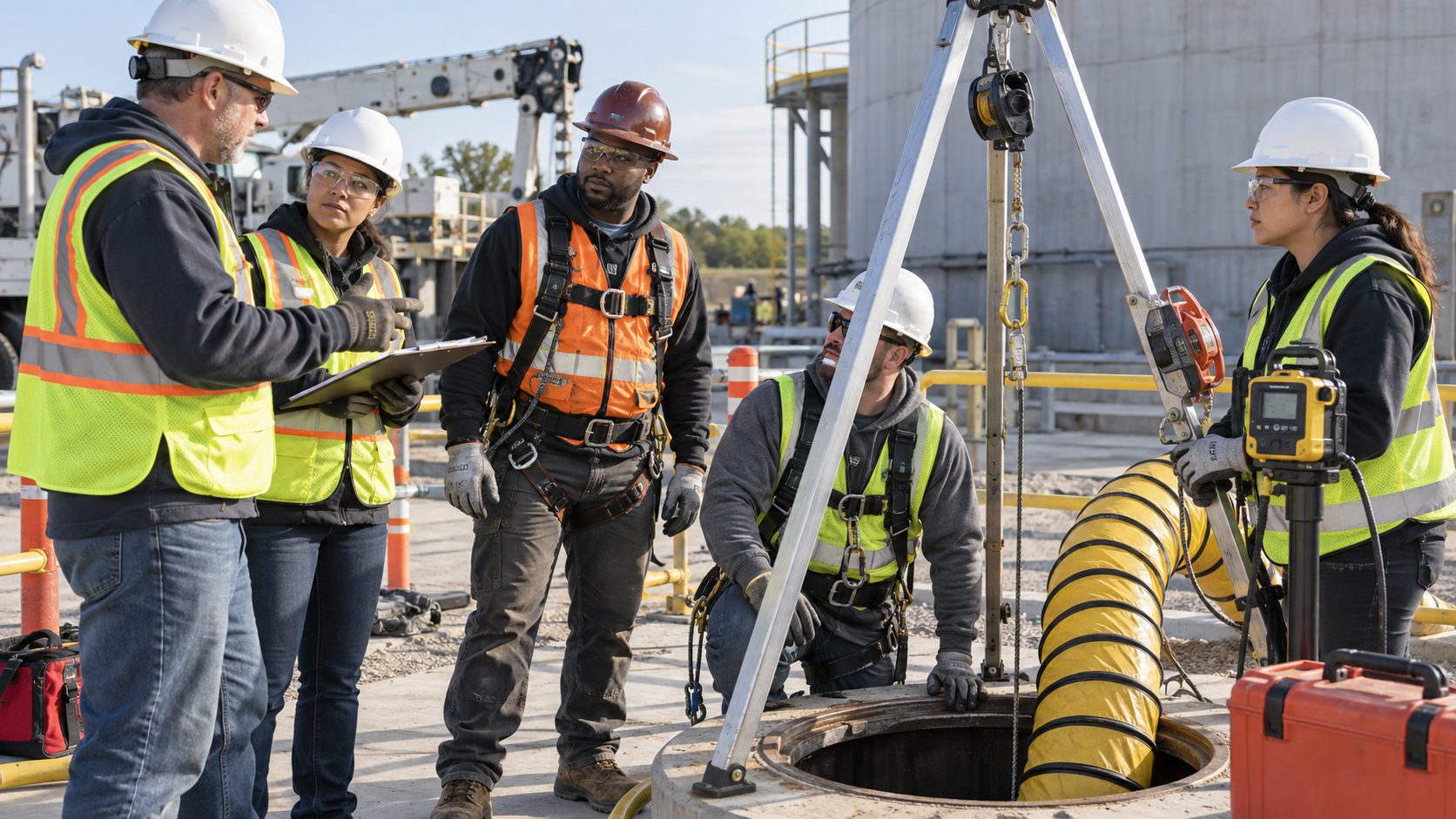
Finally, many teams wait too long to discuss rescue. Rescue planning should be part of the training and pre-entry planning conversation, not an afterthought. The crew needs to know whether non-entry retrieval is expected, whether a tripod or davit can be used, whether the access point supports the retrieval method, how emergency services will be contacted, and what attendants must do if something changes.
Next Step
For a multi-employer jobsite, start by mapping the employer roles and worker duties before buying training. If employees only need to recognize confined spaces and stay out, choose Awareness training. If they will enter or serve as attendants, choose Permit-Required Entry training. If they will authorize entry, manage permits, coordinate changing conditions, or stop work, add Supervisor training. If they will identify spaces and evaluate construction-site hazards, add Competent Person training. Then require a site-specific briefing that covers the actual space, the responsible employers, the permit process, atmospheric testing, ventilation, isolation, rescue, and communication steps for that job.
The strongest confined space training plan is not the longest course list. It is the plan that gives each employer and each worker enough knowledge to perform the role they actually have on entry day.